


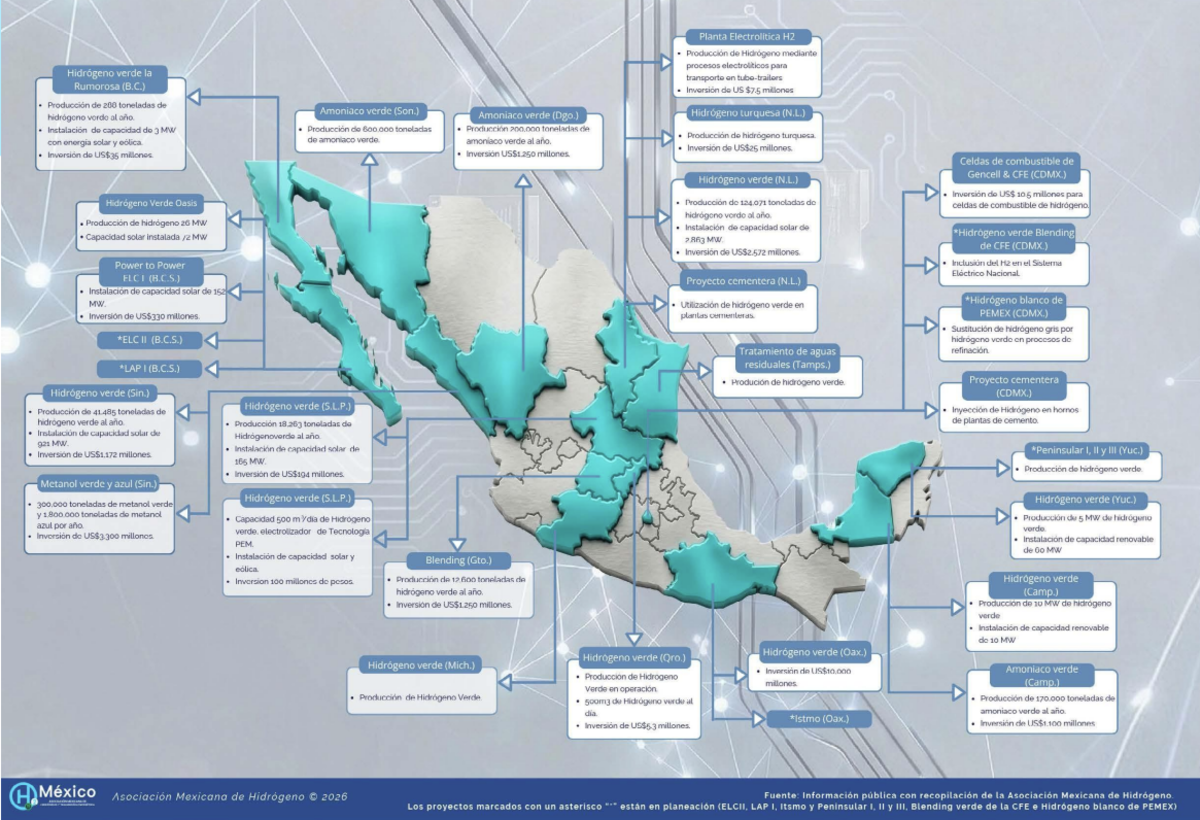
Mexico is entering a more demanding phase in hydrogen development. The country already has a portfolio of 31 projects worth US$22,370.5 million , but the challenge is shifting from investment announcements to their effective implementation, demand generation, and cost competitiveness.
According to the Mexican Hydrogen and Energy Transformation Association (H2México) , this portfolio includes an estimated annual production of 196,707 tons of green hydrogen, 970,000 tons of green ammonia, 2.1 million tons of green and blue methanol, and 8,760 tons of turquoise hydrogen .
This is in addition to approximately 4,246 MW of new renewable generation capacity , a volume that reveals that the development of Mexican hydrogen will not depend solely on electrolyzers, but also on a relevant expansion of associated energy infrastructure.
The market is already showing its first signs of materialization. H2México identifies two green hydrogen plants currently in operation, one in Querétaro and the other in San Luis Potosí , while the rest of the pipeline will have to go through different stages of development before becoming production capacity.

In that context, Israel Hurtado, CEO of H2Mexico , warns that “ Mexico now has a concrete opportunity to turn the development of hydrogen and energy transformation technologies into a platform for industrial growth, energy security and competitiveness .”
This definition places hydrogen within an agenda that extends beyond decarbonization. Mexico's opportunity also lies in attracting investment, developing suppliers, strengthening manufacturing, and utilizing these molecules in sectors that are difficult to electrify directly.
Hurtado summarizes the next stage with another definition: “The challenge is to move from potential to execution.” The question, therefore, will be how many of those 31 projects manage to advance toward financing, construction, operation, and supply contracts.
Cost appears as one of the central tests
Economic competitiveness will be one of the factors determining which part of the Mexican pipeline manages to advance to construction and operation. According to data from the International Energy Agency (IEA) and the Hydrogen Initiative, the current cost of producing hydrogen through renewable electrolysis ranges from over US$3/kg H₂ to values exceeding US$10/kg H₂ , depending on the region and the conditions of each project.
The difference compared to conventional routes is still significant. In 2025, hydrogen production from natural gas without carbon capture was estimated at between US$1 and US$4/kg H₂ , meaning green hydrogen maintains a significant cost premium in most markets.
Within this scenario, China is the only market that manages to position itself at the lower end of the range, around or even below US$3/kg H₂ . This advantage is mainly due to a combination of cheaper electricity, lower capital expenditures (CAPEX) on equipment and installation, and a more favorable cost of capital.
The equation is particularly relevant for Mexico because three variables account for a significant portion of a project's competitiveness: renewable electricity, investment in electrolyzers, and financing costs . Outside of China, the price of electricity could explain up to 40% of future cost reductions , while the decrease in CAPEX for electrolyzer installation would represent up to 60% of the potential reduction .
The third component is financial. The cost of capital—WACC and interest rates—can substantially alter the final price of hydrogen , especially in markets considered higher risk. In regions with expensive financing, this component can even become the main factor driving up production costs.
The trajectory towards 2030, however, shows a significant reduction. In areas of northern China, the cost of production could fall below US$2/kg H₂ , further strengthening the Asian country's current advantage.
In other markets with competitive renewable resources, projections also point to a decrease. Australia, the United States, the Middle East, India, and Chile could see prices between US$3/kg H₂ and just under US$4/kg H₂ , while favorable locations in Europe could approach approximately US$3.5/kg H₂ by the end of the decade.
Continue reading
Part of that convergence will depend on electrolyzers. The installed cost outside of China could decrease to between US$1,500 and US$1,900 per kW by 2030 , and even fall to between US$1,100 and US$1,500 per kW if all of the currently announced manufacturing projects materialize.
For Mexico, this comparison doesn't imply replicating the Chinese model, but rather establishing a benchmark for the competitive pressure that projects will face. The renewable resource alone won't be enough if electricity, equipment, financing, and infrastructure increase the final cost per kilogram .
The business can go far beyond producing hydrogen.
The opportunity doesn't end with the kilograms produced. H2México identifies possibilities for developing local manufacturing of electrolyzers, hydrogen turbines, storage tanks, compressors, pipelines, and fuel cell electric vehicles .
This would allow some of the more than US$22 billion mobilized by the industry to generate economic activity in complementary sectors. Mexico could capture value not only as a producer of molecules, but also as a supplier of equipment and components .
Hurtado emphasizes the need to " develop a national value chain ." According to the executive, progress on projects should be accompanied by local production capabilities that reduce external dependencies and broaden the industrial impact.
The scale of the derivatives projects reinforces this possibility. The projected 970,000 tons per year of green ammonia and 2.1 million tons of green and blue methanol far exceed the estimated volume of green hydrogen and show that part of the Mexican market could grow around Power-to-X products.
Power-to-X allows the conversion of renewable electricity into hydrogen, ammonia, methanol and synthetic fuels , expanding the possibilities for storage, transport and consumption in activities that are difficult to electrify directly.
For Mexico, this diversification can open up industrial and eventually export markets, although it also increases investment demands: projects require conversion plants, logistics infrastructure, storage, and buyers for the derivatives.
The global context also intensifies competition.
Mexico is not developing this portfolio in a vacuum. More than 1,900 hydrogen projects were announced worldwide , but only 579 reached a final investment decision and 540 are under construction or in operation, according to the Global Hydrogen Compass 2026 cited by H2México.
The data reveals a substantial difference between announcing capacity and actually delivering it. Over the past 12 months, more than 60 new projects have been committed , with Europe maintaining the highest number of FID+ developments and China continuing to scale up its renewable energy projects.
Furthermore, the rationale behind these investments is beginning to shift. Over 60% of investment in FID+ projects is concentrated in markets where energy security and industrial growth are considered as important as, or even more important than, decarbonization .
This trend supports Mexico's approach of linking hydrogen with manufacturing, resilience, and competitiveness. The challenge will be demonstrating that this vision can translate into economically sustainable projects in the face of markets already competing to reduce costs.
Hurtado summarizes this ambition by speaking of a “platform for industrial growth, energy security, and competitiveness.” However, the success of this strategy will not be measured by the number of projects included in the plan, but by those that reach commercial operation.
With 31 projects, an estimated investment of US$22,370.5 million, 4246 MW of renewable energy, and almost 197,000 tons of green hydrogen per year projected , Mexico already has a sufficient scale for the market to cease being an exclusively technological discussion.
The real test begins now: converting those numbers into competitive electricity, installed electrolyzers, industrial contracts, infrastructure, and effective production. Only then can we determine how much of Mexico's hydrogen potential will ultimately be transformed into a new industry.