


Mexico could surpass 10 GW of installed wind power capacity by 2030 if the 2,180 MW authorized by the federal government are integrated into the 7,782 MW currently operational , according to the annual report of the Mexican Wind Energy Association (AMDEE). This projection takes shape following the publication of the new call for bids for electricity generation projects , which marks a structural shift in the country's energy policy. The mechanism, based on binding planning , defines capacity requirements by geographic area , technology , and estimated year of commissioning , and aims to expedite procedures, regulate the market, and restore private sector confidence.
The addition of new wind power capacity is distributed as follows: Eastern Zone:
- Juchitán Region: 200 MW , starting operation in 2028 .
- San Luis Potosí Region: 100 MW (2028) and 170 MW (2029).
- Chetumal Region: 200 MW (2028)
- Dznitup Region: 320 MW (2028)
- Valladolid Region: 350 MW (2028-2029)
- Nuevo Laredo Region: 140 MW (2028)
- Matamoros Region: 120 MW (2027)
- Güémez Region: 200 MW (2028)
- Huasteca Region: 80 MW (2027)
- Saltillo Region: 300 MW (2028)
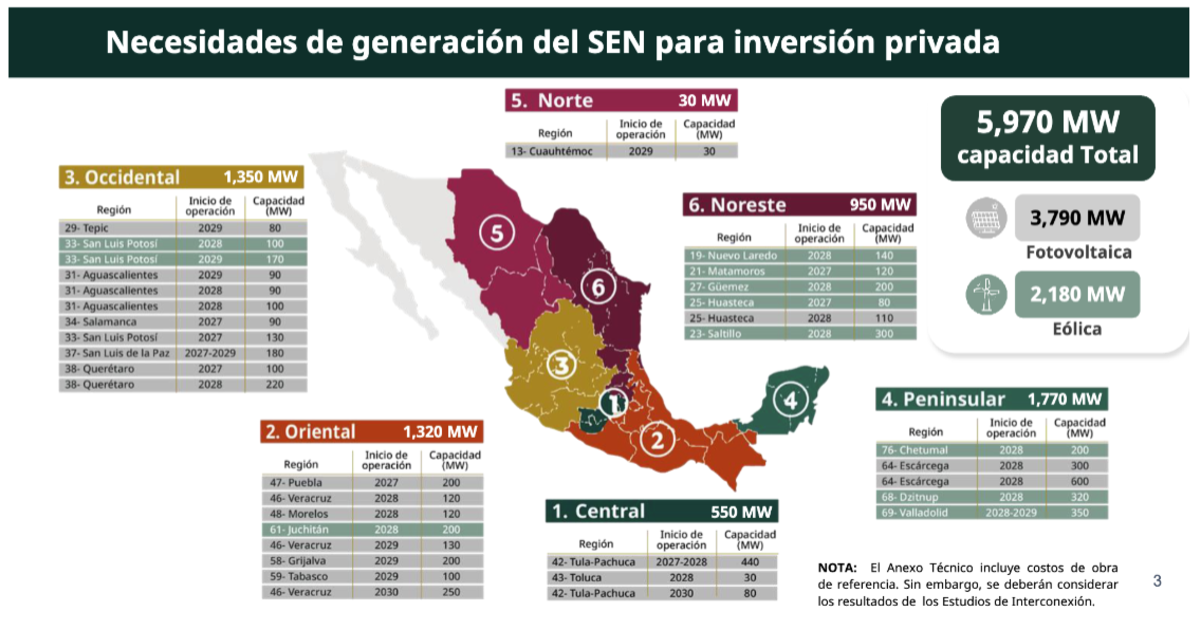
The installed capacity data comes from the 2025 Annual Report of the Mexican Wind Energy Association (AMDEE) , which outlines a roadmap to consolidate the sector as the cornerstone of the energy transition in Mexico.
S
Wind energy is already a pillar of the country's energy mix, but its growth will depend on advances in infrastructure, financing, and public policies that provide long-term certainty , says Gerardo Pérez Guerra , president of AMDEE. According to the report, as of the end of 2024 , there were 74 wind farms in operation in 15 states, with 3,342 wind turbines .Annual production was

Technology made it possible to avoid the emission of
8.87 million tons of CO2e , equivalent to taking 2.3 million vehicles off the road. Another key figure is the 64% decrease in the levelized cost of wind energy between 2009 and 2024 , solidifying its position as an increasingly competitive option.In addition to this,
The plan projects the creation of 9,780 direct jobs during 2024, an increase from the 9,482 of the previous year. Although the new plan marks significant progress, the sector warns of limitations in the National Electricity System Development Program (PROSENER) published in 2025. Unlike previous versions, the program does not establish concrete goals for the expansion of renewables , nor does it set growth targets for clean technologies such as wind, solar, or geothermal.Instead, PROSENER focuses its strategy on maintaining current generation, promoting natural gas self-sufficiency, and increasing energy efficiency.
The only explicit goal associated with the transition is a 2.9% annual reduction in energy intensity until 2036 , without defined financing mechanisms or specific incentives for renewable energy deployment. Despite these contradictory signals, the wind energy sector has an active private investment portfolio that could unlock more than $6.5 billion in the short term , according to AMDEE.The association identifies
30 projects with defined sites and reserve lease agreements with private or ejido landowners, totaling 5000 MW of new capacity. These thirty parks already have defined sites.There are agreements in place with the landowners, whether private or communal, and a reserve rent is being paid
, says Héctor Treviño , executive director of AMDEE, in an interview with Energía Estratégica. The execution of these projects will depend on regulatory efficiency and grid capacity .Currently, there are
Three wind farms have been built but have not been able to inject energy due to a lack of permits, representing 414 MW of idle capacity.They are joined by
Two more projects ready to build, totaling 175 MW . The AMDEE document supports this new framework as long as it successfully combines public leadership with the technical and financial capacity of the private sector.S
These conditions will facilitate the full contribution of companies' capital and experience to the shared goals of expanding renewable energy generation , the report highlights. Beyond installed capacity, AMDEE is reinforcing its commitment to a just energy transition .During 2024, he deepened his agenda in
Gender equality , energy poverty , green jobs , and human rights are highlighted, along with the work of the Wind Energy Expert Committee , community partnerships, and outreach activities in legislative forums, media, and public campaigns. The report states that sustainable development should not only be measured in terms of installed capacity or investment, but also in its social impact . With a solid base of installed capacity, a mature pipeline, and renewed state planning, the Mexican wind sector has the opportunity to exceed 10 GW of operational capacity before 2030 , provided that conditions of certainty, grid access, and public-private collaboration are ensured. AMDEE will continue to promote the sector's development with a clear vision: to consolidate Mexico as a leader in renewable energy and build a more sustainable energy future for all , concludes Pérez Guerra.