


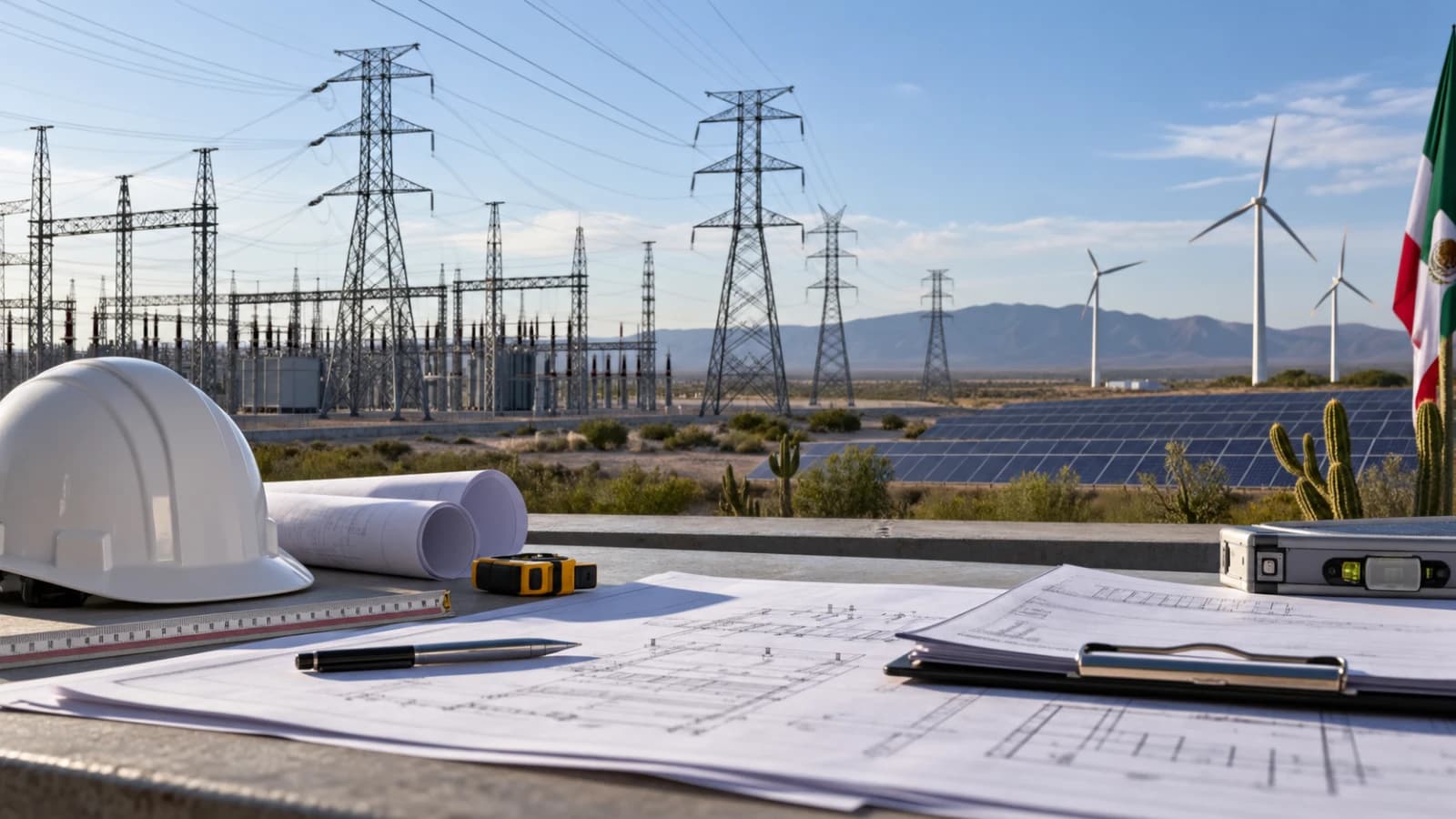
Mexico has launched a new phase for its standardization and conformity assessment system , with potential impacts on electrical infrastructure, renewable energy generation, and energy storage projects. The government published the new Regulations for the Quality Infrastructure Law , which establish, among other provisions, a transition period for replacing certain Mexican Standards (NMX) with new Standards.
One of the central points for the industry is the non-extendable 36-month period established for the corresponding Technical Standardization Committees to be established, for the Entities Authorized to Standardize, National Standardization Bodies or Standardization Authorities to issue the corresponding Standards in those matters, sectors or areas where there are currently valid NMX standards.
This provision thus opens a countdown to update part of Mexico's technical architecture. If the corresponding Standards are not issued within that period, the Ministry of Economy must publish the cancellation of the NMX standards affected by the scenario outlined in the Regulation.
However, the expiration of the period does not mean that all Mexican Standards will automatically disappear after 36 months . This distinction is particularly relevant for regulated sectors such as the electricity sector, where different technical instruments may be related to each other.

Mexican Standards (NMX) are voluntary instruments, unlike Official Mexican Standards (NOM), which establish mandatory compliance requirements . The new system incorporates a safeguard to prevent the transition from rendering references used within the latter obsolete.
Specifically, when an NMX is referenced in an Official Mexican Standard (NOM), it will remain in effect until the corresponding NOM is modified . In this way, the standards renewal process includes a continuity mechanism for technical references that are part of the mandatory regulatory framework.
This safeguard is especially important for electrical infrastructure and renewable energy projects , as it allows for regulatory continuity while the transition to the new Standards scheme is underway.
The Regulation also determines that the NMX standards issued before its entry into force will remain in effect until the Ministry of Economy publishes their cancellation or there is a current Standard that regulates the same good, product, process or service .
What might change for energy projects?
For developers of renewable energy, storage, and electrical infrastructure projects, the scope of the new framework extends beyond the change in terminology between NMX and Standards . Its implementation can impact both the technical requirements applicable to equipment and installations and the mechanisms used to demonstrate compliance.
The relevance of the Regulation for the sector is not limited to a mere regulatory interpretation. Sources close to the National Energy Control Center (CENACE), consulted by this publication, confirmed that the new regulations are important for energy projects , in a context of transformation of the rules governing standardization and conformity assessment in Mexico.
The document itself establishes an explicit connection with the sector. Among the recognized public needs are the measures necessary to protect the “efficiency, quality, reliability, continuity, security and sustainability of the National Electric System” , as well as the preservation and rational use of energy resources.
Continue reading
In this scenario, a developer must pay attention not only to which Standards replace the current NMX, but also to how the demonstration of compliance with the technical provisions applicable to the goods, products, processes or services involved in each project evolves .
The Regulation establishes that Mexican Official Standards must define the procedure and type of infrastructure required for Conformity Assessment . They must also identify the competent authorities responsible for carrying out verification, monitoring, and, where applicable, market surveillance.
Conformity assessment is therefore of particular interest to industry because it encompasses the mechanisms used to determine whether a product, process, or service meets the specifications established by the relevant technical instruments . Depending on the case, this may involve certifications, inspections, tests, measurements, or intervention by laboratories and other authorized bodies.
For the renewable energy and storage sector, this means that the specific impact must be analyzed according to the applicable Mexican Official Standards (NOMs) and regulations for each technology, piece of equipment, or installation . The Regulation does not, in itself, introduce a new specific technical requirement for photovoltaic panels, wind turbines, inverters, or battery storage systems.
What it does do is reorganize the framework through which these requirements can be developed and, subsequently, their compliance demonstrated , an issue that can become relevant during the structuring, construction and operation of projects.
International standards gain importance in the new scheme
Another element of interest for manufacturers, suppliers, and developers is the harmonization of Mexican regulations with international standards . The Regulation stipulates that NOMs (Mexican Official Standards), Standards, and their Conformity Assessment procedures must be based on applicable International Standards.
When Mexico introduces a technical deviation from these instruments, it must identify and justify it . The degree of concordance will be classified as identical, modified, or non-equivalent, depending on the relationship between the Mexican provision and the international reference used.
This point may become relevant for energy equipment and technologies integrated into global supply chains , given that the evolution of the Standards will determine which technical references are adopted and under what conditions conformity is demonstrated in the Mexican market.
The new framework also establishes timelines for regulatory development. Procedures related to topics included in the Program or its Supplement for developing Official Mexican Standards may not exceed two years , unless the Commission authorizes an extension requested by the Standards Authority.
In addition, the NOMs must undergo a systematic review at least every five years , introducing a periodic mechanism to analyze the continuity or updating of the current technical provisions.
For the energy industry, therefore, the next 36 months mark a crucial period of regulatory monitoring . The key will not only be to count how many NMX standards are being replaced, but also to identify which ones affect equipment, processes, and facilities in the sector, which standards are taking their place, and how the mechanisms for demonstrating compliance are being modified.
In this process, the continuity planned for the NMX standards referenced by mandatory regulations aims to avoid gaps as the transition progresses. For renewable energy, storage, and electrical infrastructure developers, the challenge will be to monitor the evolution of the technical standards that affect their projects and anticipate potential changes in the procedures for assessing and demonstrating conformity.