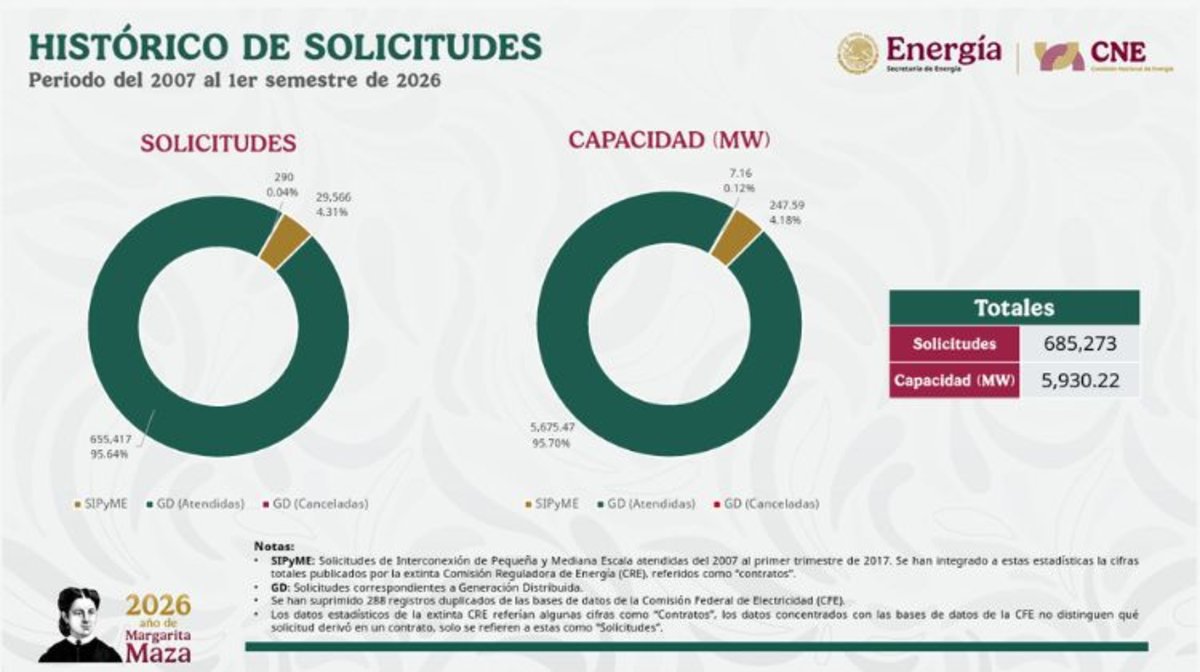
Mexico added 447.47 MW of distributed generation capacity during the first half of 2026 , reaching a cumulative capacity of 5,675.47 MW , according to the latest statistics from the National Energy Commission (CNE). This represents an 8.56% increase compared to the 5,228 MW recorded at the end of 2025.
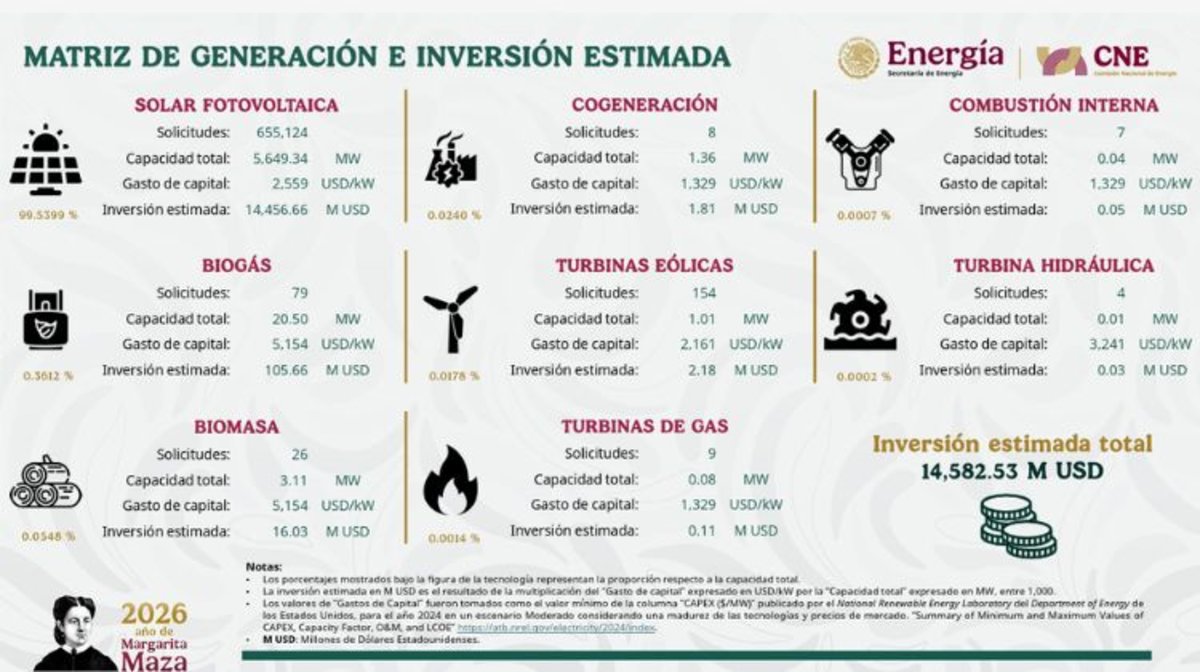
This expansion is also reflected in the volume of capital associated with the sector. According to the agency, the estimated cumulative investment amounts to $14,582.53 million , of which $14,456.66 million corresponds to photovoltaic solar systems, a technology that practically dominates the market.
The new official balance records 53,087 additional applications processed between January and June , bringing the national total to 655,417 interconnections under the distributed generation regime implemented since 2017.
If the records of the old Small and Medium Scale Interconnection Requests (SIPyME) scheme are included, the historical capacity amounts to 5,923.06 MW , with 684,973 requests served since 2007.

In this way, Mexico is approaching 6 GW of small-scale electricity generation, with a sustained expansion both in the number of connections and in incorporated power.
The CNE report also shows that, between 2017 and 2025, the applications served registered a compound annual growth rate of 40.49% , while the accumulated capacity advanced at a rate of 40.95%.
Compared to the end of 2025, when there were 5,189.71 MW and 600,651 applications, the segment added 485.76 MW and 54,766 new contracts in six months. This represents a 9.4% increase in capacity and a 9.1% increase in the number of installations. The segment's sustained growth translates into a cumulative capacity that already exceeds that of several large-scale conventional power plants and strengthens the reliability and resilience of the National Electric System.
In terms of investments, the previous report estimated a cumulative volume exceeding $13.335 billion , while the new statistics place that value above $14.582 billion.
Solar energy accounts for US$14.456 billion and Jalisco leads in installations
The technological composition of the Mexican market confirms the predominance of photovoltaic solar energy.
According to the generation matrix published by the CNE, photovoltaic systems accumulate 5,649.34 MW distributed in 655,124 applications served , which is equivalent to 99.54% of the distributed generation capacity.
The estimated investment for this technology reaches $14,456.66 million , calculated on a capital cost of $2,559 per kW installed.
Other technologies maintain a considerably smaller share.
Biogas adds up to 20.50 MW and an estimated investment of 105.66 million dollars, followed by biomass, with 3.11 MW and 16.03 million dollars.
Meanwhile, wind turbines reach 1.01 MW and represent an investment of 2.18 million dollars, while cogeneration brings together 1.36 MW and 1.81 million dollars.
Internal combustion, hydraulic turbines and gas turbines complete the mix, with capacities of less than 0.1 MW each.
Concentration also appears in the territorial distribution of interconnections.
Jalisco leads the national ranking with 808.58 MW and 107,285 applications served , concentrating 14.25% of the capacity and 16.37% of the country's registrations.
Nuevo León follows, with 596.22 MW and 75,933 applications , equivalent to 10.50% of the accumulated power.
Chihuahua ranks third with 424.85 MW, while Guanajuato registers 373.77 MW and Coahuila reaches 273.60 MW.
Together, these five states account for 2,477.02 MW, equivalent to 43.64% of all distributed generation recorded by the CNE .
The ranking continues with Michoacán, which registers 257.69 MW; State of Mexico, with 250.73 MW; Sonora, with 240.24 MW; Yucatán, with 224.35 MW; and Mexico City, with 204.94 MW.
Statistics also allow us to identify differences in the size of the facilities.
The national average is 8.66 kW per request , although in Jalisco it is approximately 7.54 kW, compared to 14.71 kW in Sinaloa and 12.84 kW in the State of Mexico.
By region, North-Bajío has the highest accumulated capacity, with 1,436.09 MW , followed by West, with 1,422.43 MW; Central-East, with 1,411.95 MW; and Northwest, with 1,405 MW.
Continue reading
However, the West accounts for the largest number of requests processed, with 191,793 registrations, equivalent to 29.27% of the national total.
Another highlight of the report is the distribution of the facilities according to their power ranges.
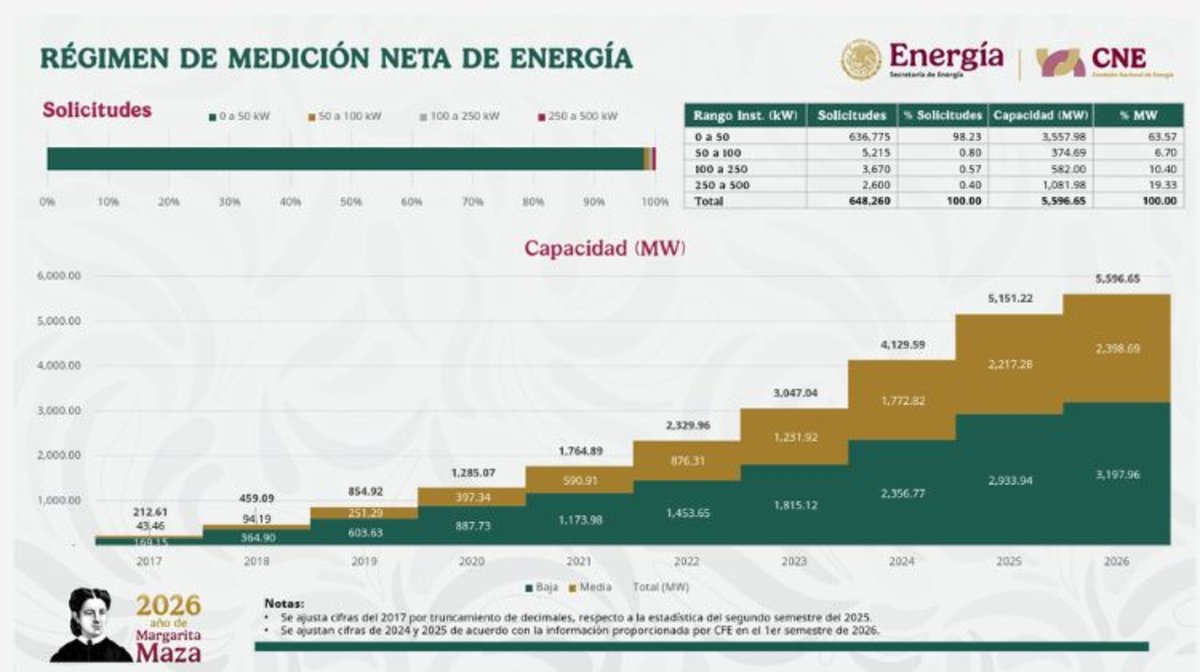
Within the net metering system, 636,775 applications correspond to systems up to 50 kW , representing 98.23% of the connections under this modality.
These facilities have a combined capacity of 3,557.98 MW, equivalent to 63.57% of their capacity.
In contrast, systems between 250 and 500 kW represent only 0.40% of the applications, but concentrate 1,081.98 MW , that is, 19.33% of the power registered under net metering.
The distribution highlights the importance of small consumers in terms of the number of installations and, simultaneously, the weight of larger capacity projects in the incorporation of megawatts.
ANES forecasts an additional 1200 MW in 2026 and is focusing on self-consumption and batteries.
The official figures are released in a scenario where the Mexican photovoltaic industry anticipates continued growth in distributed generation during the second half of the year.
Gilberto Sánchez, president of the National Solar Energy Association (ANES) , projected a few months ago that the market could expand between 24% and 25% during 2026 compared to the performance of the previous year.
“ This 2026 we must close with 1200 MW ,” Sánchez calculated regarding the new capacity that could be incorporated during the year.
The forecast represents an acceleration compared to the 447.47 MW recorded during the first six months. To reach 1,200 MW annually, the market would need to add another 752.53 MW between July and December .
One of the indicators that the association uses to anticipate this evolution is the inspections associated with medium voltage contracts, whose pace, according to the executive, is approximately double that observed during 2025.
“ This indicator tells us that we need to grow at least 20% more than we have been. This would give us 24 or 25% growth compared to 2025 ,” Sánchez explains.
The industry outlook is also linked to upcoming administrative provisions for distributed generation.
Among the mechanisms that ANES hopes to find in the new regulatory framework are projects under 700 kW, storage, collective distributed generation and schemes linked to communities and energy poverty .
The president of the association rules out that waiting for these definitions necessarily implies a halt to activity.
“ Some people say it’s uncertainty. No, we see it as an expectation ,” says Sánchez.
The executive maintains that companies continue to develop projects under the current regulations, while they inquire about when the new mechanisms will be available.
Meanwhile, self-consumption is emerging as another segment with growth potential, especially for companies interested in generating electricity behind the meter. The recent implementation of the Single Window system aims to simplify the administrative procedures associated with these types of initiatives.
According to ANES, there are already around 20 MW of photovoltaic capacity with permits granted under this scheme , while the association's projections aim to reach between 1,000 and 1,200 MW of self-consumption by 2030.
These capabilities correspond to a different regulatory segment and should not be automatically incorporated into distributed generation statistics.
For its part, battery storage is another area that the industry identifies as having opportunities to expand investment as regulatory definitions progress.
The results for the first half of 2026 show that Mexico adds almost 450 MW of new distributed generation capacity, exceeding the 5.6 GW accumulated and registering an estimated investment of more than 14.5 billion dollars .
With solar photovoltaics concentrating practically the entire market and more than 655,000 applications processed, the next official update will determine whether capacity expansion accelerates during the second half of the year, in line with ANES' expectations.


 By Energía Estratégica

 By Ailén Pedrotti

 By Emilia Lardizabal