Mexico's Energy Secretariat (SENER) extended the deadline to March 1, 2027, for registering battery storage projects within the 935 MW BESS stand-alone call for bids, after formalizing a fourth modification of the procedure that seeks to incorporate new capacity into the National Electric System.
The decision was established in the agreement published on October 29, 2026 in the Official Gazette of the Federation (DOF) , through which the Government again modifies the schedule for the presentation of expressions of interest and requests for connection studies.
Thus, the deadline originally set for October 30, 2026, has been moved to March 1 of next year. This update applies exclusively to storage systems, while the submission period for renewable energy generation projects ended on September 2.
The resolution bears the signature of Luz Elena González Escobar , Mexico's Secretary of Energy, and modifies section II of numeral 3.1 and stage 2 of numeral 17.1 of the call for strategic generation and storage projects, aligned with the binding planning.

It's worth noting that the call for proposals includes a mixed participation scheme with the Federal Electricity Commission (CFE) , whereby private developers submit independent energy storage initiatives for evaluation and potential partnership with the state-owned company. This mechanism aims to incorporate strategic infrastructure into the electrical system, under technical, economic, and contractual conditions defined by Mexican authorities.
In particular, the new text sets the registration period for Electrical Energy Storage Systems (EESS) between June 2, 2026 and March 1, 2027 , and clarifies that the deadlines must be calculated in working days, unless expressly stated otherwise.
SENER justifies this expansion on the need to "encourage a greater number of viable proposals" , with the aim of increasing the participation of developers in the procedure.
The agreement also states that the modification will allow for “strengthening the coordinated technical analysis by the energy sector authorities” , as well as “optimizing costs for individuals” and “guaranteeing administrative efficiency” .
This is the fourth update of a call originally published on May 15, 2026 , which had already been modified on May 26, July 10 and September 2.
This latest revision had extended the registration period for BESS systems until October 30, after differentiating between generation and storage schedules. Now, the new resolution extends the window again for the latter segment, without introducing any explicit changes to the total power required.
Beyond the official reasons, industry sources consulted by Energía Estratégica attribute the new extension to the complexity of the technical models requested to participate in the call , whose preparation and validation times make it difficult for developers to complete the documentation before the previous deadline.
Among the technical tasks identified are the development, parameterization and validation of PSS®E and EMTP models , as well as the verification of compliance with the Grid Code and the availability of PPC, EMS and BMS controller models, which must be provided by the manufacturers in versions acceptable to the National Energy Control Center (CENACE).
Sources warn that the absence of PPC models provided by the manufacturer may prevent compliance with the tender requirements . This is compounded by specialized validation work, interconnection studies, impact and facilities assessments, as well as detailed engineering, surveying, and geotechnical work, which may require additional contracts.
In this context, the same sources indicate that, as far as they know, the Federal Electricity Commission (CFE) would be interested in contracting these technical works , although there is still no official confirmation on the scope or conditions of a possible contract.
In this way, the extension until March 1, 2027 provides more time to complete the documentation, coordinate technical developments with manufacturers and advance in the validations necessary to present viable projects.
Seven regions account for the 935 MW BESS: conditions and interested companies
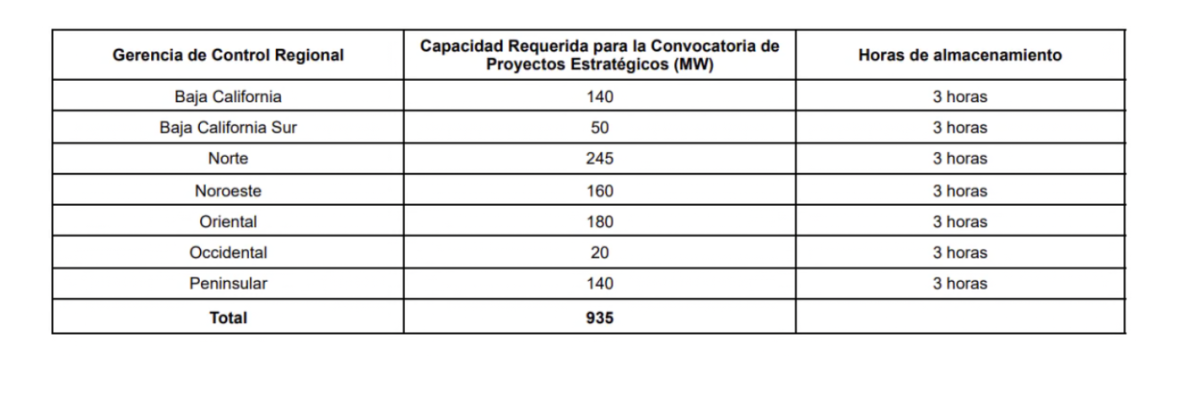
The call aims to incorporate 935 MW of independent storage with a required duration of three hours , which represents approximately 2,805 MWh of energy capacity , if all the projects are completed.
The Northern Regional Control Management leads the requirements with 245 MW , followed by Eastern, with 180 MW , and Northwest, with 160 MW .
For their part, Baja California and Peninsular have an allocation of 140 MW each , while Baja California Sur has 50 MW and Occidental completes the distribution with 20 MW .
In particular, the regulation establishes that CENACE should not consider projects located in areas where the storage requirement is already covered .
Therefore, the location of the facilities, their contribution to the reliability of the network and the specific needs of each connection point will be determining factors in the evaluations.
These criteria are complemented by the relief of congestion, the contribution of power, operational flexibility, the technological performance of the batteries and the financial viability of the proposals.
The call also establishes priority for projects whose entry into commercial operation is planned before 2030 , a condition defined by the authority as a "mandatory time parameter" to validate the firmness criteria of the initiatives.
Once the registration is completed, the CFE has ten days to indicate whether it is interested in continuing the analysis of an initiative with a view to a possible partnership.
Continue reading
If no such interest is found, the procedure outlined in this call for proposals will conclude for the project. Conversely, proposals that pass this stage must proceed with the connection studies, acceptance of the corresponding costs, and evaluation by the Technical Analysis Group (GAT) .
This group must identify those initiatives that bring the greatest benefits to the electrical system and the State, considering the operational, technological and economic parameters defined in the rules.
Furthermore, developers retain the possibility of participating simultaneously in other processes, while proposals that do not establish a partnership with CFE may resort to ordinary permit and authorization procedures, in accordance with applicable regulations.
Who are competing in the call for applications?
The new extension finds different actors in the Mexican energy sector preparing their proposals to participate in the call for independent storage, with initiatives ranging from project development to the supply of technological solutions.
One of the companies confirming its participation is Terralia , which is competing with a portfolio of 640 MW BESS stand-alone, all with three hours of storage , representing a combined energy capacity of 1,920 MWh .
The power with which the developer participates is equivalent to approximately 68.4% of the 935 MW contemplated in the call, although this does not imply that said capacity has been awarded.
The company also has a history with the mechanisms promoted by the Federal Electricity Commission (CFE), having been selected in the first mixed scheme with El Chorro, a 705 MW wind development accompanied by 317 MW of three-hour batteries , equivalent to approximately 951 MWh of storage.
For its part, Polaris Renewable Energy had anticipated its interest in expanding its presence in the energy investment and development mechanisms promoted by Mexico.
“ We have high confidence in our additional pipeline of mixed, priority and stand-alone BESS projects that may significantly increase our pipeline ,” company representatives stated in an exclusive interview with Energía Estratégica .
Meanwhile, AES Mexico had also expressed a favorable assessment of the contractual model used to structure this type of initiative.
“ The scheme of the call for bids, which is a long-term contract with a tolling agreement scheme, is working today ,” assured Andrés Cabrera , of AES Mexico, during a Strategic Energy broadcast held weeks ago.
The tolling agreement scheme is a relevant element for the commercial structuring of storage projects, by establishing long-term contractual commitments for the availability or use of the system's capacity, in accordance with the agreed conditions.
Among the names is Skysense , a company that had announced its intention to participate in the call for independent storage, while it is making progress in structuring utility-scale projects.
“ In Mexico, we want to sign a couple of utility-scale projects this year. In addition, we plan to submit some projects to the standalone call for proposals ,” said Enrique Garduño , CEO and founder of Skysense, during his participation in the Future Energy Summit Mexico 2026.
Thus, the extended schedule finds manufacturers, integrators, and developers with different levels of preparation, although expressions of interest and business background do not necessarily equate to accepted entries or awards within the 935 MW call.
Meanwhile, 34 companies are advancing in the second mixed generation call.
While the deadlines for independent storage are being extended, Mexico's second mixed renewable generation call is moving forward with 66 pre-selected projects to continue in evaluation, totaling 8,241 MW , distributed between 57 photovoltaic initiatives for 6,310 MW and nine wind farms for 1,931 MW .
As reported by Energía Estratégica on October 15, the portfolio comprises 34 economic groups , including GEMEX, Freeman, Fisterra, AES México, and Invenergy. Polaris also participates, while Terralia reports progress with an 850 MW portfolio.
The process, known as Mixtos II , started with 126 evaluated initiatives, of which 66 maintain a preferential condition to continue to the next technical and administrative stages.
This selection corresponds to generation projects and does not imply awards of the 935 MW BESS stand alone , whose registration period has just been extended until March 2027.
It is worth remembering that the planning for the new renewable energy calls includes 4,595 MW of photovoltaic and solar thermal power and 2,159 MW of wind power , with the incorporation of storage systems equivalent to 30% of the capacity of the power plants and a minimum duration of three hours .
Therefore, Mexico maintains two distinct mechanisms to expand its battery capacity: the 935 MW of independent storage and the solutions associated with new solar and wind projects.
With the fourth amendment published in the DOF, March 1, 2027 becomes the new reference date for BESS developers seeking to participate in the strategic procedure.

 By Emilia Lardizabal


 By Florencia Guglielmetti