


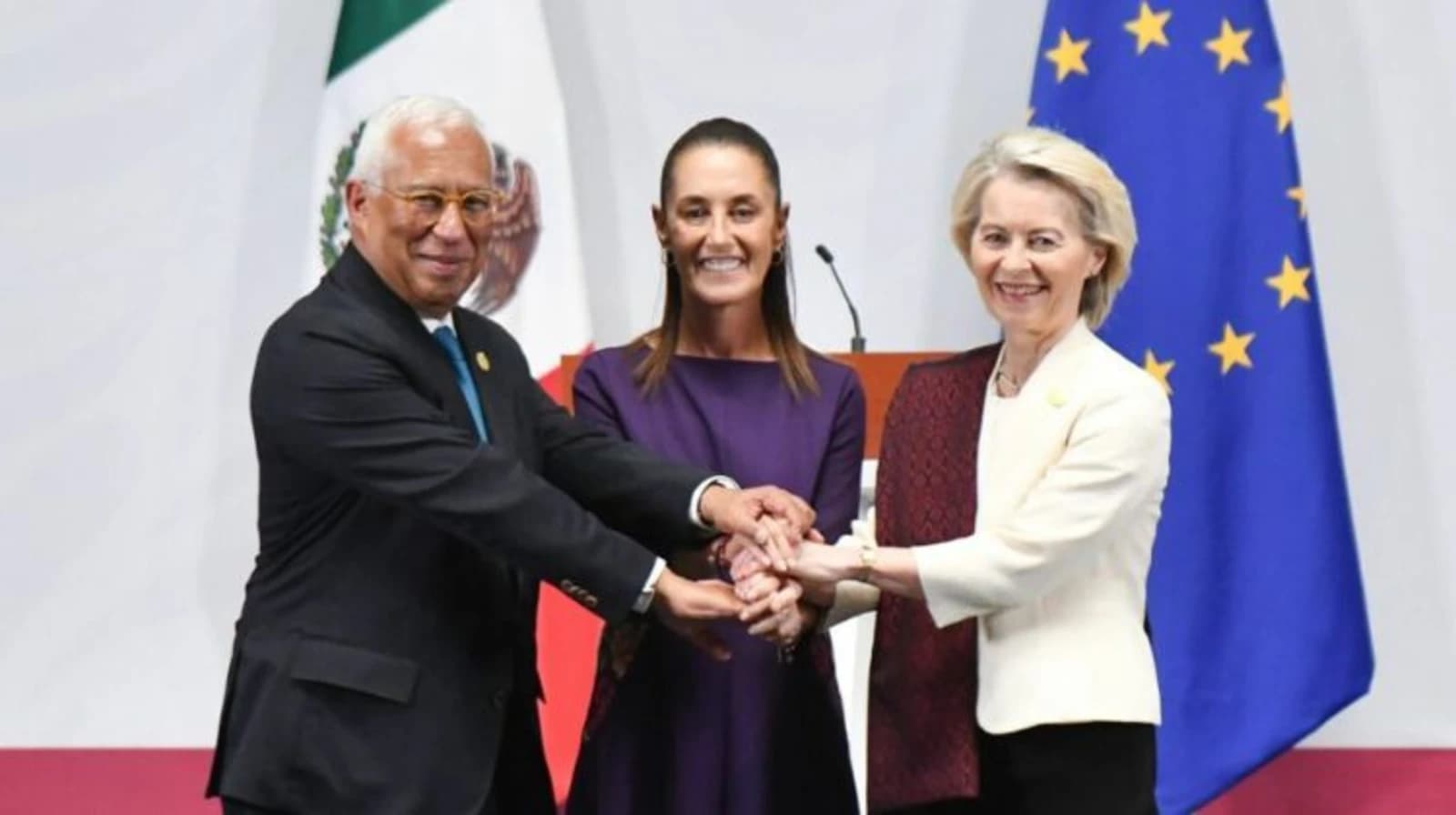
Mexico and the European Union took a key step in updating their economic relationship with the signing of the modernized trade agreement that both parties had maintained since 2000. The agreement was formalized during a meeting led by Mexican President Claudia Sheinbaum and European Commission President Ursula von der Leyen, in a political signal aimed at strengthening bilateral cooperation amid an increasingly fragmented global landscape.
During the presentation of the agreement, both leaders emphasized the need to strengthen the strategic alliance between their regions in the face of an international context marked by economic volatility and geopolitical transformations. The message made it clear that this rapprochement is not solely driven by a trade agenda, but also by the need to build greater economic and industrial resilience.
The move takes on special significance in a scenario marked by new trade tensions stemming from the tightening of tariffs driven by the United States, which has led several strategic partners to accelerate diversification processes.
Although the United States remains by far Mexico's main trading partner, the relationship with Europe is gaining importance as a strategic alternative. The European Union is currently Mexico's third-largest trading partner, behind the United States and China. In 2025, bilateral trade between Mexico and the European bloc reached approximately $94.6 billion, a significant figure, although still much lower than the volume of trade it maintains with the U.S. market.

Beyond traditional trade, the updated agreement opens new perspectives for sectors linked to energy and industry.
Continue reading
Europe seeks to consolidate more resilient supply chains to sustain its energy transition and reduce strategic dependencies in a context where energy security is no longer limited to access to fuels, but also to control over critical infrastructure, strategic minerals and technological manufacturing.
In that scenario, Mexico emerges as a partner with competitive advantages due to its industrial capacity, its manufacturing integration, and its geographical position within the North American ecosystem.
For Mexico, closer ties with Europe could represent an opportunity to attract investment in energy infrastructure, electricity grids, storage, electromobility, and clean technologies—sectors where the demand for capital and technological cooperation continues to grow.
Furthermore, the new agreement could have regional effects. If the European Union deepens its economic diversification strategy toward Latin America, Mexico could consolidate its position as a key hub for channeling industrial and energy investments.
However, taking advantage of these opportunities will depend on the country's ability to offer regulatory certainty, particularly in energy sectors where international investors are closely watching the evolution of the regulatory framework.
With this agreement, Mexico and the European Union not only redefine their trade relationship: they also reorder positions within a global chessboard where trade, geopolitics and energy are once again strongly intertwined.