


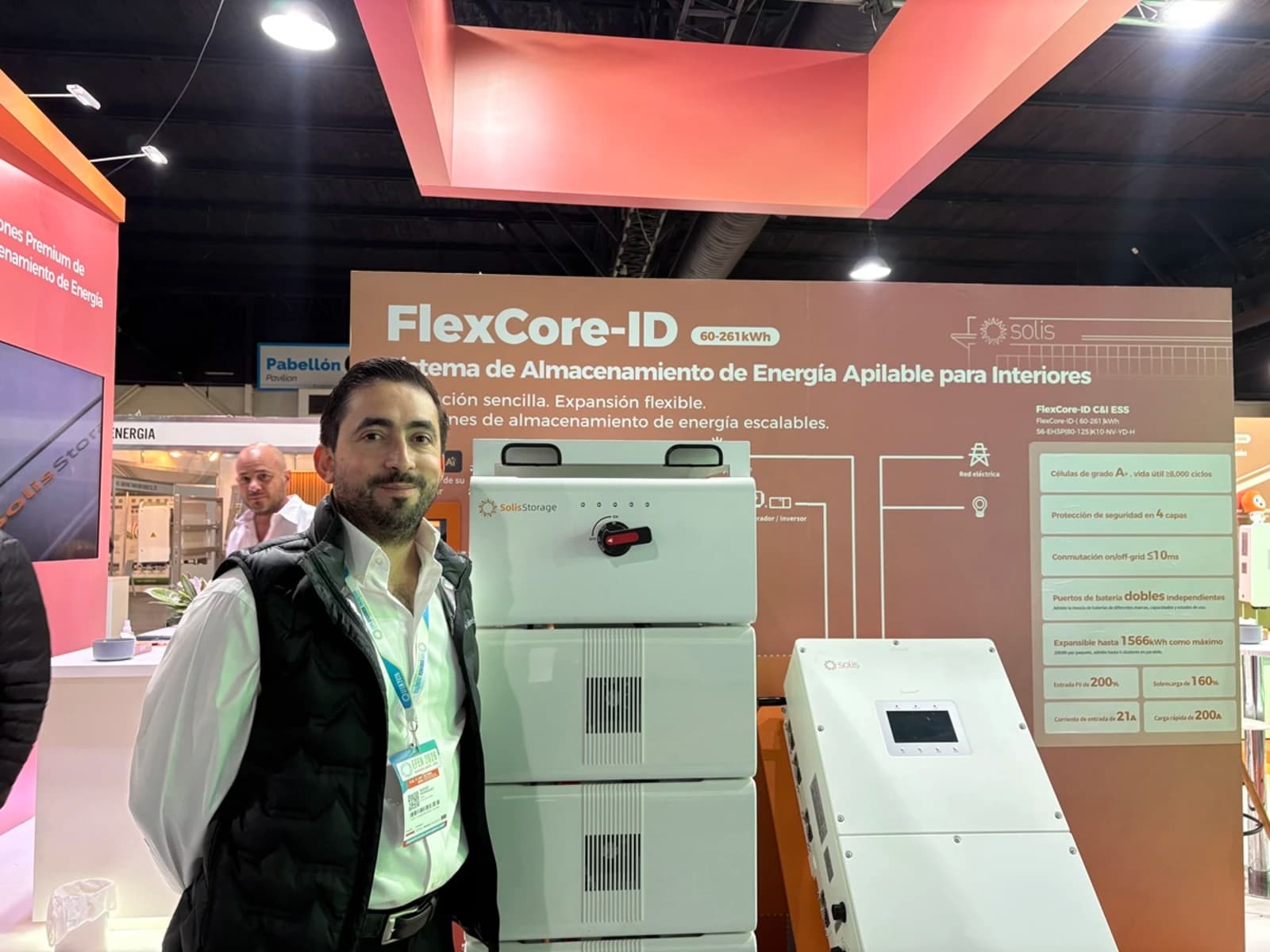
Batteries are beginning to find a use case in Argentina that goes beyond energy savings or integrating solar power generation. Solis is finding interest among commercial and industrial users for whom even a few seconds without electricity can translate into operational losses.
“There are already projects in Argentina, mainly for micro-outages. There are installations where these end up costing a lot. The most expensive energy is the energy you don't have,” said Sergio Rodríguez , Director of Technology for LATAM at Solis, in an interview with Energía Estratégica during the Energy Efficiency Expo .
“In the commercial and industrial sector, there are companies that cannot stop. If they stop, they lose money. Businesses that don't have a network lose customers,” he added.
Such is the concern that the issue has already begun to gain traction within service quality requirements. Within the framework of the 2025-2030 Five-Year Tariff Review , the National Electricity Regulatory Entity (ENRE) mandated that distributors specifically record micro-outages, voltage dips, and transient overvoltages .

This addition is relevant because the traditional SAIFI and SAIDI indicators count interruptions longer than three minutes, so shorter events are not necessarily reflected in those metrics.
Meanwhile, the agency's latest records show broader difficulties in maintaining supply continuity within the Buenos Aires Metropolitan Area (AMBA).
Based on that review, the agency determined approximately $21,481 million in breaches related to technical service and another $6,003 million related to the technical product .
In that scenario, Solis is modifying its proposal to integrate generation, batteries and power electronics, so that it is moving towards equipment where both technologies are part of the same solution.
During the Energy Efficiency Expo, EverCore and FlexCore-ID were presented, two systems aimed at the C&I segment and designed for different scales and project configurations.
Continue reading
EverCore has configurations ranging from 100.5 to 261.2 kWh , with inverters of 50, 60 and 125 kW, while FlexCore-ID uses a modular architecture that allows capacity to be expanded according to the needs of each installation.
The local strategy is not limited to equipment deployment. The company also seeks to strengthen its ties with installers, distributors, developers, and engineering firms in a market it identifies as strategic within its Latin American expansion.
Rodríguez identified residential, commercial, and industrial development as key areas for the country, although Solis also has alternatives for larger-scale projects.
Argentina enters into a broader regional strategy
The local move is part of an expansion where the company already has concrete experience with batteries for businesses.
Chile is one of its key markets. There, it put into operation the first EverCore system in Latin America, installed in San Bernardo, with 125 kW of power and 261 kWh of capacity , associated with 137.02 kWp of photovoltaic generation.
Mexico followed the same path with a 150 kW/261 kWh installation at a factory in Guadalajara, intended to provide backup in the face of recurring outages and greater flexibility in electricity management, a use case similar to the one Rodríguez is now observing in Argentina.
Within South America, Rodríguez identified Chile as a priority market and highlighted the growth of Argentina . He also pointed to opportunities in Peru, Bolivia, and Ecuador , where supply issues and electricity costs could create room for these types of solutions.
“The key will definitely be storage. Hybrid systems, a combination of inverters with batteries of different capacities and different battery chemistry characteristics,” anticipated the Director of Technology for LATAM at Solis.