


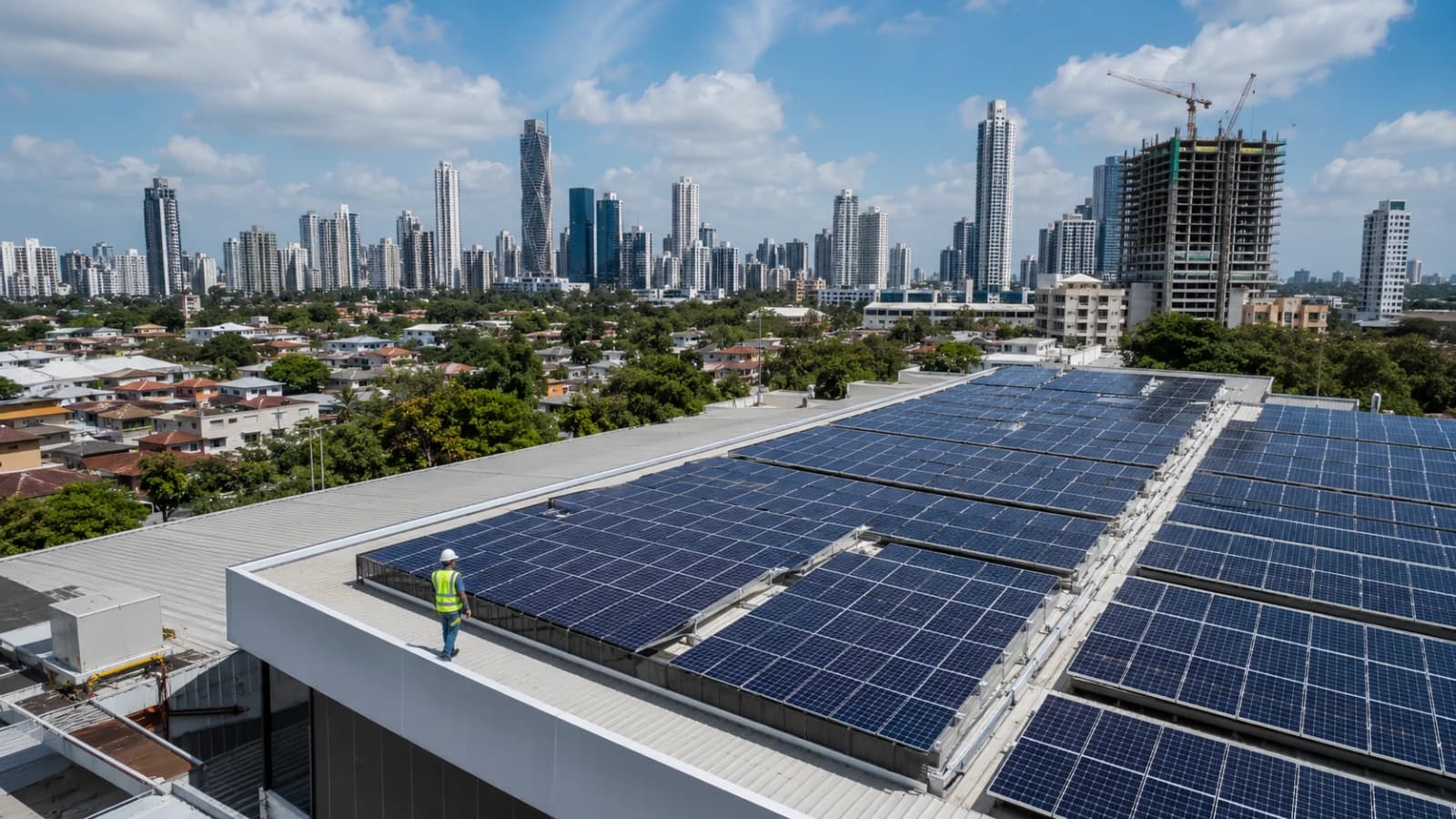
Panama has reached 196 MW of installed photovoltaic self-consumption capacity, consolidating one of the most dynamic segments in its energy transition. According to the most recent update from the Panamanian Chamber of Solar Energy , the country has 7,195 users under this model, reflecting the increasingly widespread adoption of solar systems in homes, businesses, and industries.
This milestone comes at a particularly active time for the national electricity market. While the latest awarded tenders incorporate new renewable energy projects to meet future demand, thousands of consumers are moving forward with their own investments to generate some of the energy they consume, a trend that is gaining traction throughout Latin America.
Data from the Panamanian Chamber of Solar Energy shows that the expansion of self-consumption continues in the concession areas of EDEMET, ENSA and EDECHI , demonstrating a greater penetration of the technology in different user segments and regions of the country.
In addition, the levels of self-consumption penetration on electricity demand and consumption are still far from the regulatory limits established by the National Authority of Public Services (ASEP), leaving room for the market to continue expanding in the coming years.

The trend opens up opportunities for developers, integrators, equipment suppliers, financial institutions and companies specializing in energy solutions, in a context where more and more consumers are looking to complement the traditional supply with their own generation.
Large tenders accompany the advance of solar power.
The performance of self-consumption coincides with a new stage of long-term electricity contracting in Panama, articulated by ETESA to meet the requirements of EDEMET, EDECHI and ENSA .
In the ETESA 01-25 tender , the country awarded 15,097,321 MWh for US$360.2 million , with bids ranging from US$20.05/MWh to US$26.92/MWh . The average equivalent price was US$23.86/MWh , calculated using the tender's financial methodology and a discount rate of 12%.
With the participation of the virtual bidder, the total volume allocated reached 16,186,881 MWh , while the financial commitments totaled $441.1 million . Wind power accounted for 12,453,642 MWh , compared to 2,643,677 MWh awarded to hydroelectric plants, consolidating its position as the dominant technology in the process.
Continue reading
On the other hand, the ETESA 01-26 Public Investment Law (LPI ETESA 01-26) furthered this trend by awarding 22.6 TWh through long-term contracts for existing power plants. This process reaffirmed the growing importance of renewable technologies within the national electricity supply and reshaped the market share of various players. Among the companies with the largest presence was AES , along with renewable and hydroelectric generators that secured supply contracts for the coming years.
The tender specifications for the second call for bids included separate categories for firm capacity with associated energy, capacity only, and energy only, enabling the participation of operating hydroelectric, wind, and solar photovoltaic plants. The contracts are intended to meet the requirements of the distribution companies ENSA, EDEMET, and EDECHI , in line with the country's projected electricity demand growth.
Panama is preparing a new wave of tenders focused on storage
The push for renewable energy doesn't end with the recent contracts. Panama is already working on an electricity procurement roadmap that, for the first time, incorporates energy storage as a central element to guarantee the system's reliability.
The plan presented by ETESA includes bidding processes between 2026 and 2030 to meet growing demand and support the addition of new renewable capacity. Among the key developments is the inclusion of battery storage systems, a technology that is gaining prominence as the share of wind and solar resources in the energy mix increases.
The strategy seeks to complement the expansion of renewable energies with solutions capable of providing operational flexibility, managing generation surpluses and strengthening grid stability during peak consumption hours.
For the market, this signal is particularly relevant. While recent tenders have consolidated the entry of new renewable projects, upcoming processes could open opportunities for developers specializing in storage, hybrid projects, and new flexibility solutions for the Panamanian electricity system.
This scenario positions Panama among the most active renewable energy markets in the region. Investments awarded through tenders and the sustained expansion of distributed solar generation point in the same direction: an increasingly diversified, clean, and decentralized energy mix.
With 196 MW installed and 7195 active users, photovoltaic self-consumption is already part of the pillars of Panamanian energy development and has room to continue growing in the coming years.