


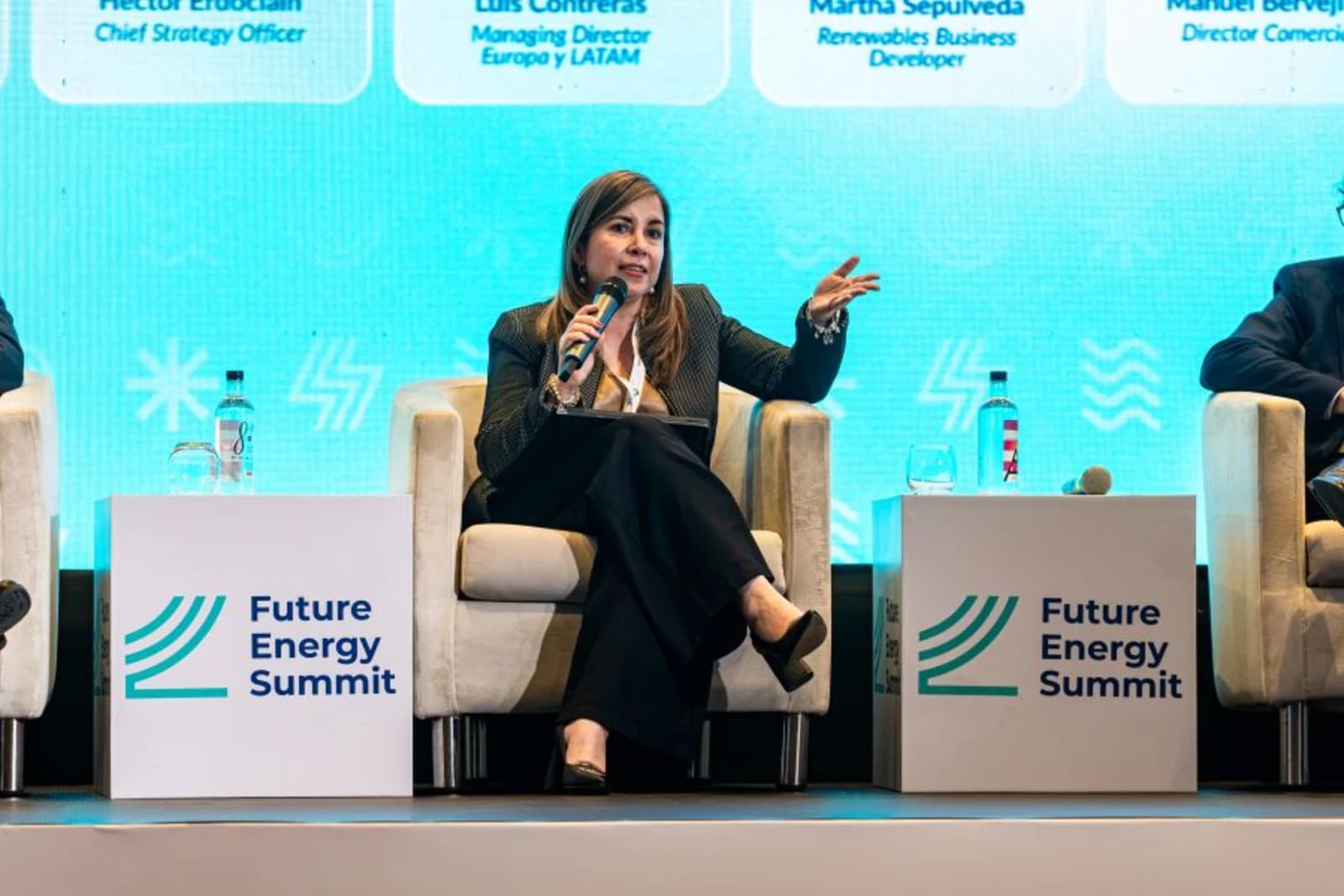
Nexans will supply cabling solutions for around 300 MW distributed across several renewable energy projects under construction in southern Peru , as revealed by Martha Sepúlveda , Renewables Business Developer of the company, during her participation in Future Energy Summit (FES) Peru 2026 .
The executive warned about the difficulties that the new power plants could face due to the overlap of electrical and industrial investments and quantified their economic impact: each month of delay during construction could represent approximately USD 2.5 million .
“If the start of operations is 2027-2028, the cables and accessories should start being selected today,” he said, referring to the deadlines that the developers were working with to complete their projects.
The warning came amid a photovoltaic expansion. According to the Ministry of Energy and Mines (MINEM) , as of April 2026, Peru had 13 solar projects with definitive concessions, totaling 2,402 MW and an estimated investment of USD 1,805.9 million . Arequipa accounted for nine initiatives totaling 1,816 MW, while Moquegua had another 322 MW. Among the developments that subsequently moved forward were Yuramayo, with 245 MW, and the Illa Phase 1 project, with 396 MW, whose Operability Study had received approval in March.

The firm's business activity is concentrated in the south of the country, where it worked with various developers and contractors. The firm did not identify the specific installations or their individual power ratings, but highlighted the particular requirements of these sites, especially the high solar irradiance, which had to be considered when defining the technical specifications of the conductors and their accessories.
The contracting deadlines that will define the projects of 2028
For power plants scheduled to begin commercial operation between 2027 and 2028, Nexans recommended starting the engineering and selection of electrical components 12 to 18 months before the start of operations . Once financing is secured, it suggested reserving manufacturing capacity 9 to 12 months in advance, through agreements that would allow for coordinating supplies with the actual progress of construction.
“These can be framework agreements per project or per portfolio, including several projects and reserving capacity,” explained the company representative. The firm order would be placed later, once conditions were in place to establish the final delivery schedule, avoiding committing to dates without first defining the technical requirements of each installation.
The strategy responded to an international demand for electrical infrastructure that extended beyond renewable energy generation. During the meeting, the executive mentioned the growth of data centers, solar energy, and storage systems —sectors that required conductors to connect their equipment and transport electricity.
According to the references presented, global photovoltaic additions had reached around 500 GW during 2025, while batteries registered a growth of close to 40% year-on-year.
In Peru, equipment needs were also linked to network expansion. ISA Energía projected investments exceeding USD 1.3 billion , associated with approximately 1,400 kilometers of new lines, six substations, and 20 expansions . The simultaneous development of generation and transmission introduced new coordination requirements for manufacturers, particularly when different projects shared needs for materials, transportation, and installation resources.
Continue reading
From design to OPEX: the technical risks that can compromise profitability
Nexans' involvement in projects doesn't end with the manufacturing and delivery of conductors. The company also develops tools and solutions to support installation tasks, a stage where damage can occur from friction against the ground, duct entry points, and conduits, potentially causing cracks that compromise the circuits' operation.
“Some are detected during commissioning. In that case, they impact the start of operations and CAPEX. But, in the worst-case scenario, they are not detected until operation, when they impact OPEX and project revenues,” Sepúlveda explained.
The consequences were particularly significant in the internal medium-voltage networks, where a fault could interrupt the power output of several wind turbines or affect the availability of a section of the power plant. Therefore, the company advocated for the manufacturer's involvement from the initial design decisions through to the technical supervision of the power line installation, with the aim of reducing contingencies that could compromise the lifespan of the assets.
"Horizon" success story: 813 MW and Nexans' experience in large regional projects
As a precedent for its activity in Latin America, the firm presented its participation in the Horizonte wind farm, developed by Colbún in Taltal, Chile , with a capacity of 813 MW and built between 2021 and 2024. The project required approximately 840 kilometers of electrical conductors , mainly medium voltage cables, supplied through its industrial operations in Chile and Peru.
The intervention began during the plant's planning phase, with meetings between the developer, construction managers, and the manufacturer's technical teams to review specifications, reel lengths, and delivery schedules. This coordination proved especially important due to the logistical challenges following the pandemic, which was then impacting international supply chains.
“Even the first cable deliveries were made before the wind turbines arrived at the project,” the executive emphasized. The collaboration continued during installation, with support provided to the engineers responsible for laying the cables and checking critical points in the electrical circuits.
This experience was part of the strategy of Indeco by Nexans , a company with over 74 years of experience in Peru and a regional platform that includes operations in Chile, Colombia, and Brazil. The French group, present in 39 countries according to the representative, served various Central and South American markets from these facilities, providing solutions for electricity generation, transmission, distribution, and consumption.
Mining, renewables and transmission: the risks for construction in southern Peru
The final part of the debate addressed the conditions necessary to convert the country's project portfolio into operational facilities. From Nexans' perspective, one of the main challenges would be the timing of investments across different sectors, especially in regions where mining activity shared infrastructure needs with new solar power plants and transmission projects.
“In southern Peru, mining, solar, and transmission projects could converge simultaneously. This could generate a crisis in the supply chains,” warned the specialist, who pointed out that even the availability of equipment could become a barrier if numerous investments moved forward at the same time.
As an international benchmark, he indicated that around 20% of the solar plants scheduled for construction in the United States by 2025 had experienced delays , although he did not specify what proportion was due to supply difficulties. This precedent reinforced his argument regarding the need to align commercial decisions with actual construction timelines.
When asked about the main risk for a large-scale renewable energy plant with a COD (Certification of Development) target in 2028, she chose construction over equipment supply . Her concern focused on the logistical difficulties that could arise during the simultaneous execution of different projects, even when engineering and manufacturing capacity had been planned well in advance.
“Even as a manufacturer, I would lean towards construction,” he concluded, identifying on-site coordination as one of the determining factors for meeting commissioning commitments.