


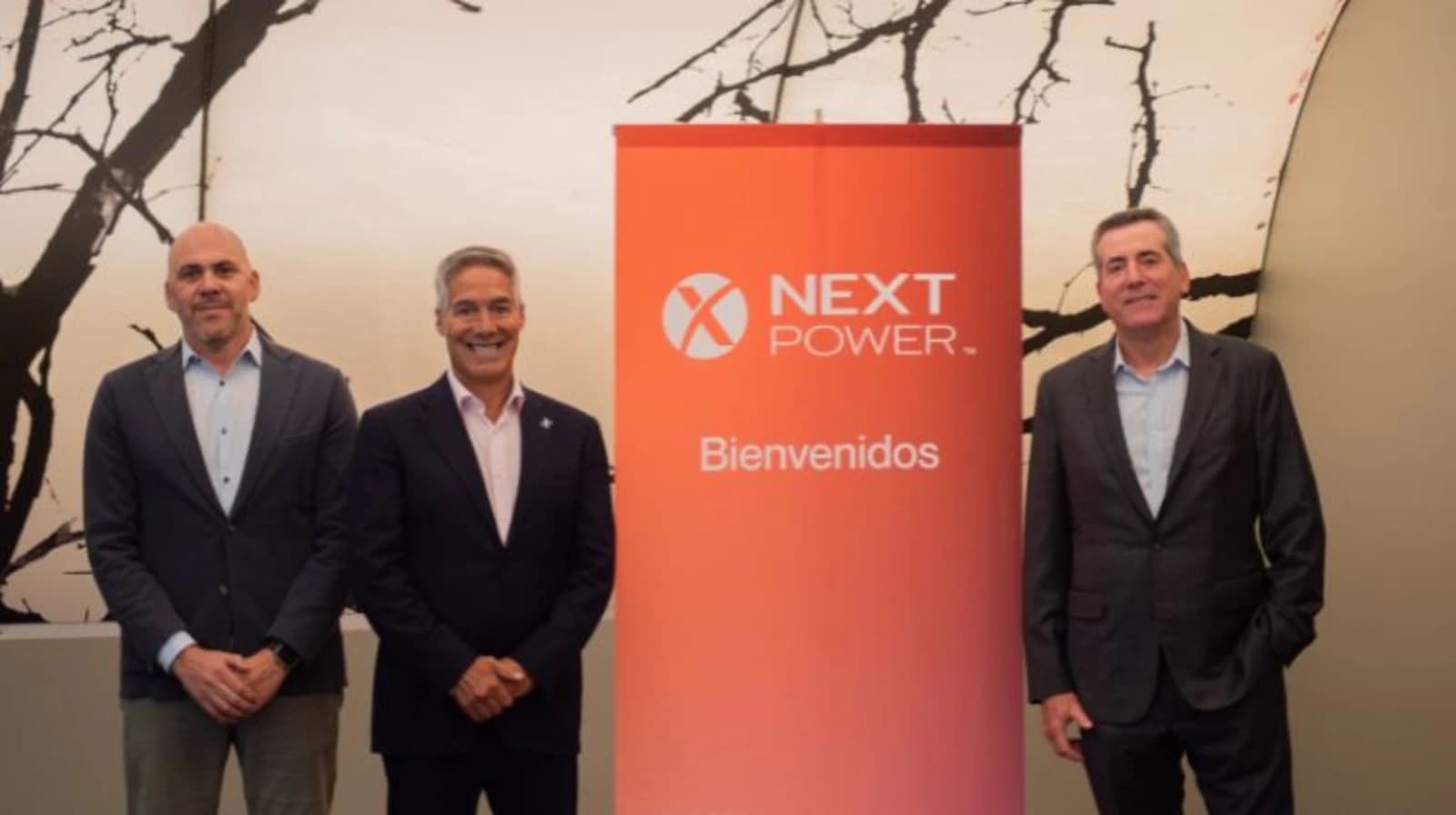
Nextpower has once again placed Mexico among its priority markets in Latin America, given the reactivation of large-scale solar and storage projects. The company sees a new phase for the utility-scale sector and aims to address it with an offering that expands its traditional tracker business into integrated solutions, incorporating trackers, batteries, and software.
Nextpower has a global supply capacity exceeding 1 GW per week, which also supplies opportunities in Chile, Argentina, Colombia, Brazil and Peru .
“ In recent months, Mexico has created a market of approximately 10 to 15 GW,” said Alejo López, Vice President of Latin America at Nextpower , during an exclusive interview with Energía Estratégica in Mexico City.
The executive's estimate comes at a time of increased activity for renewable energy investments in the country . Mexico has several public and private calls for bids for generation and storage projects underway, bringing several gigawatts of projects back into the picture.

Among the ongoing projects, the second private tender includes approximately 3.9 GW of wind and solar projects, plus a mixed scheme with the Federal Electricity Commission (CFE), representing a total of 6 GW . This is in addition to the progress being made in independent energy storage, with a plan that includes 935 MW of BESS systems .
“We are witnessing a kind of Big Bang in the solar market in Mexico; the growth is very encouraging. We are seeing large-scale projects, projects ranging from hundreds of megawatts to gigawatts, under conditions of growth and design with demanding soils, slopes, and morphologies,” explained the regional vice president.
Nextpower's renewed interest in Mexico also fits into a broader understanding of the growth in global electricity demand. Howard Wenger , the company's president, identifies electrification, data centers, and artificial intelligence among the factors beginning to drive the need for new generation capacity.
“ What is happening in the world is incredible; electrification, data centers, and artificial intelligence are creating more demand for electricity ,” said Howard Wenger, president of Nextpower .
According to the executive, this trend also opens up new opportunities for Latin America, a region where the company already has more than 25 GW of installed capacity. “ We believe it is a region with significant growth potential for the electricity sector ,” Wenger added.
The challenge isn't just about adding GW: it's also about meeting COD requirements
The anticipated growth in Mexico opens another front for developers, EPC contractors, and IPPs: meeting construction schedules and achieving Commercial Operation Dates (CODs) . This issue becomes particularly relevant given the new calls for tenders, whose projects anticipate entering commercial operation before 2030 .
“ When we talk about Utility Scale projects, the delivery schedule is very important. For EPC contractors, it's the most important thing to receive their materials on time so they can receive them and install them according to their schedule ,” Marco García, co-founder of Nextpower , told the media outlet.
The company says that behind this capability there is a global supply chain built over years around its tracker business, an infrastructure that it now intends to leverage for its expansion into integrated solutions and storage.
“ We have seen over the years that Nextpower has a great capacity for delivery and supply chain. We have 100 component factories globally ,” García emphasized.
The strategy involves transferring that industrial experience to other components of the plant, with the intention of reducing friction between suppliers, simplifying interfaces, and facilitating compliance with contractual milestones.
“We try to leverage what we’ve created for tracker systems so we can also deliver an integrated solution designed by Nextpower and then seamlessly delivered to the customer so they can meet their goals, their deadlines, achieve their Commercial Operating Dates, and continue to grow,” the co-founder added.
More than 25 GW in Latin America and projects exceeding one gigawatt: where are the next opportunities?
The new Mexican cycle finds Nextpower with a track record that the company puts at over 160 GW installed globally, of which more than 25 GW correspond to Latin America . This scale is complemented by a structure of over 2,000 employees and 1,500 patents, with a presence in 50 countries.
Continue reading
This expansion was accompanied by corporate growth that, according to its president, even exceeded internal forecasts . Wenger also highlights the company's investment grade as a key factor in supporting its relationships with clients and large-scale projects.
“ We have grown faster than planned. The company is in a very healthy financial position. We received investment-level status, which is unique in our industry and means our customers can trust our ability to deliver ,” said the president of Nextpower .
In Latin America, the company's journey began in Chile and later expanded to Mexico and Brazil. One of its first projects was Crucero, a 72 MW plant in Chile , whose contract was signed in 2013 and which was delivered in 2014.
According to the company, between 2015 and 2018 it reached more than 4 GW of projects in Mexico and captured around 50% of the tracker market in terms of current installed capacity.
“ We completed an 830 MW project with Enel Green Power in 2016-2017, which was the largest in the world at the time,” García recalled. In subsequent years, Brazil contributed the largest projects in the region, some exceeding 1 GW of capacity. “Our alignment with projects of hundreds of MW is a natural fit, given our extensive experience in design, optimization, and on-time delivery to our clients. ”
“In addition to serving large-scale projects, Nextpower also supports strategic clients with smaller-scale projects, from 5 to 20 MW ,” explained López.
With this structure, Nextpower is closely monitoring opportunities in other countries in the region . The company operates from its two main regional bases, located in Mexico City and São Paulo, Brazil, and observes different dynamics depending on the maturity level of each market.
Brazil's large-scale solar industry is experiencing a sharp slowdown. The high concentration of solar generation in two main regions, coupled with the indiscriminate integration of distributed solar generation, has led to drastic cuts in centralized solar generation and a significant reduction in investment in new projects.
The company is closely following the progress of the Brazilian storage auction and is analyzing the local content requirements.
In Chile , the outlook is linked to the combination of solar power generation, energy storage, and the electricity demand from large-scale mining. Argentina also appears to be tied to the growth in energy consumption by the mining sector and to new policies, while Colombia maintains opportunities, albeit with a slower and more complex development dynamic.
From trackers to a comprehensive platform
The regional strategy coincides with a transformation of Nextpower's business. The company seeks to evolve from its specialization in solar trackers to a platform that integrates hardware, software, storage, foundations, and other plant components.
For Wenger, the change responds to a specific problem in current projects: the multiplicity of suppliers and the interfaces that developers and EPC contractors then have to solve.
“ One company provides the investor, another the tracker, and yet another the integration and construction or the software. The contractor has to figure out how to put all these pieces together. It’s a bit of a Frankenstein ,” said the president of Nextpower.
The proposal thus aims to reduce interfaces during design, construction, commissioning and operation , integrating different components under a single solution.
“ Our clients are asking us for these types of comprehensive solutions and to generate these more efficient interfaces, which is an interface for the construction and assembly phase, the commissioning or the operation itself ,” López said.
The company had already moved in that direction with TrueCapture™ , an intelligent control system introduced in 2017 to optimize the performance of trackers. Now it aims to extend that approach to a platform that encompasses a larger portion of plant operations.
“ We are creating a complete software and hardware platform so that the solution can be installed faster, easier, at a lower cost, with more production and more energy, with higher quality components, a company, and a warranty ,” Wenger concluded.
