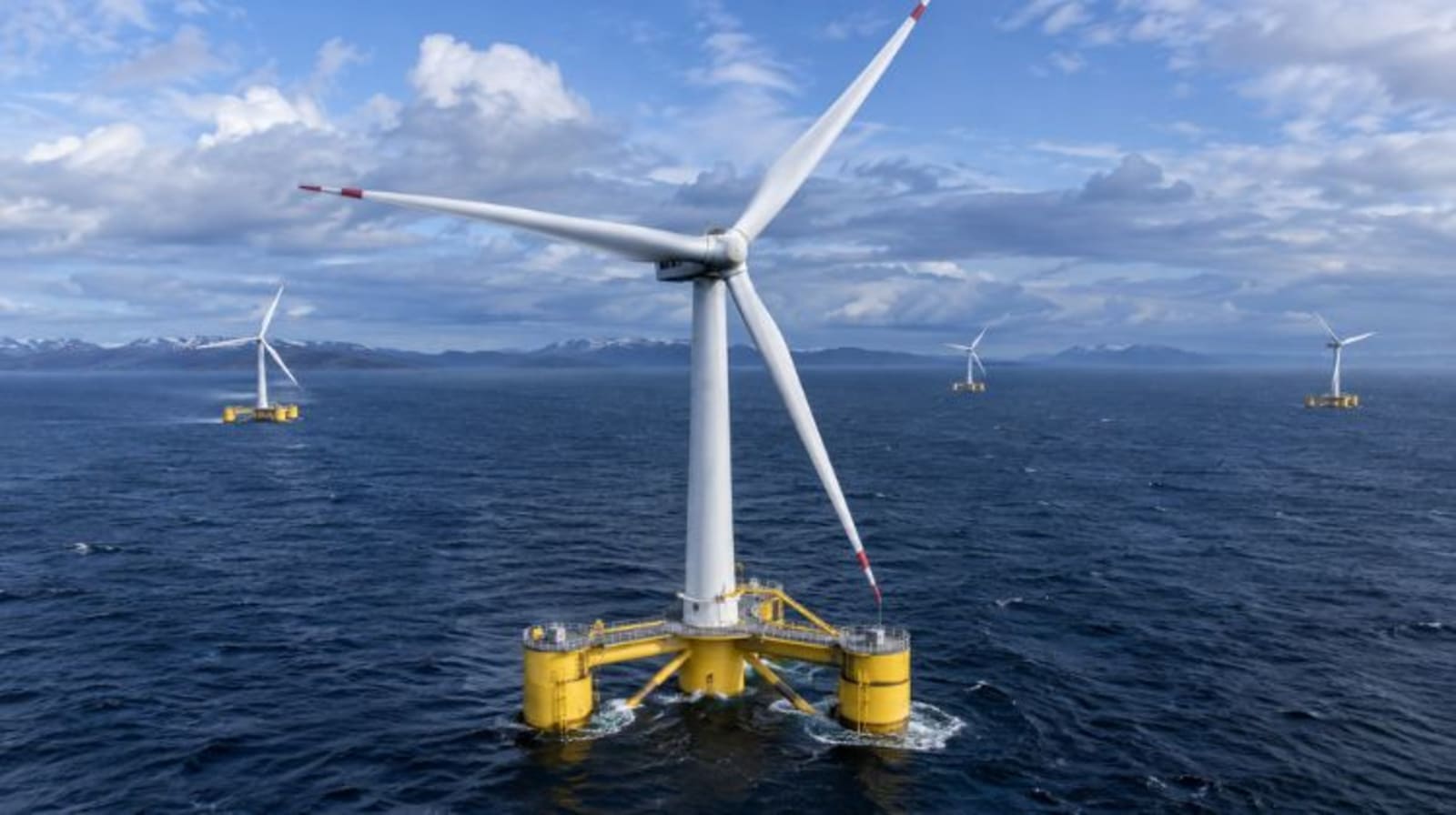
The Norwegian state agency Enova announced the allocation of 3.94 billion Norwegian kroner, equivalent to approximately 381 million euros, to finance two floating offshore wind energy projects that will incorporate high-power wind turbines and technologies aimed at reducing generation costs.
The decision, announced on October 30, 2026, envisions the installation of four turbines of 18.5 MW each, which will add up to 74 MW of installed capacity and a planned production of 300 GWh per year, enough to cover the equivalent electricity consumption of approximately 15,000 Norwegian homes.
The projects will be undertaken by Fortius Offshore Wind and Fram Wind Solutions, which received allocations of 2 billion and 1.94 billion Norwegian kroner, respectively. The funds will be contingent upon the successful completion of the initiatives.
Both companies plan to build two wind turbines each over the next five years at the METCentre demonstration center, located off the island of Karmøy in Rogaland County, on the southwestern coast of Norway.

The initiative aims to adapt floating wind turbine solutions for larger-scale installations by validating foundations, mooring systems, and construction and operating procedures. These are key components for advancing towards larger-scale commercial installations.
In that context, Enova's CEO, Evy Glørstad, argues that a sufficient reduction in the costs of this technology would represent a step towards the accelerated expansion of large-scale renewable generation.
According to the directive in the official statement, both Norwegian industry and the transport sector need to increase the availability of renewable electricity to reduce their emissions.
18.5 MW wind turbines and new floating platforms
One of the central technical aspects of the program is the use of 18.5 MW turbines, a power that allows the evaluation of the behavior of large floating foundations and the structural requirements associated with state-of-the-art equipment.
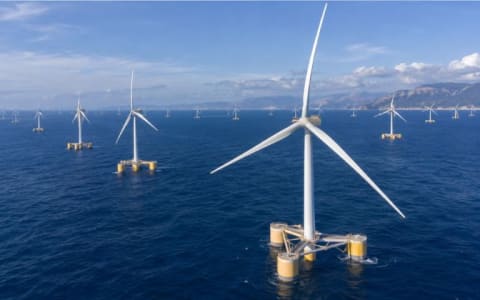
Unlike conventional offshore wind farms, where structures are fixed directly to the ocean floor, floating systems use platforms held in place by mooring lines and underwater anchors.
This configuration allows the use of wind resources in deep waters, where traditional foundations encounter greater technical and economic difficulties.
In the Norwegian case, the development of these solutions is related to the characteristics of its continental shelf, the availability of wind resources, and the experience accumulated by its maritime and offshore industry.
Continue reading
The projects selected by Enova will allow testing of different structural configurations, installation procedures and operational strategies, with the aim of identifying alternatives that reduce capital and maintenance costs.
To allocate the funds, the agency assessed the expected electricity production in relation to the support requested, the possibility of replicating the technologies, their carbon footprint, the impact on biodiversity, and the potential for cost reduction.
The program also seeks to generate technical information applicable to future commercial parks, especially in an industry that still faces challenges associated with financing, industrialization, and standardization of components.
In this regard, Oskar Gärdeman, head of offshore wind energy at Enova, points out that the capabilities of the local maritime industry and the availability of extensive ocean surfaces with strong winds are advantages for the country's technological development.
The new capacity would have an estimated annual production of 300 million kilowatt-hours, equivalent to an approximate capacity factor of 46%, calculated from the power and generation values projected by Enova.
This relationship constitutes a reference for expected performance, although the actual production will depend on weather conditions, the availability of wind turbines and the performance of the facilities during their operation.
The new developments are part of a broader national strategy. The Norwegian government remains committed to awarding areas for the development of 30 GW of offshore wind energy by 2040, using both fixed and floating structures.
One of the most relevant precedents is Hywind Tampen, the 88 MW floating wind farm that came into operation in 2023, developed by Equinor to supply electricity to North Sea oil and gas facilities.
The project allowed us to accumulate experience in offshore operations, floating foundations, and the use of wind resources in deep waters.
Meanwhile, Norway is moving forward with Utsira Nord, an area designated for commercial floating wind turbine projects off Rogaland, where development rights have been granted to two consortia.
One of them is made up of Equinor and Vårgrønn, who received rights over an area intended for a project of up to 500 MW, subject to environmental studies, authorizations, support mechanisms and investment.


 By Emilia Lardizabal

 By Energía Estratégica
 By Ailén Pedrotti