


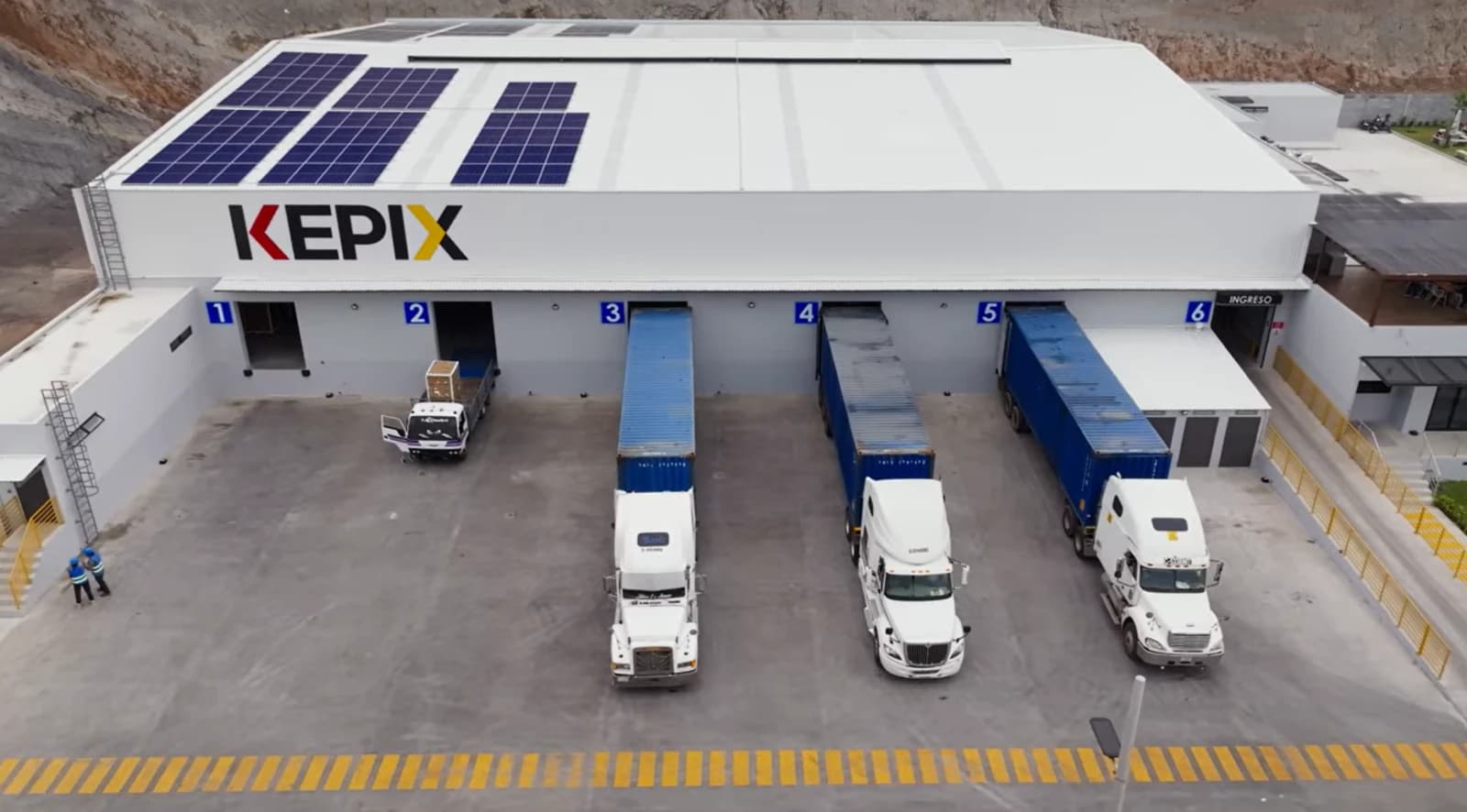
In Guatemala , energy storage opens doors to solar generation within the commercial and industrial segment, especially in operations seeking greater energy autonomy or requiring off-grid operating schemes.
This is the case of Kepix , a company dedicated to the import, export and distribution of food products between Guatemala and international markets, which implemented an isolated microgrid in Palencia to supply its new operations.
Why is this? The company began operations in 2026 on a site without access to the electrical distribution network and, given this scenario, used diesel generation as an alternative energy supply.
"The lack of access to the electricity grid became an opportunity to innovate," highlighted Guillermo Posadas of Kepix .

In other words, the answer was to implement a microgrid capable of integrating photovoltaic generation, storage, and the existing generator within the same architecture , with the aim of increasing the energy autonomy of the facilities.
Integrated generation, storage, and backup
For the development and implementation of the project, Conecta Energy worked alongside Zona Solar, Huawei's local distributor, and Operadores Nacionales (ON), Huawei Digital Power's VAP Partner for Central America and the Caribbean . Together, the teams contributed experience in industrial projects, local technical support, and equipment inventory in the region to enable the solution's commissioning.
The installation integrates 100 kWp and 215 kWh of storage, using a Huawei LUNA2000-215-S11 battery and two Huawei SUN2000-50KTL-M3 inverters.
During daylight hours, photovoltaic energy directly powers the facilities and charges the battery. When solar generation decreases or demand exceeds available energy, the storage system activates to cover part of that consumption.
In this way, the battery allows the use of solar production to be shifted to other times of the day and increases the autonomy of an installation that operates under an isolated scheme.
The diesel generator remains integrated into the microgrid, but assumes a different function: it ceases to be the main source of supply and operates as a backup when photovoltaic generation and stored energy are insufficient.
How does a microgrid work? And what benefits does it offer?
The Huawei LUNA2000-215-S11 incorporates liquid cooling , designed to maintain a uniform temperature between the cells and reduce the risk of overheating. In turn, intelligent charging management helps to preserve battery lifespan.
“It allows for proper equalization of the internal charge of the cells and has integrated safety systems, including liquid cooling to maintain stable operating conditions,” explained Pedro Ramírez of Conecta Energy .
The configuration is completed with two Huawei SUN2000-50KTL-M3 inverters , while intelligent monitoring via FusionSolar allows monitoring the operation of the installation.
The Kepix facility is designed to produce around 13,500 kWh per month, using solar generation as the main energy source and storage to manage its availability throughout the operating cycle.
As a result, it allows for a reduction of approximately 90% in operational costs compared to a scheme based solely on diesel.
However, the key change is also linked to energy independence. The company is moving from using a generator set as its primary energy source to a smart microgrid that allows it to operate off-grid with greater autonomy .
For Kepix, the lack of distribution infrastructure is no longer a barrier to its operations. The company has its own system that integrates photovoltaic production, storage, and backup power into a single energy solution .