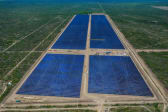
Honduras is seeking to expand its transmission infrastructure to take advantage of renewable energy plants whose production is currently limited by available transmission capacity. During the FES Government & Investment conference , Energy Minister Eduardo Oviedo identified one of the system's main bottlenecks and confirmed that funds from the Development Bank of Latin America and the Caribbean (CAF) are available to address this issue.
“We have a 50 MW solar park and 105 MW of hydroelectric generation, totaling 155 MW, trapped on a line that can only deliver 70 MW,” the official stated.
The 85 MW difference between installed capacity and the evacuation limit prevents the simultaneous dispatch of the full capacity of both technologies. However, this imbalance does not necessarily imply a permanent loss of energy, as effective production depends on the operating conditions and availability of each facility.
Oviedo indicated that the multilateral organization has already made resources available to build a line that will overcome this limitation, although he did not identify the project or specify its budget.

The strain on the electrical infrastructure coincides with increased consumption. According to data from the National Electric Energy Company (ENEE), peak demand in Honduras grew by 7% in 2025, reaching 2,086.7 MW, while the Energy Regulatory Commission (CREE) projects it will reach 2,969 MW in 2035. This scenario reinforces the need to expand transmission capacity and address the constraints that prevent the full utilization of existing generation capacity.
It is also worth remembering that on October 1, CAF approved a sovereign loan of up to USD 177 million for the construction of the El Sitio–Zamorano II–Terrero Blanco line, which will be executed by ENEE.
The project includes approximately 150 kilometers of 230 kV power lines, the construction of the Zamorano II and Danlí II substations, as well as expansions and upgrades to existing facilities.
According to official information, it will directly benefit some 865,000 inhabitants of Francisco Morazán, El Paraíso and Olancho, by strengthening the supply in the central-eastern corridor of the country.
One of its objectives is to facilitate greater utilization of the Patuca III hydroelectric plant. According to information disseminated by Honduran media, the new infrastructure would allow its evacuation capacity to be increased from approximately 77 MW to 104 MW.
Regional interconnection and voltage problems
The Energy Minister also pointed out the need to strengthen connections with Central America , particularly in southern Honduras, where a significant portion of the solar park is concentrated.
Continue reading
He explained that the country is located about six kilometers from a line linked to El Salvador, whose connection could help improve voltage levels and expand the possibilities for electricity exchange.
He also identified as a priority the replacement of infrastructure towards Nicaragua that is approximately five decades old.
“They kept building line after line to continue connecting cities and citizens, but the voltage has been dropping,” he said.
These shortcomings also affect operational stability in the face of contingencies. Oviedo recalled that, during the Central American blackout in September, Honduras experienced a widespread outage that highlighted the insufficient spinning reserve and the difficulties in managing concentrated photovoltaic generation in certain areas.
In that regard, he noted that the growth of the solar park was not accompanied by a corresponding increase in resources allocated to frequency control. The El Cajón hydroelectric plant continues to play a fundamental role in that function, despite the expansion of the system since 1985.
The challenge of leveraging existing generation
The minister's diagnosis gains relevance as Honduras prepares two tenders totaling 1600 MW, divided into a first call for 600 MW planned for 2027 and another of 1000 MW towards the beginning of 2028.
Both processes will be open to different technologies and are part of the market reorganization driven by the new Energy Justice Law.
In parallel, the Transmission Network Expansion Plan 2026-2035 is one of the instruments intended to guide investments and meet the needs of electricity transport during the next decade.
The execution of these works will be crucial so that the growth in supply can translate into greater availability of electricity, reduce dependence on high-cost diesel generation, and improve the reliability of supply.


 By Emilia Lardizabal


 By Energía Estratégica
 By Florencia Guglielmetti