


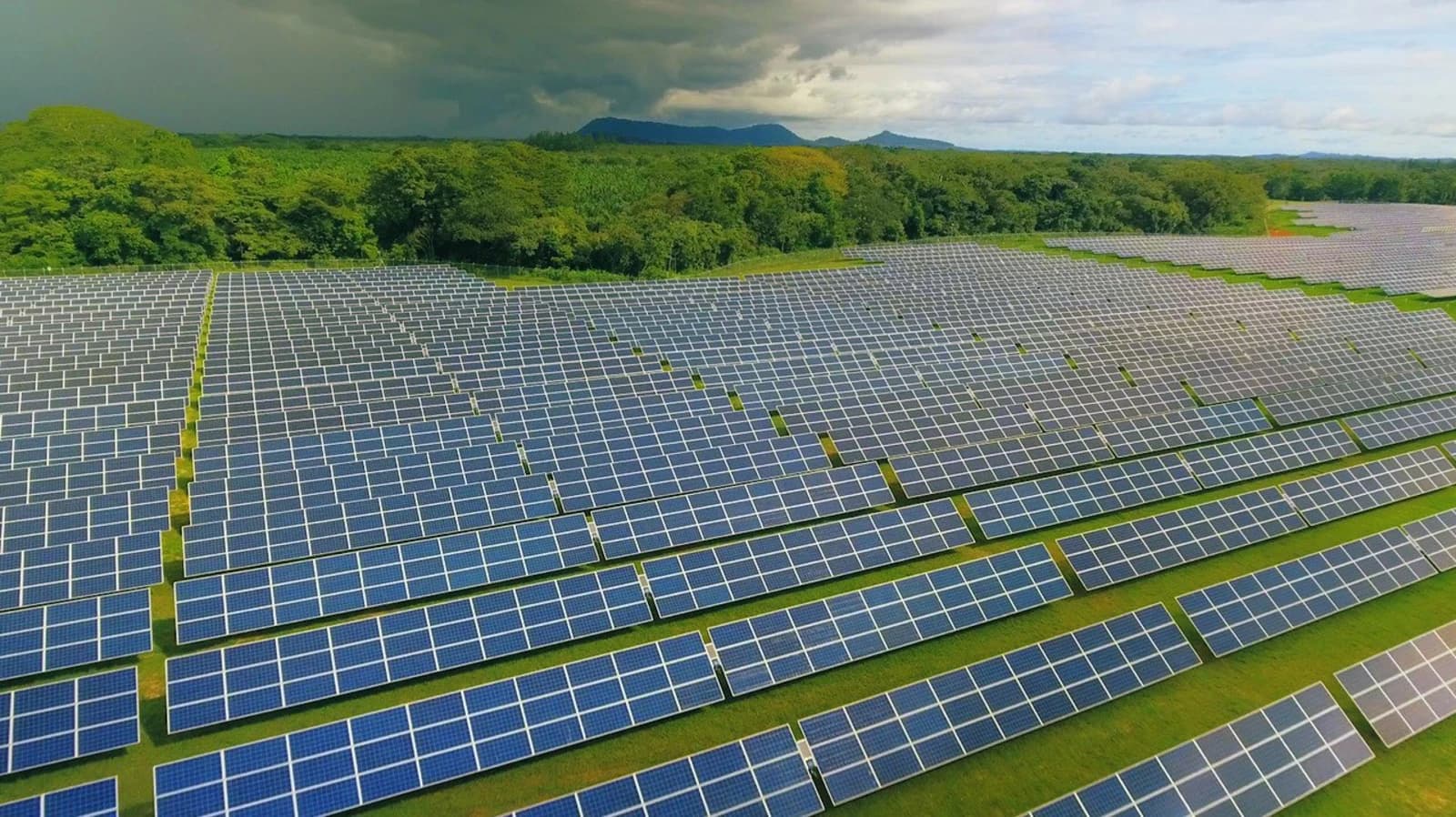
Panama 's solar pipeline accelerated strongly during August. A survey by Energía Estratégica of resolutions from the National Authority of Public Services ( ASEP ) identified 12 new provisional photovoltaic licenses , representing approximately 109.8 MWac and 140.15 MWdc .
The jump stands out compared to the rest of 2026. Between January and August, the regulator granted 27 new provisional solar licenses, meaning that 44.4% of the authorizations were concentrated in the last month alone . The calculation considers the effective date of the resolutions and excludes extensions, modifications, cancellations, and final licenses.
One of the largest blocks belongs to Americana de Energía , which added five new projects: Americana IV, VI, VII, VIII, and IX. Each will have 9.9 MWac and 12 MWdc , so together they add 49.5 MWac to the pipeline.
The five projects will be located in Pueblos Unidos, Aguadulce, Coclé province , and will use a common system to transmit their power. According to ASEP resolutions, the energy will be transported via a 34.5 kV line to a step-up substation owned by Americana I, and from there it will be stepped up to 230 kV to connect with the ETESA system at the Llano Sánchez substation.

The development of Americana had begun before August. Americana I was already part of the regulatory portfolio, while Americana II and III , also 9.9 MWac and located in Pueblos Unidos, obtained their provisional licenses in June. In the five authorizations granted during August, ASEP expressly details the evacuation scheme using infrastructure linked to Americana I.
Another significant block comprises Olivos Brillantes I, II, and III , each with 9.9 MWac , totaling 29.7 MWac in Los Olivos, Los Santos province. These projects belong to Los Olivos Solar Uno (1), SA, Los Olivos Solar Dos (2), SA, and Los Olivos Solar Tres (3), SA
In this case, ASEP's official documentation also identifies IMJUSA, SA as a shareholder of the three owning companies and as a financial backer to contribute part of the capital required for their development.
This portfolio is complemented by Poseidon Solar and Zeus Solar , both developed by Solar Farm Services, SA, with 9.86 MWac and 12.59 MWdc each in La Mesa, Veraguas province.
Emperor Solar I , from Las Uvas Solar, SA, also received authorization, with a capacity of 9.9 MWac and 12.5 MWdc in Nuevo Emperador, Arraiján district, Panama Oeste.
The list is completed by Victoria Solar , from Suero Solar, SA, which with 0.975 MWac and 1.17 MWdc is the smallest scale project among the new licenses of the month.
Continue reading
August more than doubled the previous high
The monthly comparison reflects the magnitude of the jump. January registered no new provisional photovoltaic licenses; February recorded five ; March one; April none; May one ; June three ; July five ; and August reached 12 .
Until then, February and July had marked the annual peak, with five new authorizations each. June added another three, so the acceleration began to gain momentum towards the middle of the year.
In fact, 20 of the 27 licenses granted between January and August were concentrated in June, July and August , equivalent to 74.1% of the total for the period.
In February, Eco Energy Generation, the three STGVG Solar projects, and Pétalo de Nance I were added. March added Cruces Solar, and May incorporated Gavilán Solar.
June added Santa Monica Solar along with Americana II and III, while July added Molino Solar, Cascada Solar, Dasami Solar, Pétalo de Churubé I and Dasa Solar 6.
The 9.9 MW figure is repeated in the new pipeline
The August portfolio also presents a marked pattern: nine of the 12 new projects have exactly 9.9 MWac , while Poseidon and Zeus are just below, with 9.86 MWac.
This data is particularly striking because Law 45 of 2004 establishes differentiated treatment for renewable energy plants based on their capacity . Projects up to 10 MW are exempt from certain transmission and distribution charges when they make direct sales or participate in the spot market.
For power plants of more than 10 MW and up to 20 MW, the benefit reaches the first 10 MW during the first ten years of operation.
However, Panamanian regulations also include a specific safeguard against potential artificial divisions of projects. The Transmission Regulations stipulate that ASEP must ensure that generation facilities are not divided to avoid paying for transmission services.
Therefore, although the concentration immediately below 10 MW is an evident feature of the authorizations granted during August, the available official documentation does not allow attributing that design to a fractionation motivated by regulatory benefits .
These authorizations are also provisional licenses valid for 12 months . They do not, in themselves, authorize the construction, installation, operation, or exploitation of the power plants, but rather allow developers to complete studies, procedures, and other requirements necessary to subsequently move towards a definitive license.