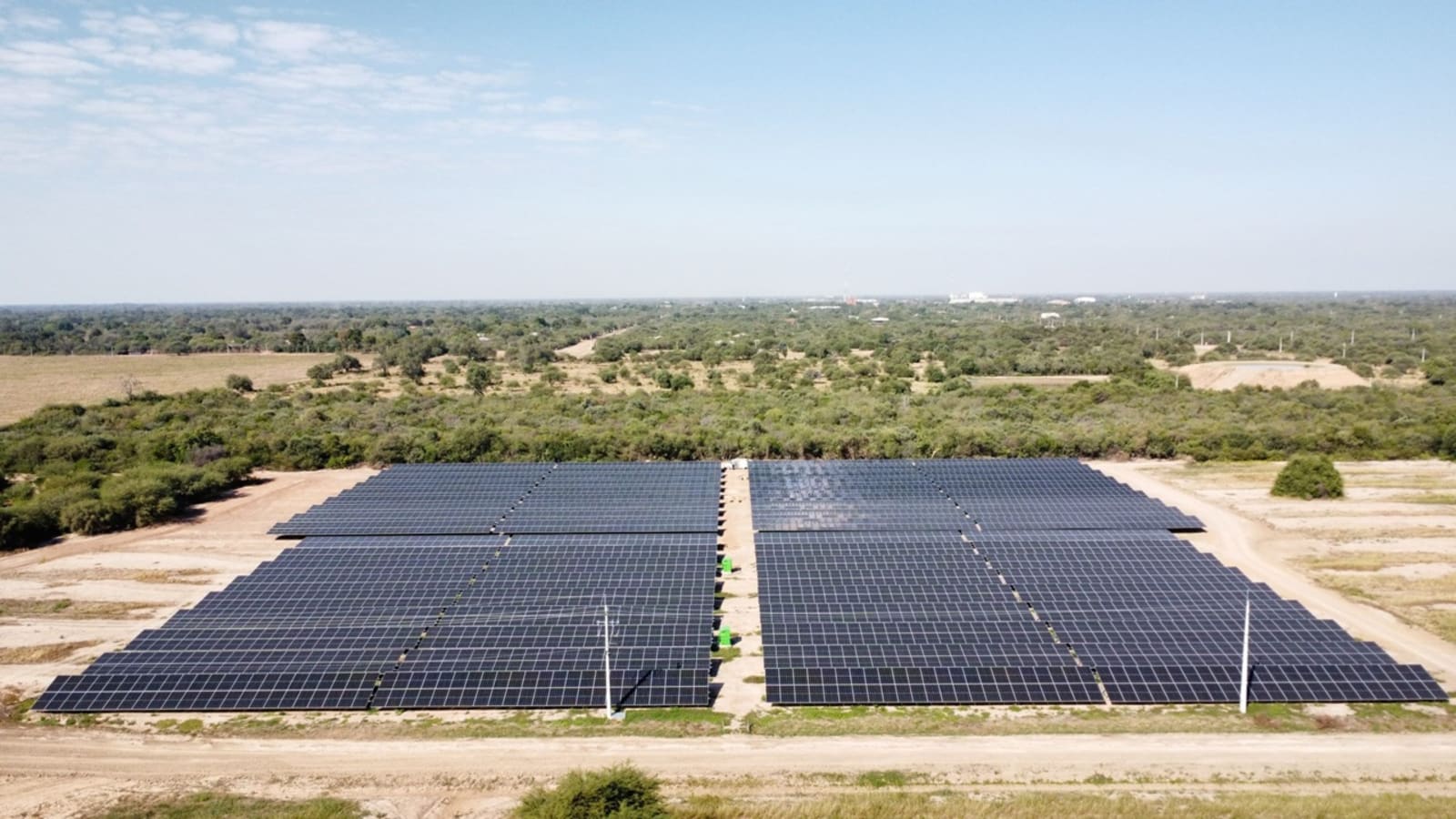
Paraguay took a new step to regulate the entry of private renewable generation into the electricity system before launching its first solar tender of 140 MW , planned for the Loma Plata project in the Central Chaco.
The Ministry of Public Works and Communications (MOPC) , through the Vice Ministry of Mines and Energy , issued three regulations intended to regulate central aspects of non-hydroelectric power generation under Law No. 7599/2025 .
The provisions cover everything from the technical conditions for connection to the National Interconnected System (SIN) to the contracts that developers must enter into with the National Electricity Administration (ANDE) and the rules for transferring contracts, credits and equity stakes.
The package seeks to establish a more predictable framework for self-generators, co-generators and exporters, at a time when Paraguay is trying to expand its energy mix beyond hydroelectric generation and attract private investment towards new renewable technologies.

Resolution No. 1698/2026 establishes the mandatory technical guidelines for connecting renewable energy projects to the SIN at voltages equal to or greater than 66 kV .
Among other aspects, it incorporates requirements related to power quality, operating protocols, technical qualification tests and standardized measurement systems, regardless of the technology used.
For its part, Resolution No. 1699/2026 defines the contractual conditions that will govern the relationship between ANDE and the various market players.
The agreements must include the connection point, coordination with the dispatch center, basic commercial conditions, and mechanisms for resolving any disputes.
The third regulation, Resolution No. 1700/2026 , regulates the transfer of contracts, credits derived from the injection of surpluses and shares in Special Purpose Companies.
In these cases, the assignee must demonstrate technical and financial solvency, while the original assignee will be obliged to maintain at least 51% of the share capital with voting rights .
Loma Plata will be the first test of the new scheme
The approval of these rules coincides with the preparation of the tender documents for Paraguay's first photovoltaic tender , corresponding to the Loma Plata project.
The call for bids includes 140 MW of solar power and anticipates that ANDE will acquire all of the electricity generated through a contract of up to 30 years .
The plan includes 18 months of construction, 27 years of operation and maintenance, and six months of decommissioning .
The initiative will be the first concrete experience of contracting private generation under this model and, at the same time, will serve as a reference for future calls.
The Government's objective is to move towards a mechanism of successive tenders backed by long-term contracts and guarantees capable of facilitating the financing of new capacity.
During a panel at the Future Energy Summit Government and Investment , the scheme was informally referred to as “RenovPar” , although that name is not official.
The reference used by Paraguay is the Argentine experience.
Between 2016 and 2023, the various bidding processes that included programs such as RenovAr, RenMDI and other procedures awarded 5929 MW through 283 PPA contracts .
For Paraguay, the Loma Plata tender will thus have greater relevance than the incorporation of the first 140 MW of solar power.
The process will test the new regulatory framework, the response of private investors, and the country's ability to structure bankable contracts in a market where growing demand requires a sustained addition of new power.
With the new connection, contracting and transfer rules now defined, the next step will be to translate that regulatory framework into the concrete field of investments and see if the first call for bids manages to open a new stage for private renewable generation in Paraguay.

 By Emilia Lardizabal


 By Energía Estratégica
 By Ailén Pedrotti

 By Florencia Guglielmetti