


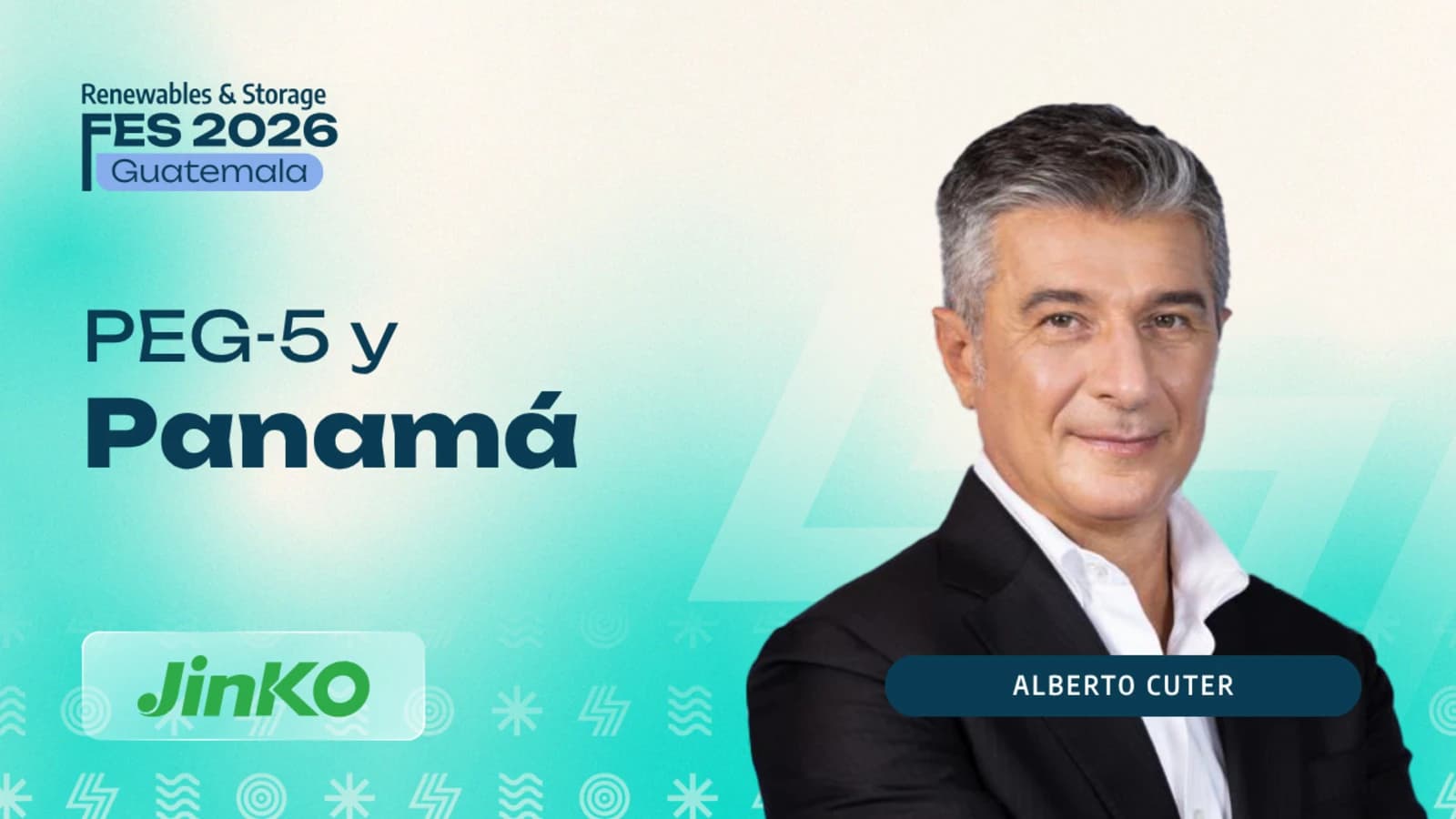
Analyzing the Central American scenario, Alberto Cuter , executive vice president of Jinko Solar , stated that " Guatemala could become one of the first major countries in the region to achieve a 100% renewable electricity matrix."
The executive outlined this context exclusively during FES Guatemala 2026 , following the awarding of the "historic" PEG-5 tender, which awarded 1258 MW in 57 renewable projects , mobilized the local energy sector and reinforced the country's attractiveness for new solar developments.
According to Cuter, the sector's enthusiasm was evident during the meetings held in the country. "There is a lot of interest from investors and EPC companies: they are building towards the goal. There is a very positive feeling," he stated.
The company's vision is supported by the strong interest the call for bids generated among developers, investors, and contractors: "This new tender is a step closer to the goal that the energy minister has set for 2050 regarding the percentage of renewable energy," he stated.

Watch the full interview: https://www.youtube.com/watch?v=6KUcm1qibwE
The reading becomes even more relevant when compared to other Central American markets. While Guatemala gains scale with its energy storage auction and prepares for new initiatives, Panama awarded renewable energy contracts at an average price of USD 23.86/MWh , a benchmark that boosted competitiveness throughout the region.
Given this scenario, Cuter explained that customers want to know what technology they will have when the construction of the plants begins.
"The prices offered in the bidding process were extremely aggressive. Clients come to us and warn us directly: 'If you don't give me this price, the projects won't go through.' As always, our role will be to negotiate to find a middle ground," he stated.
At FES Guatemala, the National Electric Energy Commission (CNEE) announced that the country is working on PEG-6 , a new tender for approximately 300 MW of firm energy , and PET-4 , aimed at expanding transmission infrastructure. These regulatory signals reinforce the perception that the Guatemalan market still has room to grow and attract investment.
Beyond the advancement of solar energy, Cuter believes the next challenge will be the proper management of renewable energy generation. From his perspective, photovoltaic growth must be accompanied by BESS systems to avoid problems already observed in more mature markets.
The discussion, he explained, is no longer solely about building more solar parks. The focus is shifting towards managing the energy produced and the ability to shift it to the hours of greatest value for the system.
“Now we don’t just have to focus on building photovoltaic plants, but above all on managing the energy we produce,” he said.
Italy is cited as one of the examples Jinko Solar uses to illustrate this phenomenon. With a high share of renewable energy, the market is increasingly experiencing periods of extremely low prices during peak solar production hours.
Continue reading
The situation is similar to what is happening in Spain , where negative values are already a reality in certain electricity markets. According to Cuter, this precedent should serve as a reference for Latin American countries seeking to accelerate the integration of solar energy.
“Even if you have a PPA or go to the merchant market, you're not going to sell the energy on the weekend,” he warned.
The consequence is clear: producing more energy no longer guarantees higher income if the grid cannot absorb it or if prices fall to levels that affect the profitability of projects.
For this reason, the company has been strengthening its storage business. According to Cuter, Jinko Solar has already completed a 1.6 GW project in Chile and is pursuing new opportunities in various Latin American markets.
“Jinko understood this a long time ago, which is why we already have an entire battery business line. There’s no way to have a renewable energy matrix, especially solar, without a form of storage,” he stated.
Pressure on prices and technological bet
This scenario coincides with a period of transformation for the global photovoltaic industry. After almost two years of oversupply and intense competition among manufacturers, prices are beginning to adjust gradually.
Cuter mentioned the termination of the tax credit for Chinese industry, arguing that "it made no sense for the government to give money for exports and then have manufacturers fight over price in the end."
In his view, the supply chain is still facing a complex situation. “Prices have to rise because for almost two years now, companies across the entire value chain, from the module to the silicon, have been losing a lot of money,” he warned.
The executive explained that the recovery of margins involves not only module manufacturers, but also producers of silicon, wafers, and cells.
“We are not yet at break-even, but I think the prices of the modules need to be adjusted a little more so that we can get there,” he said.
In parallel, Jinko Solar seeks to differentiate itself through technological innovation. The company aims to lead in both supply volume and product performance.
“Our goal is to be number one, not only in terms of module delivery or volume, but also in technology,” he stated.
The focus is primarily on N-Type TOPCon technology, a segment where the company claims to maintain a leading position.
He explained that the launch of the 3.0 platform about a year ago allowed them to accelerate their commercial participation: “We launched the 3.0 product almost a year ago, and with that we now have almost 25% of everything sold.”