Peru seeks to advance the regulation of small and medium-scale distributed generation , within the framework of an agenda to modernize the electricity sector that includes new provisions on complementary services, contracts and integration of renewable technologies.
During EXPO PECIER FISE 2026 , the Director General of Electricity of the Ministry of Energy and Mines (MINEM), Roberto Tamayo , confirmed that the agency is working on these provisions and expects to have a package of regulatory proposals during 2027 to update the regulatory framework and facilitate new investments.
It is worth remembering that in 2024, MINEM published a proposed regulation for distributed generation connected to the systems used by public electricity service users.
However, distributed generation still faces questions related to power limits, connection conditions, and surplus remuneration mechanisms , aspects considered relevant to the economic viability of new installations.

This discussion also coincides with the opportunities identified by photovoltaic technology providers, who are seeking to expand their presence in the Peruvian market through new modules and solutions adapted to different generation scales.
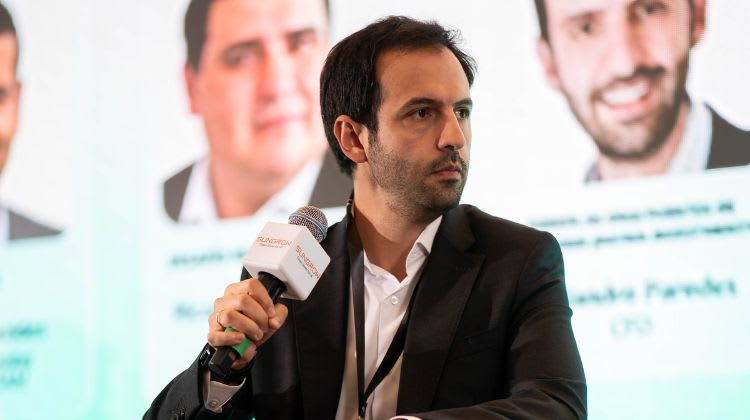
In an exclusive interview during Future Energy Summit (FES) Peru 2026, Tomás Harfuch, Sales Manager for the Andes region at Jinko Solar , analyzed the country's business prospects and the new technological trends that are beginning to influence investment decisions.
“I am in charge of the DG segment, distributed generation, which are projects of up to approximately 20 MW,” explained the executive, who clarifies that his activity includes both the distribution area and the development of projects.
The reference corresponds to the commercial segment served by Harfuch and not to the limit established in the Peruvian draft regulation.
From their perspective, Peru presents commercial opportunities linked to new photovoltaic initiatives and contracting processes , although there are still projects in different stages of development.
New technologies and opportunities for distributed generation projects
In parallel with the evolution of the Peruvian market, Jinko Solar seeks to strengthen its high-efficiency module offering through the commercialization of Tiger Neo 3.0 and the development of a new premium line specifically geared towards distributed generation.
Currently, the manufacturer works with two generations of Tiger Neo: version 2.0, which constitutes its regular line, and version 3.0, presented as its most recent technological evolution.
According to Harfuch, the new TOPCon generation incorporates modifications to the cell architecture that allow for improvements in various performance parameters.
“It has certain improvements at the cell level,” the executive explained, before detailing that these innovations translate into “better bifaciality, less degradation, a better temperature coefficient, and slightly higher power outputs.”
The executive also highlights the performance of Tiger Neo 3.0 under low irradiance conditions, a feature he considers especially interesting for certain areas of Peru such as Lima.
Regarding its portfolio, Harfuch confirms that Tiger Neo 3.0 currently occupies a prominent place in the company's sales.
“Today it is the line that we are selling the most commercially,” he assured.
In addition, the manufacturer is preparing a new premium module for distributed generation , although it has not yet announced its technical specifications or the expected launch date.
“We will soon launch another premium line for the DG segment,” says Harfuch, who avoids offering more details about the development.
These characteristics are relevant for developers who evaluate the energy performance of their facilities and consider variables in addition to the initial cost of the equipment.
Continue reading
In that sense, the executive identified a change in the economic criteria used to select photovoltaic technology , especially in projects where the expected production during the useful life is decisive.
“Today I believe the discussion is shifting from getting the cheapest dollar per watt to the total value of the system,” the executive stated during his participation in the FES panel.
The regional photovoltaic market is undergoing changes in business conditions and manufacturers are beginning to prioritize new technological attributes.
During the panel, the executive also referred to the international industry's price outlook and anticipated: "From my perspective, I perceive that we are heading towards a slightly more stable market, with less volatility and more rational prices."
This view coincides with a period of adjustments in the international photovoltaic supply chain, where tax changes in China are generating expectations of changes in module export prices.
Storage and trade prospects towards 2027
Another component of the group's technological strategy is battery energy storage (BESS) , a solution that is gaining relevance in the planning of new renewable projects.
Harfuch explains that Jinko Solar and Jinko ESS are two separate businesses. While the former specializes in photovoltaic modules, the latter focuses on high-capacity energy storage systems.
“I believe that BESS is becoming very important today,” the executive argues, considering that these solutions should begin to be part of the technological evaluations of new developments.
This perspective is related to the regulatory work of MINEM on complementary services, intended to respond to the operational needs of the electrical system in the face of a greater participation of variable sources.
However, the provisions on distributed generation and complementary services fall under different regulatory areas , so their development must be evaluated according to the conditions established in each regulation.
In commercial terms, Jinko Solar has a regional structure that includes teams in Brazil, Colombia, Central America, Ecuador, and Argentina.
Chile serves as the main Latin American operational base , where the areas of logistics, human resources, technical support and commercial support are concentrated.
In Peru, Harfuch leads commercial management together with Juan Pablo Montenegro , recently added to the team and based in Ecuador, who also provides support to operations in Bolivia.
Looking ahead to 2027, the company maintains internal targets linked to sales volumes and margins, although the executive avoids revealing specific figures.
“We are doing a good job, we are currently meeting the objectives we have set for ourselves,” Harfuch said.
The manufacturer is also working with local engineering, procurement and construction (EPC) companies , with which it seeks to finalize new deals in the coming months.
“We have been working with several local EPC contractors who trust us, and well, we support them,” the executive highlighted.
In this context, the evolution of Peruvian distributed generation will depend both on regulatory definitions and on the technical and economic conditions that allow new investments to materialize .
While the Ministry of Energy and Mines (MINEM) continues its review of the regulatory framework, manufacturers like Jinko Solar are advancing in the development of solutions aimed at addressing a potential market expansion, with more efficient modules, new products and storage technologies.
Harfuch's expectation for next year is that the business opportunities currently being evaluated by the company will translate into new confirmed projects, accompanying the photovoltaic growth of Peru and the rest of Latin America.

 By Matías Medinilla

 By Emilia Lardizabal
 By Energía Estratégica