Peru has 14,462 MW of photovoltaic solar projects with approved pre-operational studies, of which 2,490 MW are expected to be connected to the electrical grid during 2027. However, the portfolio's progress faces questions about the realization of investments and compliance with established timelines.
In this scenario, equipment suppliers are already receiving requests for quotes with deliveries scheduled for next year, although uncertainty remains regarding their actual delivery. This was stated by David Lobo, Head of Sales Latam at Axial , in an exclusive interview during the Future Energy Summit (FES) Peru 2026 .
“We are currently bidding on various projects and solutions, such as 1V and 2V trackers, and some fixed structures, but the vast majority are located in the south and have delivery dates by 2027,” Lobos stated. However, he cautioned that doubts remain about meeting those deadlines.

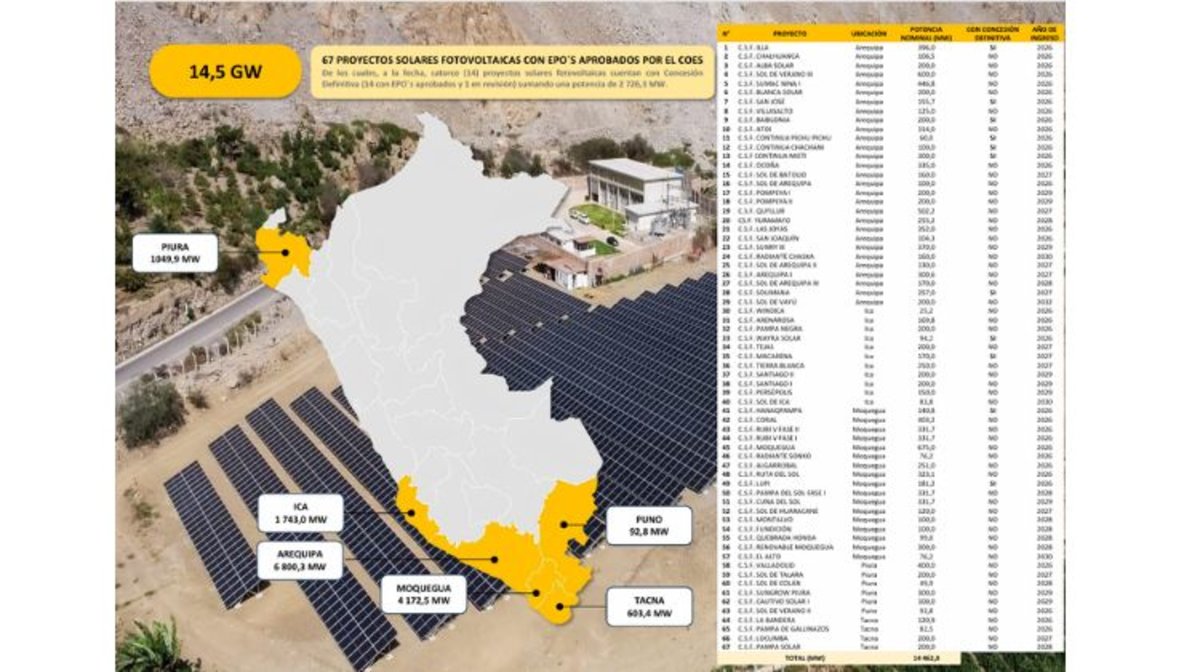
According to data from the Supervisory Body for Investment in Energy and Mining (Osinergmin) , prepared with information from the Economic Operation Committee of the National Interconnected System (COES) , there are 67 photovoltaic projects with approved pre-operational studies , totaling approximately 14.5 GW of projected installed power.
However, only 14 initiatives have received final approval , which shows that a significant part of the portfolio still needs to complete administrative stages before moving towards implementation.
This difference is also reflected in the installed capacity projections. While the total solar projects studied represent a potential of 14,462 MW, the photovoltaic initiatives with final concessions included in the compendium amount to around 2.7 GW.
Solar projects aiming to be operational by 2027
The Osinergmin report allows us to assess the expansion expectations of the Peruvian photovoltaic market over the next few years.
According to official information, solar projects with approved pre-operational studies contemplate 7,795 MW of income during 2026, another 2,490 MW for 2027 and 1,606 MW for 2028 .
These figures correspond to the years of entry planned in the studies and do not imply that all facilities will actually be connected in those periods.
Among the initiatives that register 2027 as the year of entry is Quyllur, of 502.2 MW, in Arequipa , which is among the photovoltaic developments of greater capacity planned for that period.
Also included are Arequipa I, with 300.6 MW; Solimana, with 257 MW; Tierra Blanca, with 250 MW; Tejas, with 200 MW; Locumba, with 200 MW; and Macarena, with 170 MW .
The projects are at different stages of administrative progress. Specifically, Solimana and Macarena have received final concessions , while other initiatives mentioned still lack this permit in the September document.
The portfolio also shows a marked territorial concentration. According to Osinergmin, Arequipa has 6,800.3 MW of photovoltaic projects with approved studies , followed by Moquegua, with 4,172.5 MW, and Ica, with 1,743 MW.
This distribution aligns with Axial's perception of the origin of commercial requests. Lobos identifies that most of the projects consulted are located in southern Peru.
Regarding the dimensions, the executive points out that the quotes include small installations and developments of up to 400 MW, although the most frequent segment corresponds to power plants between 100 and 200 MW .
“We are talking about projects averaging 200 MW, but there are some between 300 and 400 MW. However, we quote everything from smaller projects,” said the Axial executive.
However, commercial expectations contrast with the effective implementation scenario envisioned by the regulatory body.
Osinergmin estimates that, considering only non-conventional renewable projects with approved studies and definitive concession, installed solar power could reach 2,324 MW in 2027 , compared to the 1,296 MW projected for 2026.
This represents a potential addition of 1,028 MW of solar power between the two years under that scenario, below the 2,490 MW that are listed with planned additions for 2027 in the general portfolio of approved studies.
The difference reflects the impact that the processing status has on growth prospects and the need to distinguish between the dates declared by developers and the capacity backed by definitive concessions.
Continue reading
Meanwhile , Peru is looking to move forward with a new electricity bidding system , based on the draft regulations for Law No. 32249, prepared by the Ministry of Energy and Mines (MINEM). The initiative has already received a favorable evaluation from the Multisectoral Commission for Regulatory Quality, and the government plans to publish the regulations before the end of 2026 , which could open up new contracting opportunities for renewable energy generation projects.
Financial requirements also condition new developments
Beyond the procedures and connection deadlines, suppliers are identifying changes in the criteria that customers use to select equipment intended for photovoltaic power plants.
“Customers today are starting to place a lot of value on risk,” says Lobos, who warns that developers are paying closer attention to the technical and supply conditions of the components.
“They are very concerned about traceability, where the materials come from,” adds the Head of Sales Latam of Axial, describing the inquiries the company receives in the regional market.
According to him, this evolution would be linked to greater information requirements from financial entities, particularly regarding certifications, product validation and operational guarantees.
Consequently, procurement processes incorporate checks on the origin of materials, manufacturing conditions, and the ability of components to maintain their performance for periods of 20, 25, or 30 years .
“It’s not just about price,” the executive maintains, although he clarifies that cost continues to be the main factor in the selection of suppliers.
As an example of these new demands, Lobos reveals that Axial is negotiating a project in which the client requested access to the complete process of supplier validation, certifications and traceability of materials , from their origin to final delivery.
The company also offers developers the opportunity to visit its production facilities to verify manufacturing and quality control procedures.
In this regard, Axial has production facilities in China, Turkey, Europe and Brazil , although the competitiveness of the supply from its Brazilian plant varies depending on the destination market.
The executive specifies that Uruguay and certain projects in Chile are among the destinations where Brazilian production offers competitive commercial conditions.
The company also explains that customers are asking whether evaluation procedures change depending on the country of origin of the components. In response to these inquiries, the company maintains that it applies the same internal product validation and quality control standards , regardless of the supplier's origin.
These requirements are especially relevant for projects seeking to move forward with their construction by 2027, in a scenario where risk assessment, technical guarantees and traceability of supplies are becoming more important in contracting decisions.
Which countries are leading Axial's priorities?
Beyond the opportunities presented by Peru, Axial identifies Mexico, Central America, and Colombia among its main strategic markets in Latin America , although it warns that trade priorities may change depending on the evolution of each country.
In that context, the executive ranks Mexico first due to its size and growth potential . Other markets of interest include Honduras, where a tender is being prepared, and Guatemala, with its P4 and P5 procurement processes . The Dominican Republic is also among the countries the company is closely monitoring.
“Central America is a region where we believe we can be very competitive. The issue of hurricanes is a major concern for customers; people there highly value quality, and Axial can contribute that value,” the company representative stated.
For its part, Colombia could rank third among regional priorities if Central America is considered as a single bloc. The executive links the prospects for the Colombian market to the evolution of its political landscape.
Meanwhile, Peru and Chile continue to be key markets for the company. Regarding Chile, Lobos notes that it maintains a steady volume of opportunities, while Argentina is beginning to generate greater interest due to its development potential .
“We are looking at Argentina with considerable affection,” he said.
Finally, Brazil represents a market where Axial already has a consolidated presence, with more than 1 GW supplied, according to the company , in addition to local production capacity and a prominent share in the distributed generation segment.
 By Emilia Lardizabal
 By Florencia Guglielmetti

 By Energía Estratégica

 By Ailén Pedrotti