Peru could add approximately 700 MW of energy storage capacity by 2030, an expansion that is already attracting interest from companies such as ENGIE, Enel, Kallpa, Acciona, Sungrow, and Zelestra, among other players seeking to position themselves in one of the fastest-growing segments of the electricity sector. This projection comes from a survey conducted by Alexander Zanabria , Legal Manager of Hábitat Verde Abogados.
The Peruvian storage market already has operational projects in generation, mining, self-consumption, rural electrification and hybrid systems, while a new portfolio of utility scale developments and complementary services is beginning to take shape towards the end of the decade.
The approval of Law 32249 and the progress of the future Regulation of Complementary Services appear as some of the main catalysts of this growth.
"After the publication of this regulation and the rules for the complementary services market, a door to growth and projection opens up," said Alexander Zanabria, Legal Manager of Hábitat Verde Abogados, in dialogue with Energía Estratégica .

Who are already taking a position in the Peruvian BESS market?
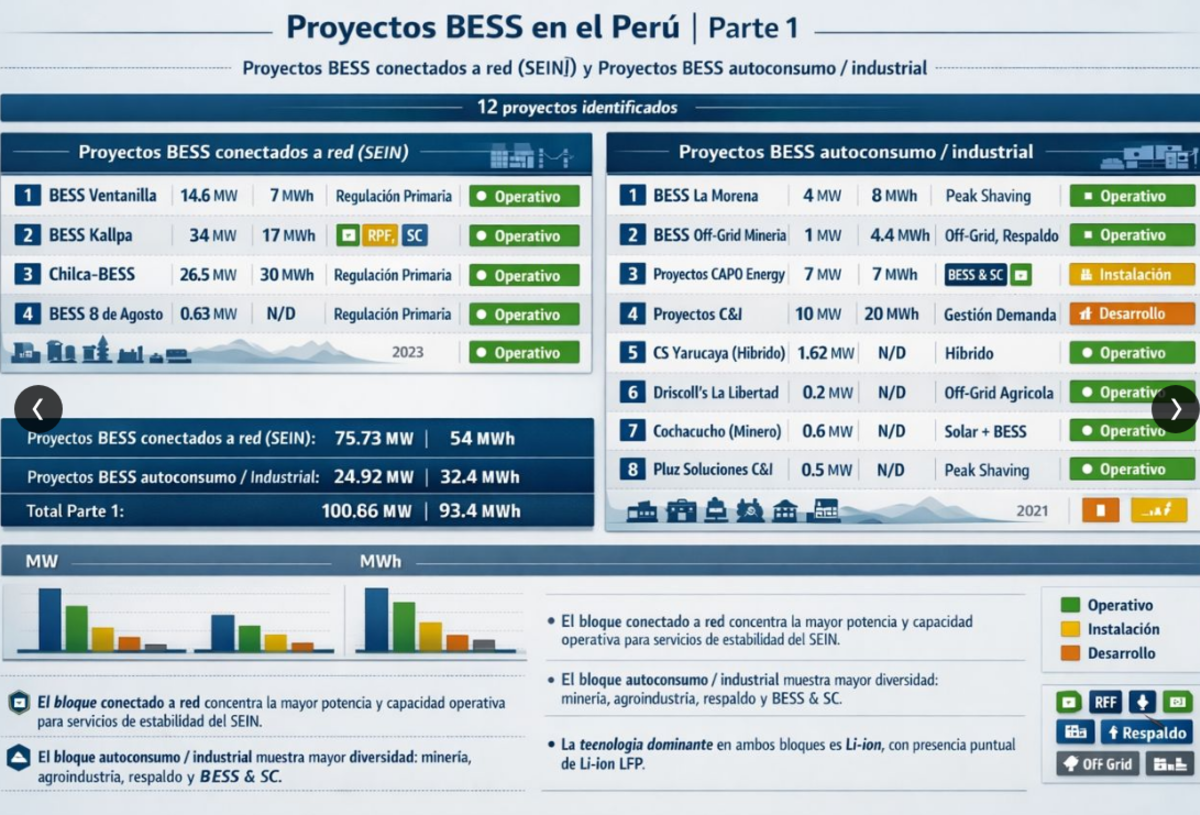
The grid-connected segment currently concentrates the country's most visible projects. Notable among them are Enel Generación Perú , which operates the BESS Ventanilla project with 14.6 MW of power and 7 MWh of capacity for primary frequency regulation , and Kallpa Generación , which adds 34 MW and 17 MWh in Chilca, primarily focused on primary frequency regulation and ancillary services.
Added to this is ENGIE Energía Perú , which is developing one of the largest currently operating facilities in the country through Chilca BESS , with 26.5 MW and 30 MWh , while Polaris , through Generación Andina, is adding another 0.63 MW through the BESS 8 de Agosto project in Huánuco for primary frequency regulation.
Together, these initiatives represent 75.73 MW of operating power , constituting the main Peruvian experience in storage connected to the national electricity system.
However, this expansion is no longer limited to large power generators. In the commercial and industrial segment, eight initiatives and companies are emerging, such as CAPO Energy , which is developing a portfolio of nearly 7 MW and 7 MWh through peak shaving solutions and BESS-as-a-Service schemes. Also noteworthy are operational projects developed by Novum Solar and Huaura Power , responsible for the CS Yarucaya hybrid power plant, with 1.62 MW , considered one of the first integrations of renewable generation and storage within the SEIN (National Interconnected System).
For its part, Pluz Soluciones has an operational 0.5 MW industrial application for demand management and energy cost reduction, while companies like M4S are developing hybrid systems for agricultural and mining operations in different regions of the country for 0.8 MW.
Mining activity is also beginning to position itself as one of the main drivers for energy storage. Compañía Minera Poderosa stands out in this sector, operating the BESS La Morena project, with 4 MW of power and 8 MWh of capacity , geared towards peak shaving and estimated energy savings of US$1.2 million annually . This is in addition to an investment of approximately US$5.5 million made in La Libertad.
Likewise, projects such as BESS Off-Grid Mining , driven by Bluesun , incorporate 1 MW of power and 4.4 MWh for isolated supply and permanent energy backup in remote operations, reflecting the growing interest of the extractive sector in hybrid solutions that reduce operating costs and dependence on fossil fuels.
From the National Interconnected System (SEIN) to the Amazon: storage is gaining ground in the most isolated areas of the country
The development of energy storage in Peru is not limited to projects connected to the National Interconnected System (SEIN). Currently, the country has at least 17 operational or developing PV+BESS initiatives in isolated systems, primarily in the Amazon and high Andean communities, where batteries complement solar power generation and reduce dependence on fossil fuels.
Key players include Electro Oriente , with six projects in Loreto; Electro Ucayali , with four initiatives in towns such as Atalaya, Purús, and Masisea; and Electro Puno , which operates hybrid systems on the islands of Amantaní and Taquile. Acciona is also involved, participating in rural electrification solutions using photovoltaic systems with energy storage in Amazonas.
Within this segment, the project planned for Iquitos , promoted by Electro Oriente, stands out, which includes 130 MWp of solar generation and 160 MWh of storage , becoming the largest BESS project identified to date in Peru and one of the most relevant isolated electrification developments in Latin America.
The next wave of investment is already taking shape
According to the survey conducted by Alexander Zanabria, Legal Manager of Hábitat Verde Abogados , the market could reach close to 700 MW by 2030, driven by new technical requirements for renewable energies, the expansion of mining, the development of complementary services and the growing need for flexibility of the electrical system.
Continue reading
Within this scenario, Sungrow emerges, associated with projects exceeding 500 MW and 1,000 MWh of renewable energy storage and integration. Another relevant player is Zelestra , a developer backed by EQT, which has a regional portfolio exceeding 7 GW and is exploring opportunities to incorporate storage into solar projects and hybridization schemes within Peru.
The expected growth also reflects future technical requirements for renewable energy. These include hybrid projects associated with new renewable energy plants, a segment that could incorporate between 200 MW and 500 MW of storage capacity in the coming years.
In parallel, the future ancillary services market could add between 100 MW and 300 MW more, while mining projects a potential demand of between 50 MW and 150 MW for peak shaving, backup and renewable integration applications in remote operations.
As Zanabria explained, energy storage already played a partial role in the electrical system through primary frequency regulation, fast response, and hybrid applications. However, it lacked comprehensive recognition that would allow it to be treated as a multi-service asset with clear rules for access, dispatch, metering, settlement, and remuneration.
The new regulations do not create the utility of storage from scratch, but they do reorganize the electricity market to admit complementary service providers under criteria of technological neutrality and with a more robust legal basis.
"A BESS system is a multi-purpose system. When it is under load it behaves as a demand, when it is unloaded it is a source of generation, and when it provides frequency regulation it is a technical support," Zanabria explained.
"The difficult part is precisely making that traceability of remuneration for their services. The measurement, the settlement, the valuation, the performance, the penalties, the losses, the tolls and above all the coexistence of multiple services," he added.
The current regulatory framework identifies four major areas of work: full legal recognition of storage, technical operation under the PR-20 procedure, the economic regime applicable to measurement and settlement, and the ability to structure stackable revenues that reduce financial risks and facilitate access to project finance.
Although the draft regulation for complementary services makes progress in aspects such as competitive opening, technological neutrality and cost allocation by causality, questions still remain related to the economic treatment of load energy, the delimitation between technical obligations and remunerable services, commercial measurement and the applicable framework for hybrid or behind-the-meter systems.
The discussion takes on particular relevance considering the magnitude of renewable energy growth projected for the coming years. "We have mapped out nearly 20,000 MW of solar and wind projects by 2030," the specialist emphasized.
Unlike markets such as Chile or Spain, Peru is not yet facing massive problems of grid spills or congestion resulting from renewable energy penetration. However, the regulator has already begun to introduce measures aimed at strengthening the flexibility and stability of the electricity system.
Among them, the progressive lifting of the exemption for renewable power plants larger than 10 MW to participate in primary frequency regulation stands out, as well as the future obligation to contribute synthetic inertia from 2028 onwards through the guidelines established in PR-20 .
"Only the economic signal is missing," concluded Alexander Zanabria.