


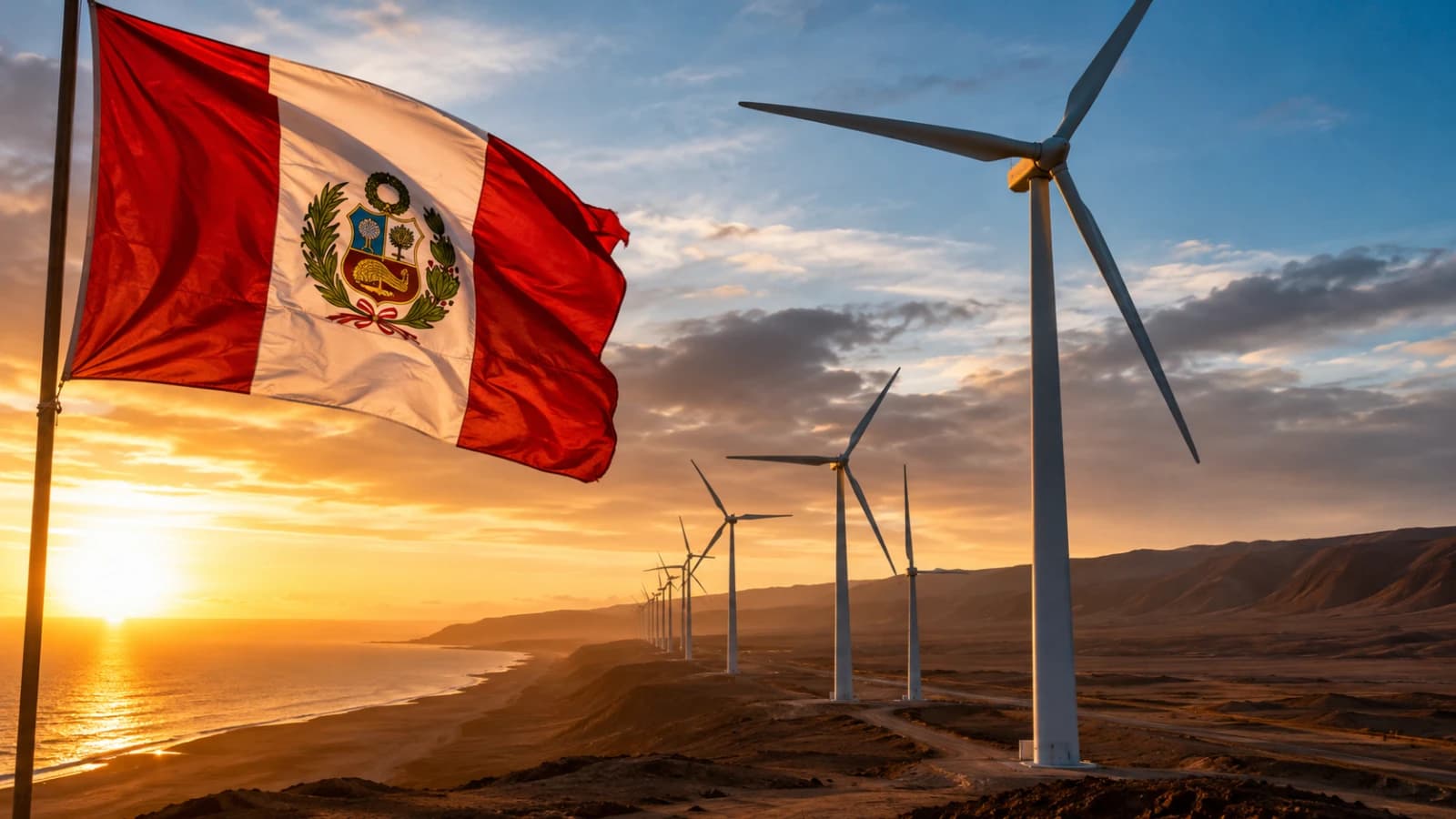
Peru has 42 wind power projects in its portfolio with Pre-Operational Studies (EPO ) approved by the Economic Operation Committee of the System (COES), totaling 8242.8 MW, according to a survey conducted by Energía Estratégica based on data from the Supervisory Body for Investment in Energy and Mining (OSINERGMIN).
However, the size of the pipeline contrasts with its level of progress: 37 initiatives, equivalent to 88% of the total, are still without a final generation concession .
Of the 42 wind farms, only Caravelí, Guarango, Emma, Muyu, and Mórrope appear to have been granted this permit. Collectively, the respective concessions represent 988.2 MW , according to the power outputs recognized in the ministerial resolutions reviewed by Osinergmin.
Among the companies that have already crossed that milestone are Orygen Perú , with Mórrope and Muyu; Ibereólica Caravelí , with Caravelí; SL Energy , with Guarango; and GR Bayóvar , responsible for Emma.

The gap becomes more significant when considering the timeline declared by the developers. Of the total, 17 parks, representing 3,485.9 MW, are scheduled to begin Commercial Operation (COO) during 2026, while another eight projects, equivalent to 1,451.4 MW, are targeting 2027.
In other words, approximately 4.94 GW, almost 60% of the entire surveyed wind power portfolio, have a declared commissioning date between 2026 and 2027. This data positions that two-year period as the main bottleneck for verifying how much of the pipeline actually manages to become new installed capacity.
However, these dates correspond to the POCs listed in the approved EPOs. Therefore, they do not in themselves constitute confirmation that the parks are under construction or will actually be completed within those timeframes.
Osinergmin itself specifies that the EPO conformity certificate issued by COES is one of the requirements for obtaining the final concession from the Ministry of Energy and Mines (MINEM). Furthermore, its validity is subject to conditions related to the connection, technical modifications, and environmental certifications.
The current picture shows precisely that difference between technically studied capacity to connect to the National Interconnected Electrical System (SEIN) and projects that have already obtained the final concession.

Who's trying to get in first?
The first major wave appears concentrated in 2026. And it's not just about numerous developments: several of the largest wind farms planned in Peru have a declared POC for this year .
The largest project is Violeta Eólica , promoted by Empresa de Generación Eléctrica Violeta. The initiative envisions 452 MW in Piura , with a 220 kV connection to Piura Oeste. The report lists it with a projected completion date of 2026, but it has not yet received final approval.
Also included is the Rosa project, by Empresa de Generación Eléctrica Rosa, with 404 MW in Lambayeque . Its connection is projected at the La Niña 500 kV substation and is scheduled to begin in 2026.
Another major player in this first wave is La Libertad , by Oryx Power Perú, which envisions 403.2 MW in the region of the same name and plans to connect to the 500 kV Trujillo Nueva-La Niña line. This project also does not appear in the final concession list.
Added to that list are Céfiro, from Céfiro Energía, with 300 MW in Ica; Ika Sur, from Orygen Perú , with 241.8 MW; Samaca, from Empresa de Generación Eléctrica Las Salinas, with 168 MW; Zapote, from Zapote SAC, with 163.8 MW; Windica, from Fener Perú, with 150 MW; and Ika Norte and Salinar Sur, both from Orygen Perú and with 148.8 MW each.
They also have POC 2026 Cherrepe, from Kallpa Generación, with 142.5 MW; Norteño, also from Kallpa Generación, with 131.1 MW; Salinar Norte, from Orygen Perú, with 117.8 MW; Naira II, from GR Aparic, with 20 MW; and Naira I, from GR Huambos, with 19.8 MW.
In that first batch, Mórrope, by Orygen Perú, and Caravelí, by Ibereólica Caravelí, stand out as the only projects with a 2026 Project of Completion (POC) that also have definitive concessions. Caravelí is already under construction and is more than 73% complete; with 218 MW , it is expected to contribute more than 600 GWh annually to the system.
Mórrope is being developed by Orygen Perú in Lambayeque. Its Environmental Impact Assessment (EPO) considers 256 MW and a 220 kV connection in West Lambayeque, while the resolution granting the definitive concession stipulates a capacity of 224 MW.
Continue reading
Caravelí, for its part, corresponds to Ibereólica Caravelí and will be located in Arequipa. The EPO (Engineering Project Plan) contemplates 218.3 MW and a connection to Poroma 220 kV, although the final concession was granted for 219.6 MW.
A second wave of eight projects totaling 1,451.4 MW is expected by 2027, although none currently have a final concession.
The survey also reflects a change in scale. Ten projects account for approximately 3.55 GW , more than 43% of all wind power with approved EPOs. The list includes initiatives ranging from 300 to 400 MW.
The scale is particularly relevant when compared to the currently operational wind farm. As of June 2026, Peru had 1,021.3 MW of installed wind power capacity distributed across 11 plants . Consequently, the 8.24 GW remaining in the pipeline is equivalent to more than eight times the total wind power capacity currently operating in the country .
Kallpa and Orygen concentrate more than 2.2 GW
The portfolio also allows you to identify which companies have the greatest exposure to the next expansion of the segment.
Kallpa Generación leads the ranking by power output with five projects totaling 1173 MW . Its portfolio consists of Norteño, with 131.1 MW; Cherrepe, with 142.5 MW; Pacífico, with 306 MW; Tanaka, with 403 MW; and Pacífico II, with 190.4 MW.
In second place is Orygen Perú, with seven projects totaling 1117.4 MW . The developer's projects include Mórrope, Ika Sur, Ika Norte, Salinar Sur, Salinar Norte, Taita, and Muyu.
Between the two companies they account for 2290.4 MW, around 28% of the entire Peruvian wind pipeline analyzed .
Further behind is the company behind Violeta Eólica , with its 452 MW, while Acciona Energía Perú has accumulated 421.6 MW through Buena Esperanza, of 306 MW, and Wari, of 115.6 MW.
Rosa Electric Generation Company adds 404 MW , Oryx Power Peru concentrates the 403.2 MW of La Libertad and Engie Energía Peru brings together 374.4 MW through Urani, Sariri and Twister.
Lambayeque and Ica become the major centers
Lambayeque has 2,711.2 MW distributed among 13 projects, while Ica has 2,565.7 MW in 15 initiatives. Together they represent 5,276.9 MW, practically 64% of the entire wind power pipeline identified by Osinergmin.
Piura ranks third with 1295.4 MW , followed by Arequipa with 1111.9 MW . La Libertad registers 403.2 MW, Áncash 115.6 MW, and Cajamarca 39.8 MW.
The map published by Osinergmin thus shows a strong concentration of future expansion on the coast , particularly in the Lambayeque and Ica corridors.
And the concentration isn't just geographical. Several projects are seeking to connect to the same transmission nodes .
The new 220 kV intermediate substation serves as the connection point for Samaca, Céfiro, Windica, Ika Sur, Ika Norte, Salinar Sur, Salinar Norte, and Guarango. Together, these eight wind farms represent more than 1,600 MW .
In Lambayeque, the Felam 220 kV substation is listed for Zapote, Flug, Pacífico, Frontera and Shatki, while other developments are aimed at La Niña, Reque, Guadalupe and Lambayeque Oeste.
The reiteration of these points does not allow us to affirm that there is guaranteed network availability for all projects , but it does reveal which are the nodes around which an important portion of the new pipeline is being structured.
Regulatory debate, project development, and transmission needs will be part of the agenda at the upcomingFuture Energy Summit (FES) Peru , to be held on September 28. The event will bring together authorities, generators, developers, investors, and suppliers involved in the country's energy transition.
The survey shows that Peru has the scale, wind resources, and a broad business portfolio to accelerate this technology. The next challenge will be to transform the 8.2 GW of technically assessed potential into projects with concessions, financing, connection infrastructure, and effective conditions for integration into the National Interconnected Electric System (SEIN).