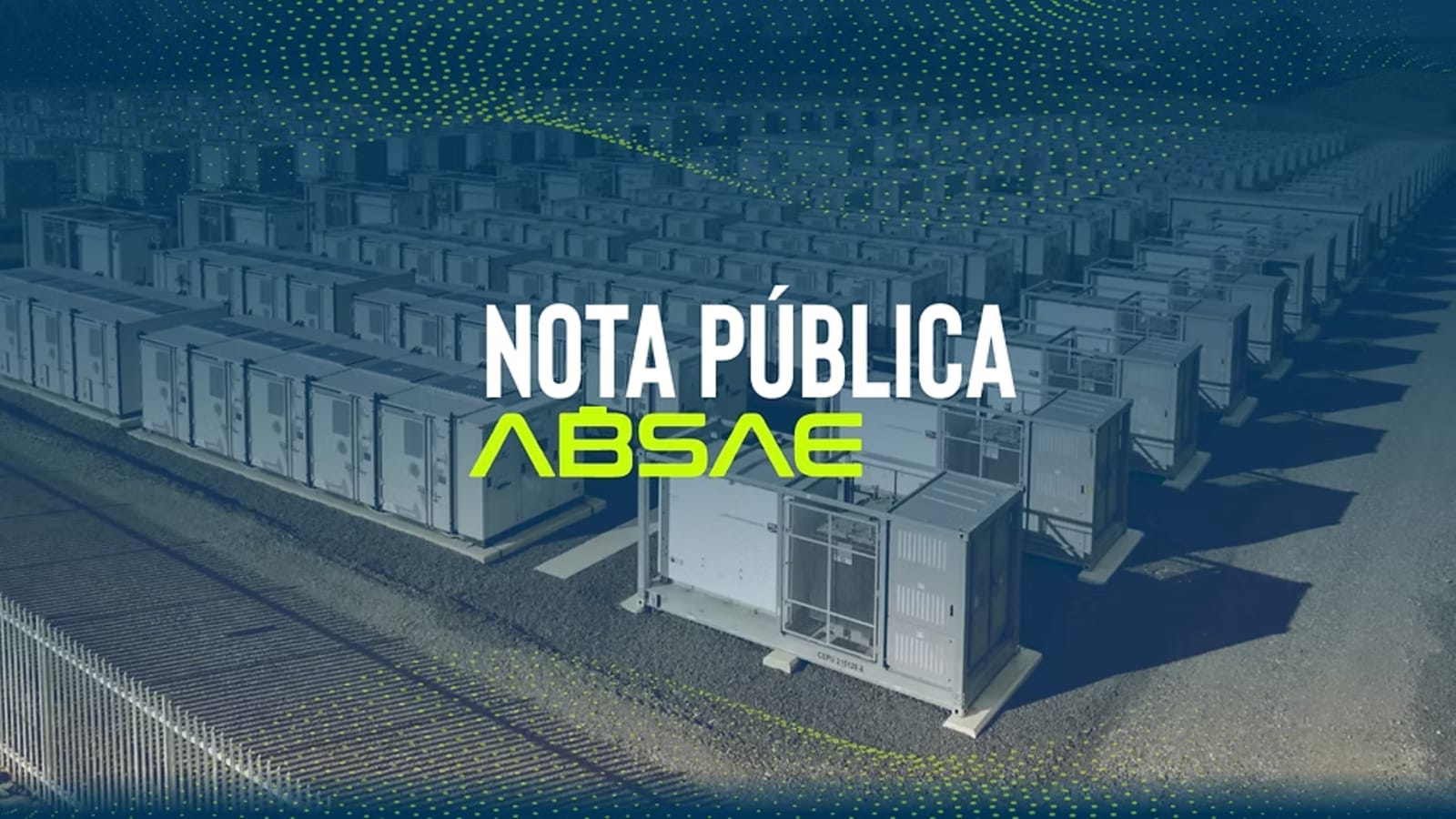
The Brazilian Association of Energy Storage Solutions (ABSAE) came out in support of the maximum price defined For the first auction of reserve capacity dedicated to batteries in Brazil , considering that the value is based on a transparent methodology, takes into account the real costs of a BESS project and is below the limits established in previous capacity tenders.
The entity placed special emphasis on one distinction: the maximum price will not necessarily be the award price .
“The maximum price is not the equilibrium price. It indicates the maximum value that can be offered for a project capable of meeting all the contract requirements. It is up to the competition to determine the fair value,” ABSAE stated.
For the association, one of the most relevant advances is that the Energy Research Company (EPE) published for the first time the methodology used to calculate the reference price, including sources, criteria and validation stages, except for information whose disclosure could affect competition.

The calculation incorporates the technical requirements of the product and the main costs expected during the 15-year contract : initial investment, natural degradation of the batteries, equipment replacement, operation and maintenance, insurance, network fees, financing, cost of capital and taxes.
ABSAE believes that this level of openness allows for a more precise understanding of which variables explain the economic ceiling of the tender and provides a more solid reference for developers, financiers, and consumers.
The comparison with other technologies is another central point of their positioning.
According to the association, the reference price set for BESS is already below the maximums used in the capacity auction held in March, when the ceilings reached R$ 2.25 million per MW/year for existing thermal power plants and R$ 2.9 million per MW/year for new gas-fired thermal power plants .
In that round, discounts were close to zero for coal, less than 1% for existing gas, and around 0.5% for hydroelectric expansions.
For ABSAE, this comparison shows that storage is entering into competition with a more adjusted economic benchmark than other contracted alternatives to provide capacity to the system.
The sector estimates savings of up to R$ 6 billion per year
The association also referenced a study by Volt Robotics presented in September, which compared the revenues contracted in the March auction — with an approximate average of R$ 2.4 million per MW/year — with fixed revenues for batteries close to the maximum now defined.
For a scenario of 4500 MW of storage , the analysis estimated around R$ 3900 million in annual savings in fixed income alone .
When the operational benefits of storage are added, the effective cost could be between 37% and 57% lower , according to the study cited by ABSAE.
The association also warns that these calculations are based on values close to the tender ceiling, so high competition could widen the gap even further.
And competition, at least in terms of potential supply, would not be lacking.
ABSAE notes that projects totaling almost 300 GW were registered, compared to a demand that represents only a fraction of that volume, a scenario that anticipates significant pressure on offered prices.
What does the fixed income from batteries actually cover?
Another point the entity seeks to clarify is the scope of remuneration.
The developer will not be able to obtain additional income outside of the contract and the system will be at the disposal of the National Electric System Operator (ONS) , which will define when to charge and discharge the batteries.
The facilities must be able to perform up to two complete cycles per day , deliver energy for four hours in each cycle, recharge in up to six hours, and maintain a minimum efficiency of 85% throughout the contract .
Therefore, the fixed income must cover the entire economic cycle of the asset: CAPEX, degradation, replacements, operation, maintenance, insurance, connection, taxes and dismantling at the end of the concession.
ABSAE also points out that the benefit derived from arbitrage between loading and unloading times will not remain in the hands of the employer .
This economic balance will be directed to the account that remunerates the reserve capacity and, therefore, will contribute to reducing the amount that those who finance the mechanism must face.
Volt Robotics estimates that benefit at approximately R$ 500 million per year , taking as a reference the price differences observed since 2024.
This would be in addition to another R$ 630 million annually in avoided charges , mainly due to a lower need to use thermal generation.
The analysis also estimates that up to 88% of the energy used to recharge the systems could come from water discharged from hydroelectric and renewable generation plants that are currently disconnected .
Considering all the effects, the total economic benefit could be between R$ 3.9 billion and R$ 6 billion annually , of which up to R$ 5.5 billion would benefit consumers , along with an approximate reduction of six million tons of CO₂ per year.
There are still regulatory variables to be defined
ABSAE's support of the maximum price does not imply that all elements of the auction are closed.
Among the issues still under discussion is the mechanism for distributing the charge that will remunerate the batteries, currently under analysis in Congress and in the National Electric Energy Agency (ANEEL).
Also weighing on the cost of financing, interest rates, credit conditions, and the evolution of a local supply chain that is still being structured are factors.
The association also notes that the process of accrediting equipment with the National Bank for Economic and Social Development (BNDES) continues, while local industrial capabilities begin to be deployed.
The final operating standard established by the ONS will be another relevant factor, as it will determine the degradation, efficiency, and usage profile of the systems.
For ABSAE, these points are part of the natural maturation of a technology that is beginning to gain scale within the Brazilian system, but they do not alter its positive assessment of the initial economic design of the tender.
The sector expects that the combination of a transparent maximum price, a strong oversupply of projects, and competition among participants will ultimately lead to awards at values lower than the ceiling defined by the Government.
Countdown to FES Brazil: the BESS auction reaches the center of the debate
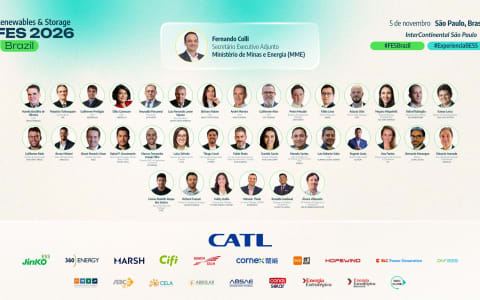
The discussion on the price and competitiveness of energy storage will also be addressed at the Future Energy Summit Brazil , which will take place on November 5 at the InterContinental São Paulo hotel .
The meeting will bring together CEOs, investors, developers, manufacturers and technology providers in the lead-up to a tender that has already registered unprecedented interest and that could mark a turning point for the Brazilian battery market.
With more than 20 confirmed speakers , the event will address seven major themes related to energy policy, business strategies, innovation, storage, investment and development opportunities, solar, wind and hybrid projects, and new financing alternatives.
The event will also feature networking opportunities among hundreds of company representatives, focusing on business opportunities and new projects related to the energy transition.
FES Brazil will close the 2026 Future Energy Summit international tour with storage as one of the central themes and with the country's first major BESS auction already at the center of the sector agenda.

 By Florencia Guglielmetti
 By Energía Estratégica

 By Matías Medinilla

 By Emilia Lardizabal