The Peruvian photovoltaic market faces new challenges in the timelines for procuring, delivering, and installing equipment , amidst a growing portfolio of solar projects seeking to move forward with their execution. Developer demands are forcing suppliers to adjust their schedules and logistics strategies.
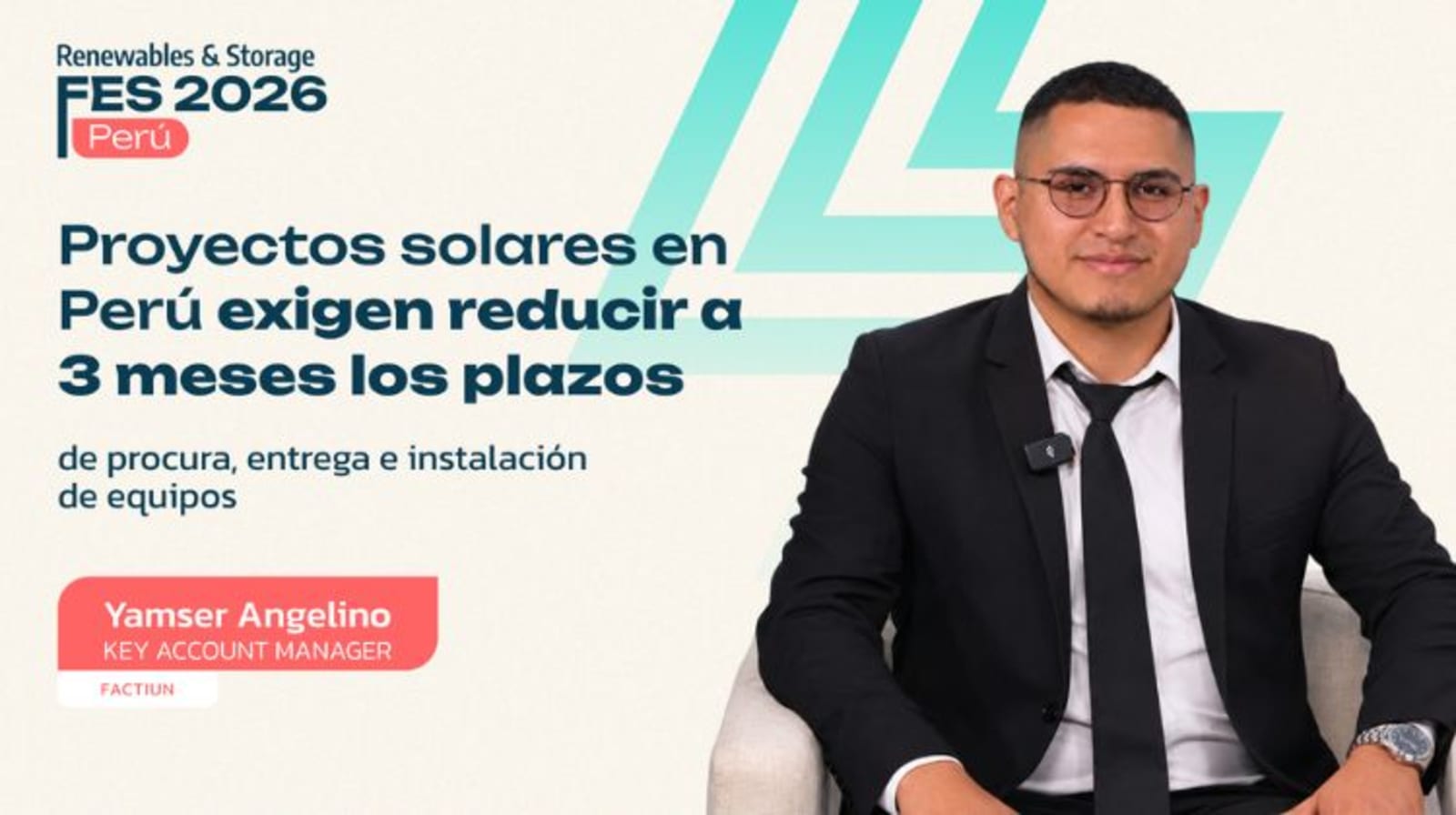
“We are talking about periods of 3 to 4 months, very tight,” warned Yamser Angelino, Key Account Manager of Factiun , in an exclusive interview during the Future Energy Summit (FES) Peru 2026.
“We usually handle an average of six months,” Angelino added, contrasting these orders with the times that the company traditionally considers for the procurement, delivery and installation stages.
In parallel, the executive noted that some generation developments the company is working on have commercial operation dates planned for 2028 , in a context of restrictions affecting the generation segment.

This scenario unfolds in a market with a significant portfolio of initiatives at various stages of development. According to data from the Supervisory Agency for Investment in Energy and Mining (Osinergmin) , compiled using information from the Economic Operation Committee of the National Interconnected System (COES) , there are 67 photovoltaic projects with approved pre-operational studies , totaling approximately 14.5 GW of projected installed capacity .
However, only 14 initiatives have received final approval , which shows that a significant part of the portfolio still needs to complete administrative stages before moving towards implementation.
According to official information, solar projects with approved pre-operational studies anticipate adding 7,795 MW of capacity in 2026, another 2,490 MW in 2027, and 1,606 MW in 2028. These figures correspond to projected timelines and do not imply that all of that capacity has actually come online or will actually come online on the planned dates.
Meanwhile, the Peruvian energy sector awaits the approval of the bidding regulations of Law No. 32249 , a key tool to promote long-term supply contracts and enable new investments.
“We usually receive projects with very complicated topography,” said Angelino, who highlighted the importance of having technical experience to face the difficulties presented by the different regions of the country.
In this sense, Factiun seeks to meet the requested deadlines through its network of strategic partners and operational support teams , which participate in different stages of photovoltaic developments.
The company has collaborators in Peru, Chile, Ecuador and other Latin American markets, which allows it to support its clients from preliminary studies to installation and commissioning.
“We have several partners that cover everything from preliminary studies to installation or commissioning,” explained the Key Account Manager, describing the scope of services that the company provides to meet market requirements.
This structure is complemented by Factiun's accumulated experience in international and regional projects, with a track record of more than 20 years from Europe and more than a decade of participation in photovoltaic developments in Latin America.
Continue reading
Among its background in the Peruvian market, Angelino highlights the San José solar project, of 180 MW , where the company applied its operational support structure to optimize resources and shorten execution periods.
In particular, it argues that the participation of personnel with direct knowledge of the construction conditions constitutes a differentiator when preparing technical and economic proposals, especially in facilities with complex terrain and demanding schedules.
Industrial self-consumption: projects between 5 and 40 MW drive inquiries
Factiun identifies opportunities in medium-scale projects. “We are receiving many medium-scale projects, but at the level of industrial self-consumption, for example, from the mining, cement, and agricultural industries,” the executive stated.
In this segment, the developments consulted have capacities starting at 5 MW and reaching approximately between 30 and 40 MW , while initiatives promoted by generating companies contemplate higher capacities.
The diversification of customer profiles demands solutions tailored to the characteristics of each industry, both in terms of engineering and supply planning and construction execution.
Likewise, the Factiun representative identifies opportunities in the Andean region, where energy supply problems are driving interest in new generation alternatives.
“Ecuador is a very emerging market that is growing very fast,” said the executive, who points out that the company’s strategy consists of supporting the development of the Ecuadorian photovoltaic sector through the transfer of construction experience.
According to Angelino, this support is not limited to offering competitive prices, but also seeks to provide technical knowledge that helps avoid problems during the operational phase of the projects.
Agrivoltaics: an opportunity still without consolidated demand
Another segment that Factiun maintains within its commercial strategy is agrivoltaics , although Angelino acknowledges that this technology does not yet present an explicit demand among customers in Peru and other markets in the region.
The company seeks to publicize the possibilities of this type of solution based on its international experience, particularly in European countries such as France and Italy, where it has references for projects that incorporate agrivoltaic systems.
Consequently, the company seeks to expand knowledge about technological alternatives that do not yet have a significant presence among regional business inquiries.
Angelino mentions Chile and Colombia as benchmark markets in Latin America due to their experience in building large solar projects, although he considers it necessary to incorporate new perspectives on the solutions that can be developed in the coming years.
Finally, the Factiun representative emphasizes that the experience of the technical and administrative teams in the field constitutes a central component of their commercial proposal , especially to serve projects that combine topographic challenges and execution requirements.
According to him, knowledge of the actual construction conditions allows for the formulation of technical and economic proposals with a greater understanding of the difficulties that may arise during installation, an aspect that is becoming increasingly relevant in light of the requests for reduced deadlines that the company is receiving in Peru.

 By Emilia Lardizabal
 By Florencia Guglielmetti