


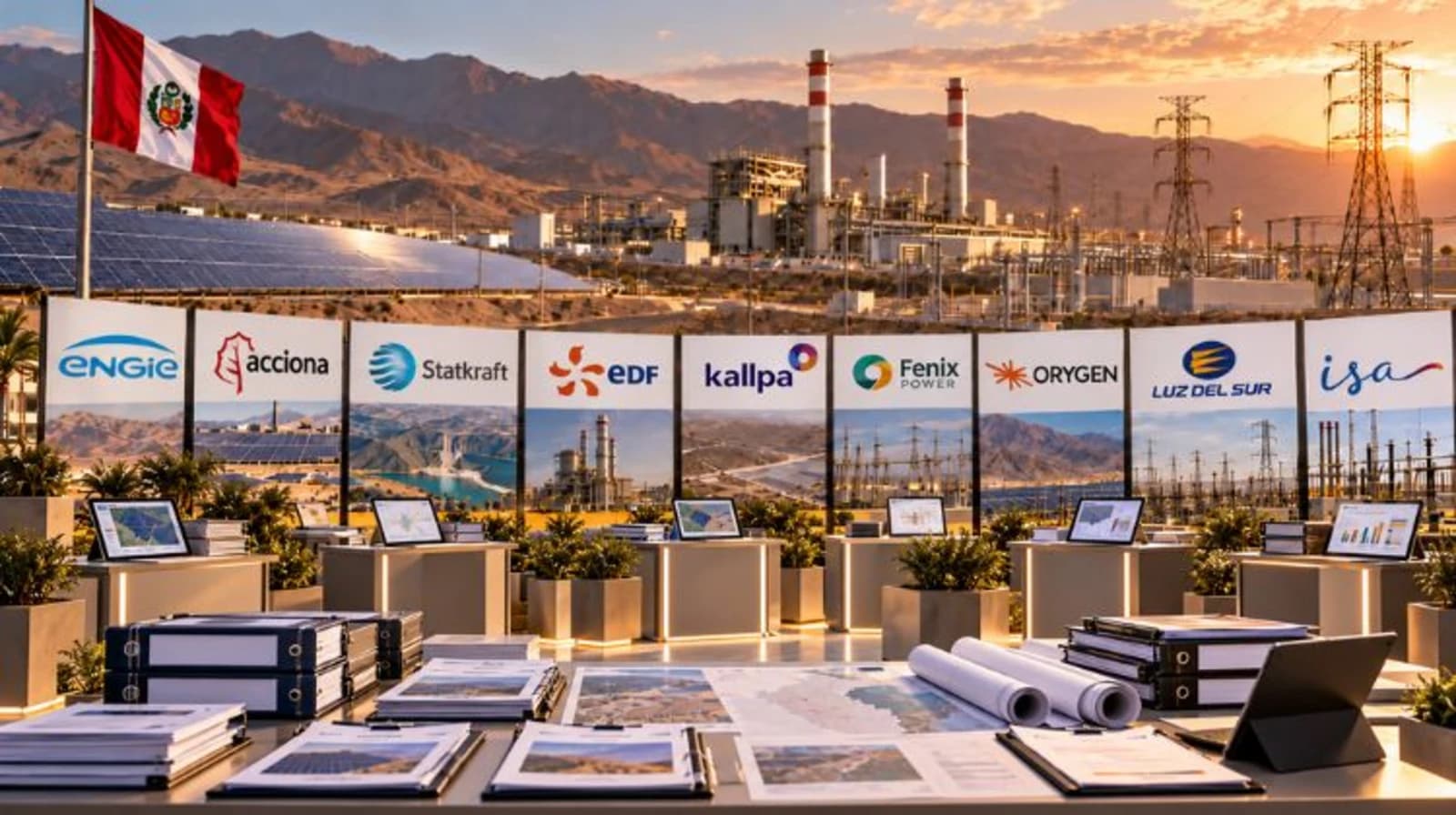
The main energy companies operating in Peru are proposing new contractual, technical and commercial conditions for future electricity supply tenders , in a context where the country is moving forward with the regulation of Law No. 32249, which modifies Law No. 28832 to promote the diversification of the energy matrix and guarantee supply.
The approval of the new regulations is one of the steps the electricity sector is waiting for to move forward with the next calls for tenders , especially those aimed at incorporating new renewable generation capacity.
According to the documentation accessed by Energía Estratégica , companies such as ENGIE, ACCIONA, Statkraft, Kallpa, Luz del Sur, Electrosur, Electropuno, Plus Energía, Inland Energy, Electrodunas, Fenix Power, Orygen and EDF Perú, among others, submitted observations and proposals that include contracts of up to 20 years, greater flexibility to market renewable energy by time blocks, requirements for new projects and changes in the award mechanisms .
The proposals also include modifications to maximum prices, guarantees, bilateral contracts and the powers of the regulatory body, with differing positions regarding the participation of existing power plants and the conditions for promoting new investments in renewable generation .

The Ministry of Energy and Mines (MINEM) project envisions long-term contracts of ten to fifteen years, with grace periods of three to six years and a maximum limit of 65% of the distributor's total demand . For the medium term, it establishes contracts of four to five years with a limit of 40%, while the short term ranges from one month to three years, with a maximum of 35%.
Given these conditions, ACCIONA proposes extending contracts to 15 or 20 years and that between 60% and 80% of demand be contracted on a long-term basis , with the aim of providing predictability of income and facilitating the bankability of new projects.
In contrast, Luz del Sur, Distriluz, Statkraft, and Fenix Power are requesting greater flexibility in the percentages and contract terms , rather than rigid commitments for distributors. Among their arguments is the risk of over-contracting in the face of demand fluctuations, which could lead to purchase obligations exceeding actual supply needs.
Along these lines, the Peruvian Renewable Energy Society (SPR) requests objective requirements for participants, flexible contracting percentages and at least ten months to prepare long-term tenders , in addition to rules that facilitate the integration of renewable technologies.
For its part, ENGIE requests clear participation criteria, defined regulatory deadlines, and the possibility of submitting indivisible bids that cover multiple time blocks. It also proposes admitting projects with authorization or concession and avoiding duplication of information already managed by the Economic Operation Committee of the National Interconnected System (COES).
New projects or existing plants? The conditions for competing for contracts
Another key point of discussion is whether long-term tenders should prioritize new generation capacity or allow existing power plants to compete for the same contracts .
In addition to defining which power plants will be eligible to participate, companies are requesting technical requirements and guarantees that demonstrate the viability of the projects before they are awarded . EDF Peru proposes requiring pre-operational studies, environmental certification, and proof of progress in obtaining concessions, while ENGIE proposes admitting developments with authorization or concessions and establishing objective qualification criteria. The draft regulations also include performance guarantees for facilities that are not yet operational.
Guillermo Grande, CEO of EDF Peru , stated during the Future Energy Summit Peru 2026: "Long-term tenders need to be reserved for new projects only." He added that existing facilities could participate in shorter-term tenders.
Along similar lines, Ignis Energy Peru requests prioritizing new infrastructure and allocating the corresponding energy to these projects first to ensure their bankability.
However, Kallpa, ENGIE, Statkraft, Fenix Power, Celepsa, Electroperú and San Gabán defend the participation of existing power plants, arguing that competition must include the various authorized generators.
From Kallpa, its commercial manager, Irwin Frisancho , stated during the same meeting: "We must let competition take place, let existing energy compete with new energy and price; the resulting better price will benefit the regulated user."
Fenix Power proposes preserving technological neutrality and avoiding further restrictions through subsequent procedures. Statkraft requests a review of the preferences for new developments and contracting percentages, while Celepsa and Electroperú also support open competition.
The need for contracts to back investments is another determining factor. César Butrón, president of the COES Board of Directors , warned during the Future Energy Summit Peru about the financial difficulties of the projects.
"They're not achieving financial closure. That's the big problem; there aren't enough long-term contracts," the executive noted, also identifying the expiration of existing contracts scheduled for 2030 and 2031 as a relevant factor for future tenders.
Time slots, prices and contracting: What modifications are you requesting?
The separate contracting of power and energy constitutes another focus of the observations, due to its implications for technologies with different generation profiles.
The project includes three products: power only, energy only, and power with associated energy . The option to contract energy by time blocks would allow for the structuring of specific offers, although several companies are requesting that the total cost of supply also be considered.
Kallpa, Orygen, Celepsa and TGP propose that the tenders allow coverage offers during the 24 hours, while the National Society of Mining, Petroleum and Energy (SNMPE) requests to compare offers by blocks and comprehensive proposals through a minimum cost optimization mechanism.
There are also different proposals on how to proceed when a tender fails to meet all the required demand . ACCIONA requests the establishment of rules for partial awards, while the FONAFE companies propose declaring the process void if any block remains uncovered. Electrosur, for its part, suggests enabling bilateral agreements in the event of unsuccessful tenders, to address outstanding supply requirements.
Regarding pricing, Kallpa and Orygen propose a single, combined maximum price , instead of separate limits for each block. Statkraft also calls for a review of the criteria used to establish these values.
Continue reading
For its part, ISA-REP supports the separation of power and energy due to its potential to facilitate renewable participation , but requests that the payment of tolls and transmission charges not depend on the generator having previously received the corresponding amounts from the distributor.
Electroperú, Inland Energy and SPR propose that transmission factors adequately reflect system losses, congestion and marginal costs, with the aim of improving economic contracting signals.
The observations also extend to the economic incentive of up to 3% foreseen for early tenders , the simplification or revision of which is being requested by companies such as Electroperú and Electrosur. In turn, Statkraft and Ignis Energy Perú are calling for greater clarity regarding the minimum billable quantities , a condition that affects the guaranteed revenue for generators and the purchase commitments assumed by distributors.
Requests related to bilateral contracts also appear. Luz del Sur, Pluz Energía, Distriluz, Electrosur, and FONAFE companies are requesting greater flexibility to sign agreements without bidding and to define commercial strategies according to coverage needs.
The request goes beyond using bilateral agreements to cover specific shortfalls. Luz del Sur, Distriluz, and Pluz Energía advocate for the possibility of negotiating longer-term contracts without relying exclusively on tenders , while Electrosur proposes resorting to this method only when competitive bidding processes fail to attract any offers.
The project limits these contracts to a one-year term, without the possibility of extension , when it is justified that the demand could not be met through bidding and that it is not feasible to hold another call for bids.
Another specific request is to respect the fixed and variable power capacity committed to in contracts prior to the reform , to prevent new awards from altering existing commercial obligations. At the same time, Kallpa, Celepsa, Pluz Energía, and Electrodunas are questioning the provisions that would allow or require a distributor with its own generation capacity to contract with itself , due to the potential effects on competition and the transparency of the awarding process.
Regarding the surplus market, Celepsa, Electroperú and SPR propose eliminating or redesigning it , while Orygen requests that reallocations between distributors not be carried out without the participation of the generator.
Another relevant point is the scheduling of tenders. Luz del Sur, Pluz Energía, and Fénix Power are asking for Osinergmin's powers to be limited and for the commercial autonomy of distributors to be preserved , especially regarding the quantities, methods, and deadlines for contracts.
In particular, Luz del Sur proposes that bidding programs be communicated to the regulator, instead of being subject to general prior approval , while Fenix Power requests that the essential elements of the scheme be defined directly by MINEM.
Osinergmin, COES and the requirements for isolated systems
The Supervisory Body for Investment in Energy and Mining (Osinergmin) itself presents observations on the project and requests clarification of definitions, justification of the contracting percentages and establishment of clear criteria for the accumulation of demand.
It also proposes ensuring that generators have sufficient firm power and energy to support their contractual commitments , as well as reviewing administrative deadlines, publications, and contract submission procedures.
Regarding isolated systems, EDF Peru proposes differentiated mechanisms for installations under 10 MW and safeguards against possible conflicts of interest when a distributor has its own generation.
The draft regulations stipulate that, in certain tenders for these systems called subsidiarily by the Ministry, priority will be given to generation with renewable energy resources .
In a complementary regulatory procedure, specifically referring to the operational coordination of isolated systems, COES requests a review of the minimum threshold that would enable its intervention, going from 1.5 MW to 50 MW .
The organization bases its proposal on the infrastructure, communications and personnel costs needed to coordinate these facilities, which could reach 1.5 million soles annually in certain scenarios.
The SPR also proposes raising the threshold to 20 MW in that procedure, with the aim of avoiding disproportionate operational requirements for small installations.
These observations pertain to a different regulation than supply contracts, but they incorporate elements related to operating costs, technical responsibilities, and the economic viability of renewable projects in isolated systems .
Technological neutrality and upcoming regulatory challenges
The observations also include Cálidda, Transportadora de Gas del Perú (TGP) and the Peruvian Hydrocarbons Society (SPH) , which request technological neutrality and rules that guarantee supply during the 24 hours.
These organizations propose reviewing mandatory contracting quotas and allowing existing generation to participate on equal terms, considering the firmness and security requirements of the system.
Meanwhile, companies promoting new developments emphasize long-term contracts, objective requirements, and mechanisms that facilitate the financing of renewable energy plants , while other generators prioritize open competition and commercial flexibility.
Thus, the observations of the main companies, associations and technical bodies raise the conditions that must be specified before implementing the next electricity tenders in Peru.
The duration of contracts, the participation of new and existing projects, maximum prices, hourly products, and backup requirements will be key factors in defining investment opportunities and the commercial conditions of the new contracting scheme.
