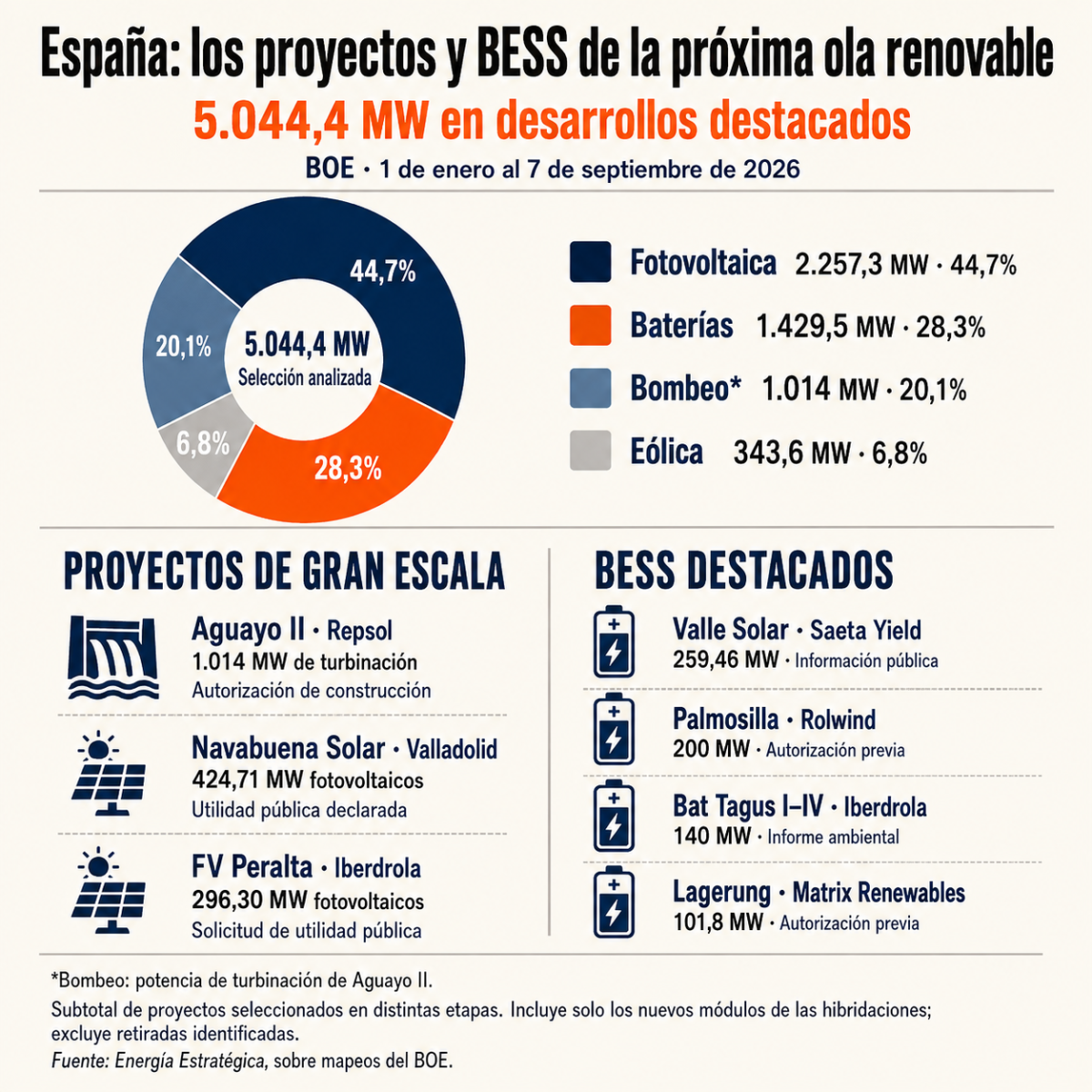
Spain's next renewable energy expansion is taking shape in the official gazettes. The monitoring carried out by Energía Estratégica identifies 5,044.4 MW among the projects selected for this report , considering solar, wind, battery storage, and pumped hydro power generation.
The breakdown shows us the relative importance of each technology: 2257.3 MW correspond to photovoltaics; 1429.5 MW to batteries; 1014 MW to the turbine capacity of Aguayo II; and 343.6 MW to wind power . The first two categories account for 73% of the subtotal, while pumped storage contributes 20.1% and wind power represents 6.8%.
The scale also shows a significant concentration. Aguayo II alone accounts for one-fifth of the total power, while Navabuena Solar, Peralta, the four La Puebla plants and the six Helena facilities analyzed add up to 1367.2 MW , equivalent to 60.6% of the selected photovoltaic segment .
The importance of batteries adds another dimension to the business landscape. Their presence encompasses both standalone installations and expansions of solar power plants and wind farms. This diversity allows specialized developers, such as Rolwind and Matrix Renewables, to coexist with groups that incorporate storage into their generation portfolios.

The figures describe a selection of developments with actions registered between January 1 and September 7, 2026 , at different administrative stages. The calculation considers each component only once, separates expansions of existing capacity, and excludes rejected or withdrawn projects identified in the note.
Based on this, the report reveals how Iberdrola and Solaria combine photovoltaic activity with hybrid systems; Endesa focuses on a large-scale operation in Aragon; Bruc deploys batteries linked to its solar assets; and Forestalia and Jinko maintain a presence in new generation developments. This represents participation within the analyzed sample, without equating these volumes with electricity market share or capacity ready for construction.
It should also be clarified that the survey includes environmental assessments, projects currently under public review, permits, and declarations of public utility, along with rejected or withdrawn applications. The main findings are as follows: which companies are moving forward, how many MW they are generating, and where their developments are concentrated.
The leading names behind Spain's next renewable energy wave
Iberdrola is making progress on several fronts. Cofrentes I, a 154.665 MW photovoltaic plant , received its declaration of public utility in May, followed by work on land acquisition and evacuation infrastructure. In Cuenca, the Callejas and Maza projects received administrative authorization for construction and their declaration of public utility in April.
Each of these two latest developments adds 51.315 MW of solar power to an existing 49.5 MW wind farm . The combined photovoltaic contribution reaches 102.63 MW, a significant distinction for measuring the expansion without counting the previous generation as new.
The company's presence continues until September, when the mapping includes an environmental impact report for the modification of the 78 MW Alcocero de Mola wind farm in Burgos.
Solaria , for its part, has a combined capacity of 297.7 MW across Helena Solar 2, 3, 4, 5, 6, and 12, with declarations of public utility registered between May and June. Within this group, Helena Solar 2 contributes 82.49 MW and includes infrastructure in Toledo and Madrid.
The company also appears in Burgos with the Maira Beta Grouping, of 140.127 MW, and land acquisition activities. In Toledo, Castor has registered prior and construction authorizations to incorporate 19.99 MW of batteries into a 49.99 MW photovoltaic plant.
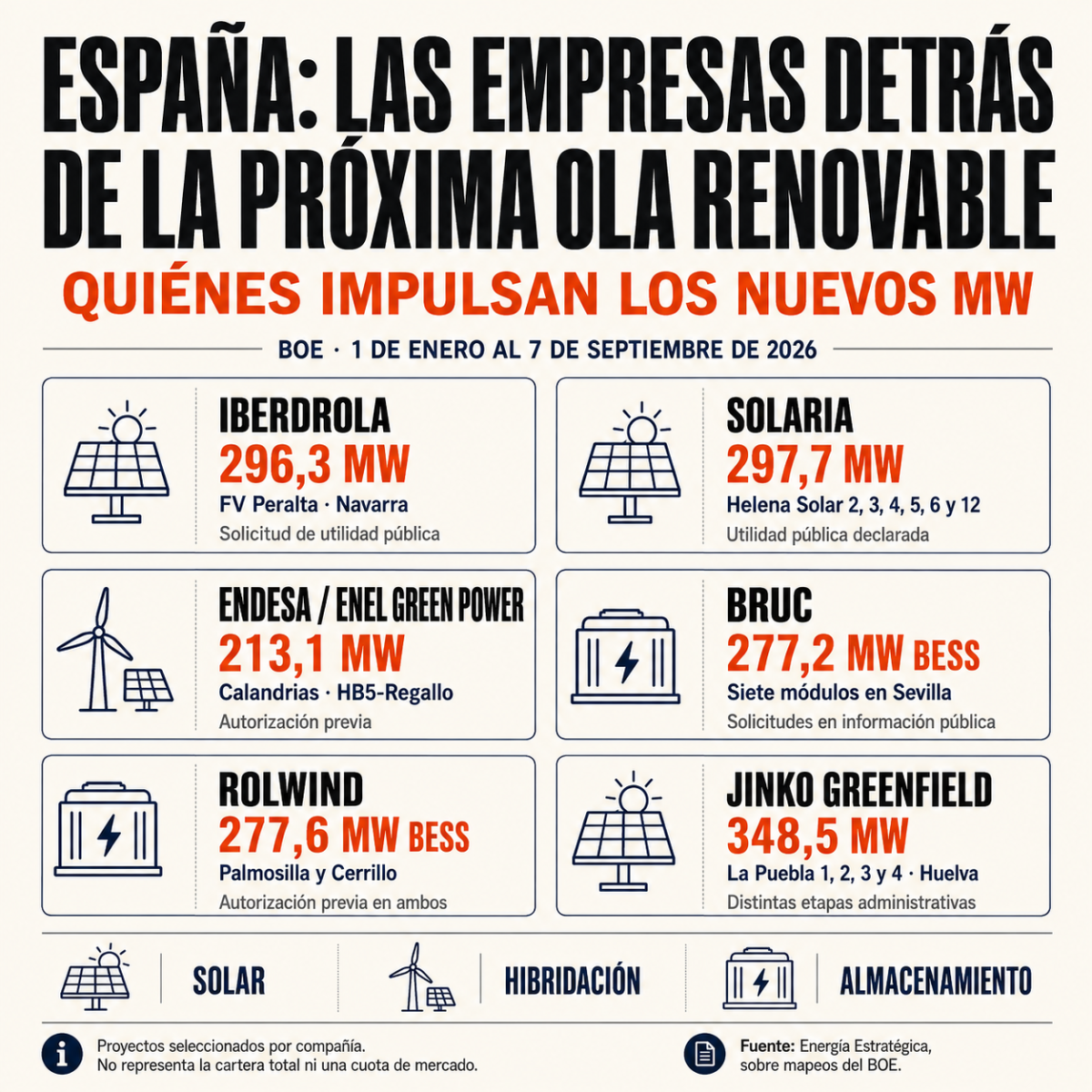
Bruc 's reported activity focuses on energy storage linked to solar installations. GES, Freya, Afrodita, Jade, Artemisa, SES, and Esmeralda total 277.2 MW , distributed across seven modules of 39.6 MW each in Seville. The files from February correspond to public information requests for prior authorization and construction permits.
Freya exemplifies this model: the battery is planned next to a 44 MW photovoltaic plant and will utilize part of its evacuation infrastructure. The portfolio extends to other initiatives, such as La Isla, with an additional 16.5 MW module in Alcalá de Guadaíra.
In terms of power generation, Jinko Greenfield Spain 1 stands out with its La Puebla 1, 2, 3, and 4 plants in Huelva. The most recent records for each facility total 348.48 MW : the latter two received prior administrative authorization in June, while the former were submitted for public comment in July for the declaration of public utility.
Forestalia maintains a diversified presence in Aragon. Among the environmental impact assessments submitted at the beginning of the year are Sición and Silvano, with a combined capacity of 90 MW of wind power; Navallo I, with 115 MW of photovoltaic capacity; and Atria, Avior, and Gondul, with 88.4 MW of solar power. These are in addition to the Azami, Arturo, Atalán, and Basán wind farm complex, totaling 198 MW, located in Navarre and Zaragoza.
Megaprojects that set the standard
The Mudéjar 400 kV Just Transition Junction , developed by Enel Green Power España, is one of the most significant examples of technological integration. The environmental impact assessment, submitted in February, includes 1,195.5 MW of photovoltaic capacity, 648.6 MW of wind power, and 79.8 MW of energy storage in Aragon.
That dimension corresponds to the projected configuration. Its subsequent trajectory combines partial approvals and changes that prevent considering the entire initial volume as authorized and current capacity.
Continue reading
In June, Endesa's subsidiary obtained prior administrative authorization for the Calandrias photovoltaic module of HB5-Regallo, with a capacity of 213.094 MW . They also made progress on HB7-Pitarra, with 61.72 MW of solar and 45.6 MW of wind power, and the Santa María component of HB2-La Plana, with 65.3 MW of photovoltaic capacity.
Among the individual power plants , Navabuena Solar, with 424.71 MW , stands out in Valladolid, having received its declaration of public utility in July. Its size places it among the large photovoltaic developments identified in the mapping.
Another relevant case is Iberdrola's FV Peralta project, with 296.297 MW , in Navarre. In February, its application for public utility status, along with the evacuation infrastructure, was submitted for public comment. The announcement represents a specific step within a process with precedents prior to 2026.
BESS implements two strategies to expand its portfolio in Spain
Storage has two clear modalities : independent installations and modules associated with generation plants.
In the first segment, Rolwind has a combined capacity of 277.6 MW , comprised of the 200 MW Palmosilla plant in Tarifa and the 77.6 MW Cerrillo plant in Álora. The former received prior administrative authorization in June; the latter received both prior authorization and construction authorization.
Matrix Renewables also records progress in Girona with BESS Lagerung, of 101.8 MW , which obtained prior administrative authorization during that month.
Hybrid systems, on the other hand, deploy battery clusters across different solar sites. In Altarejos, Cuenca, the Aitana, Aspe, Bañuela, and Turbón modules total 86.76 MW . Each module contributes 21.69 MW to a photovoltaic plant of approximately 49 MW and received prior authorization and construction permits in August.
In the same province, Opdenergy is planning 80.22 MW through the Belinchón 1, 2, and 3 BESS plants, with 26.74 MW per unit. All three projects underwent public consultation in February; the June follow-up report shows prior authorizations and construction permits for the first two.
Iberdrola contributes another group in Cáceres: Bat Tagus I, II, III and IV , of 35 MW each, which together total 140 MW and were listed in February with an environmental impact report prepared.
The scale increases in Valencia with Saeta Yield , whose BESS I and II Valle Solar systems total 259.456 MW associated with the photovoltaic plant of the same name. Its applications for prior authorization and construction permits were submitted for public comment that same month.
Also included are the Pacheco modules, from X-Elio, with 105 MW of storage in Cartagena and prior and construction authorizations registered in June. Solaria adds, among other projects, the Maira Gamma Group, with 45 MW of batteries in Burgos.
Hybridization expands the combinations
Technological integration also includes wind farms with solar modules, complexes that bring together three sources, and developments linked to hydroelectric power plants.
Elawan offers two examples of combined wind and solar power. Manzanares , in Ciudad Real, includes 34.3 MW of solar power alongside 36 MW of wind power and was submitted for public comment in April. Campanario II , in Albacete, incorporates 10 MW of wind power into a 48.12 MW solar installation; it received its construction permit and declaration of public utility in May.
The same company is expanding this strategy with Frontones Phase II , also in Albacete. The application published on August 31 proposes adding 20 MW of battery storage to a project that already includes 50 MW of wind power, 26.25 MW of photovoltaics, and 4 MW of storage. This new phase thus expands upon a configuration that already incorporates all three technologies.
Another combination appears in Cíjara , owned by Endesa, in Extremadura. The January mapping shows prior administrative authorization for a hybrid system combining 55 MW of photovoltaic power with 52.22 MW of hydroelectric power .
Furthermore, the storage portfolio also includes hydroelectric infrastructure. In June, Repsol obtained prior administrative authorization for modifications, construction authorization, and a declaration of public utility for the expansion of Aguayo-Aguayo II in Cantabria.
The project includes 1,014 MW of turbine generation and 1,181 MW of pumping capacity , corresponding to two operating modes of the same facility. Its scale places the company among the key players in this period of expanding its focus beyond batteries.
 By Emilia Lardizabal



 By Ailén Pedrotti

 By Florencia Guglielmetti