



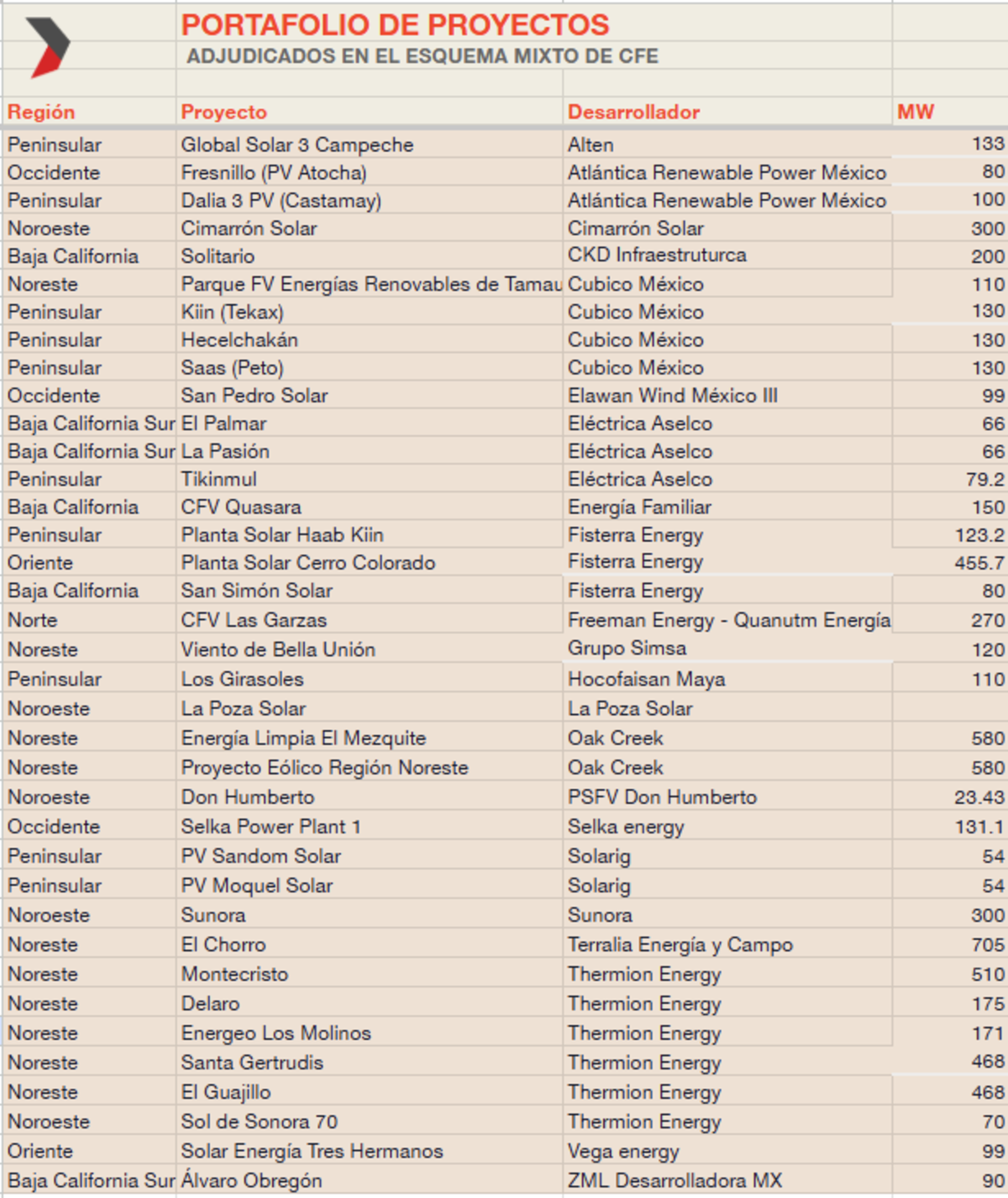
A total of 7410 MW distributed across 37 projects and awarded to 31 developers under the mixed scheme are beginning to outline the new map of renewable investments in Mexico.
Although the Federal Electricity Commission (CFE) has not yet officially published the full details of the process, information compiled by Energía Estratégica allows us to identify which companies were selected and how much capacity each one would concentrate within the mixed scheme promoted by the Mexican Government.
The distribution of capacity shows a clear concentration in a small group of companies that will lead much of the country's upcoming renewable expansion: Thermion Energy appears as one of the main winners of the process, followed by developers such as Terralia, Fisterra Energy, Oak Creek, Cubico México, Solarig and Atlántica Renewable Power.
Among the main awardees is Thermion Energy , which would accumulate more than 1600 MW through the Montecristo, Delaro, Energeo Los Molinos, Santa Gertrudis, El Guajillo and Sol de Sonora 70 projects.

Oak Creek follows, with approximately 1160 MW distributed between Energía Limpia El Mezquite and Proyecto Eólico Región Noreste.
In third place is Terralia Energía y Campo , which would reach 705 MW , including storage capacity equivalent to 45% through BESS systems .
Following behind is Fisterra Energy , with approximately 659.2 MW corresponding to the Haab Kiin Solar Plant (123 MW), the Cerro Colorado Solar Plant (123.2 MW), and San Simón Solar (455.7 MW). Cubico México has around 500 MW through the Energías Renovables de Tamaulipas PV Park (110 MW), Kiin (130 MW), Hecelchakán (130 MW), and Saas (130 MW). Atlántica Renewable Power México also stands out, with 180 MW awarded through its photovoltaic projects.
Further back is Solarig , with approximately 108 MW distributed between PV Sandom Solar and PV Moquel Solar.
In the next group are Sunora and Cimarrón Solar , both with 300 MW of awarded capacity.
For its part, Freeman Energy - Quantum Energía adds 270 MW through the CFV Las Garzas project.
Continue reading
The list is completed by Eléctrica Aselco (211 MW), CKD Infraestructura (200 MW), Energía Familiar (150 MW), Alten (133 MW), Selka Energy (131.1 MW), Don Humberto (131 MW), Grupo Simsa (120 MW), Hocofaisan Maya (110 MW), Elawan Wind México III (99 MW) and Vega Energy (99 MW).
One of the new developments is the inclusion of Atlas Renewable Energy among the winning bidders. According to information obtained by this publication, the company has been selected to develop the CFV Concepción Mendizábal Phase 1, Phase 2, and Phase 3 projects, strengthening its position within the Mexican market.
The geographical distribution of the initiatives shows a strong concentration in Sonora, Tamaulipas, Campeche, Yucatán and Baja California Sur, states that appear as some of the main recipients of the new renewable capacity contemplated within the scheme.
While the names of the developers and many of the projects are beginning to be known within the industry, the CFE has not yet officially published the final list of awards or the complete details of the process.
Therefore, the information presented is a reconstruction by Energía Estratégica based on data provided by Miguel Ángel Ramírez Bocanegra, Director of Bora Energy , supplemented by internal industry sources. Consequently, some project names, companies, or development vehicles may change once the authorities formalize the results.
It is worth remembering that the process unfolds in parallel to the Second Call for Priority Attention to Generation and Interconnection Permit Applications aligned with Binding Planning , whose schedule was recently modified by the Ministry of Energy (SENER).
According to the new schedule, applications for generation permits can be submitted to the CNE between July 6 and August 6. The review of requirements and any necessary adjustments will then take place during August, while the National Energy Control Center (CENACE) will announce the results of the interconnection studies and the costs of reinforcement works on August 24.
From that point, the developers must express their acceptance of the works and associated costs, including a re-evaluation phase that could extend until mid-September. Finally, the technical evaluation and permit review by the National Energy Commission will be completed between September 14 and 22.
Thus, the publication of the final results of the Second Call was scheduled for September 23, 2026 , almost a month later than originally planned, extending the time for developers to complete technical, regulatory and interconnection requirements before the final definition of the selected projects.