Iberdrola and Endesa are the energy companies best positioned to capture the new electricity demand that mobility will generate in Spain.
How do they do it? The first already combines more than 11,400 charging points with around 23 GW of renewable energy installed in the country; the second adds 7,162 points, a commitment marked by fast and ultra-fast charging, and 11 GW operational through Enel Green Power Spain.
The Strategic Energy survey crosses eMobility deployment and green energy capacity.
Under that criterion, Repsol, EDP, Acciona Energía, TotalEnergies, Plenitude, Galp, ENGIE, Moeve and Naturgy appear in a second competitive map, with strategies ranging from service stations and loyalty apps to B2B agreements, ultra-fast charging, generation, green hydrogen and fleet solutions.

Iberdrola: leadership in charging and the greatest renewable energy capacity in Spain
Iberdrola emerges as the best-positioned energy company in the combined mobility and renewables sector. The company operates more than 11,400 charging points across the country and has another 2,500 in various stages of installation . Its strategy is not solely focused on high power: 60% of its network is low power, with 22 kW charging stations geared towards urban, residential, and convenience charging.
This data is relevant because it demonstrates a commitment to capturing different consumption moments . Iberdrola is not only aiming to be present in high-power corridors, but also in parking lots, urban environments, and locations where users spend more time.
At the same time, the company has around 23 GW in Spain between wind, solar and hydroelectric power, in addition to more than 200 wind farms, more than 45 photovoltaic plants, 118 hydroelectric plants and more than six battery projects.
Meanwhile, its global target exceeds 60 GW of renewables by 2028 , with 75% already under construction or ready to build.
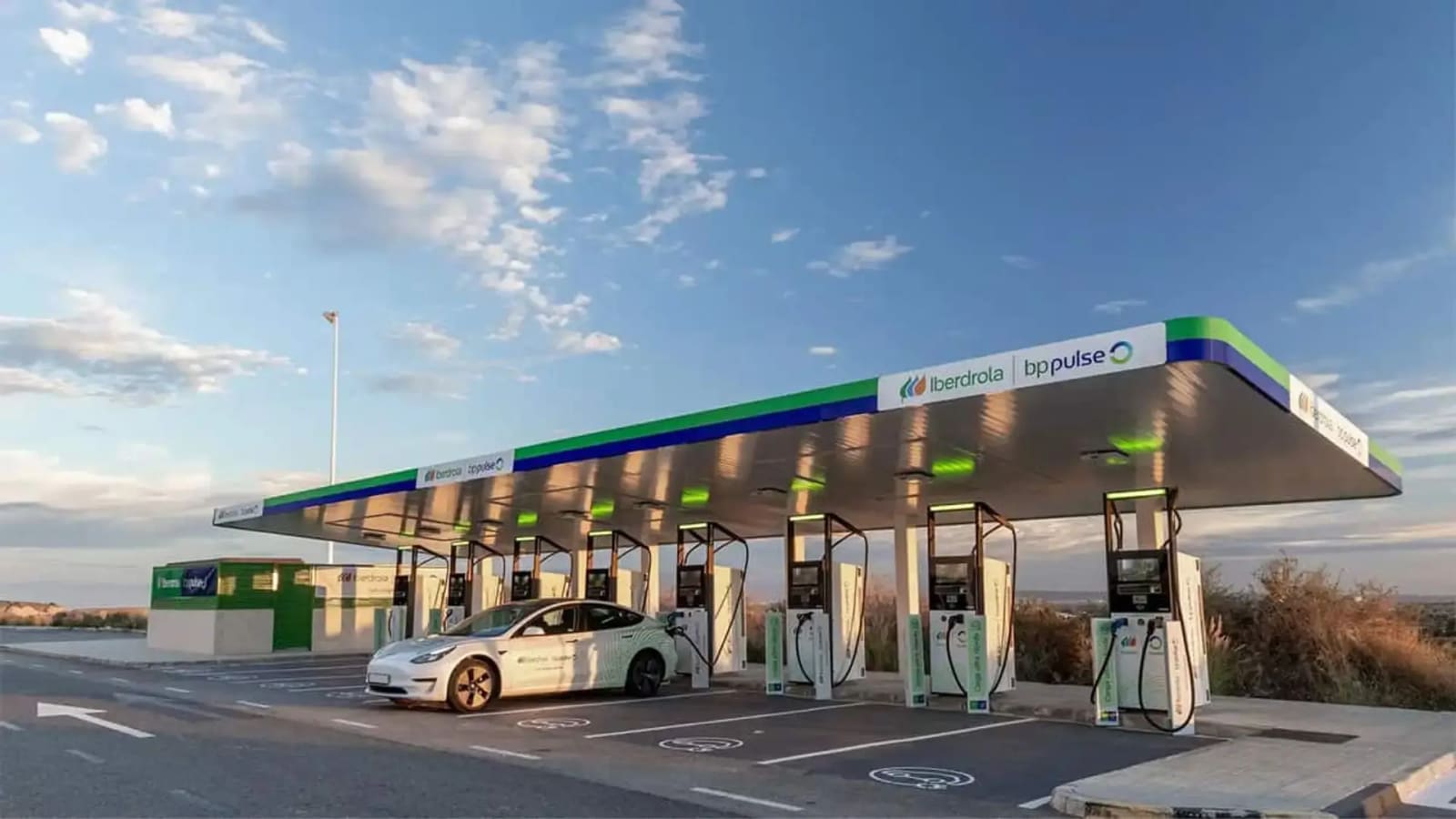
Furthermore, its alliance with bp pulse strengthens its position in the high-power charging segment . The joint venture already has over 2,500 operational charging points in the Iberian Peninsula, more than 2,000 of which are in Spain. Nearly 70% of its equipment is ultra-fast, with power outputs between 150 and 600 kW, and the stated goal is to reach 11,700 ultra-fast charging points by 2030.
Endesa: High-power charging and backup power from Enel Green Power
Endesa ranks second in terms of infrastructure, energy capacity, and commercial offering. Through Endesa X Way, the company reached 7,162 points of sale installed in the local market, representing a 10% increase compared to the previous year.
Its main differentiating feature is its commitment to fast and ultra-fast charging . 45% of its network already falls into this category , and it added 1,053 charging points of this type in the last year alone. This positions it strongly in corridors, high-traffic locations, and services where charging speed defines the user experience.
In renewables, Endesa has 11 GW of operational capacity through Enel Green Power España, encompassing hydroelectric, wind, and solar power . The survey identifies 3.1 GW of wind and 2.9 GW of solar, in addition to an operational portfolio of 359 power plants. Furthermore, 458 MW are under construction across 11 power plants, including projects such as the Esparragal I solar park.
The company is also looking to bundle its offering. The launch of Endesa Drive with Ayvens points in that direction: a leasing service that integrates vehicle, charger, installation, and energy allowance. This represents one of the most significant shifts in the market: charging is no longer an isolated product but rather part of a complete energy solution.
Repsol: commercial reach, Waylet and expanding renewables
Repsol exemplifies the case of an oil company leveraging electric mobility to strengthen its position in the transportation sector. Its network comprises over 6,390 charging points managed through Waylet , more than 2,600 of which are company-owned. Furthermore, it leads the service station segment with over 1,100 charging points located within its facilities.
Its advantage lies not only in the number of charging points, but also in its extensive commercial reach. Repsol already has a strong relationship with drivers, a widespread physical network, and an app that integrates charging, payments, discounts, and loyalty programs. It also offers subscription plans, such as Mobility 50, 100, and 150, to reduce the cost of charging.
In renewable generation, the company reached 5.9 GW of global installed capacity after adding 2.2 GW of new capacity in Spain, the United States and Chile during 2025. Although its volume is still below that of utilities such as Iberdrola or Endesa, its positioning is relevant because it combines low-carbon generation, service stations, an app and end customers.
EDP: smaller public network, but strong B2B strategy and global renewable backing
EDP isn't among the energy companies with the most public charging points in Spain, but its strategy deserves attention. The company has 979 operational public charging points and more than 2,500 contracted points across the country . Furthermore, it stands out for its B2B partnerships, such as the one with Decathlon, which adds more than 400 charging stations.
This model reveals another avenue for growth for energy companies: not just competing for roadside charging, but installing infrastructure in locations where there is already traffic, occupancy, and potential consumption. Shopping centers, stores, parking lots, logistics facilities, and businesses thus become new areas of electricity demand.
Globally, EDP Renewables operates at around 20 GW of renewable energy capacity and projects reaching 25 GW by 2028. Its 2026-2028 plan anticipates investments of €12 billion , focusing on green energy and networks. In this case, the importance of eMobility in Spain is understood more in terms of integration with corporate clients than leadership in the public network.
Acciona Energía: 100% renewable energy and growth through acquisitions
Acciona Energía combines a strong sustainable identity with a charging presence that is still more focused than that of Iberdrola, Endesa, or Repsol, but is expanding. The company offers a charging network, its own app, solutions for businesses and municipalities, charging point operation, 100% renewable energy, and V2G projects.
Its leap in scale came after the acquisition of Cable Energía , the Shell Recharge operator in Spain and Portugal. Following this acquisition and its operational alliance with Qwello , it now has around 450 points of service and projected reaching 1,500.
In generation, Acciona has approximately 6.86 GW installed in Spain, equivalent to 49% of its 14 GW global capacity .
The survey identifies approximately 162.5 MW of pipeline projects, including photovoltaic hybrid systems, new solar assets, and wind power repowering. It also records 192 MW of storage capacity globally.
Continue reading
Its competitive advantage lies in the consistency between charging infrastructure and energy generation. The company can position electric mobility as part of an end-to-end clean energy solution, from production to consumption.
TotalEnergies: High power and renewable ambition in Spain
TotalEnergies appears Within the energy sector, this company stands out as a player to watch due to its dual strategy: renewable energy expansion and a more visible entry into public charging. The company has 704 public charging points in Spain, distributed across 265 operational stations throughout the 17 autonomous communities . More than 65% of these are fast or ultra-fast charging infrastructure.
This profile places it closer to a high-power strategy than a distributed low-power network. The focus seems to be on stations, corridors, and locations where charging speed allows for a model more similar to traditional refueling.
In the area of sustainable energy, TotalEnergies had 28 GW of gross installed capacity globally as of March 2025. In Spain, it inaugurated its largest European solar complex in Seville, with 263 MW, and maintains the country as a priority market, with 3 GW in advanced stages of development.
Plenitude: European scale and progressive entry into Spain
Plenitude, part of the Eni group and affiliated with Be Charge, stands out for its continental reach. The company has over 22,000 of its own charging points installed in Europe, with equipment reaching up to 400 kW of power, and aims to reach 30,000 points in the European Union by 2028.
In Spain, its strength does not yet lie in a public network equivalent to that of Iberdrola, Endesa, or Repsol, but rather in its ability to connect local users to a broader European network. Its business combines charging, electricity trading, and renewable energy expansion.
Plenitude reports approximately 6 GW of green energy installed by April 2026 and nearly 950 MW in Spain between photovoltaic and wind power .
Their goal? To reach 6.5 GW in 2026, 15 GW in 2030 and 60 GW in 2050.
Furthermore, their corporate presentation mentions a pipeline of 22 GW under construction or in advanced stages.
The company thus appears as an actor with less local reach than the Spanish leaders, but with a relevant European presence and an integrated strategy encompassing renewables, energy retail and charging.
Galp: Iberian expansion and support at service stations
Galp reports having over 9,300 charging points across the Iberian Peninsula , a figure that places it among the players with the greatest regional visibility. Its business model is based on a multi-energy approach and a widespread network of charging stations, with Spain and Portugal as its natural markets.
In renewables, the company reports 2 GW of installed capacity, primarily in the Iberian Peninsula. This figure includes the acquisition of 351 MW of operational wind power in Spain during 2026.
In addition, Galp had announced sustainable growth targets of 12 GW by 2030.
ENGIE: industrial focus, high power and heavy transport
ENGIE Spain operates in electric mobility through ENGIE Vianeo , with a focus more on fast and ultra-fast infrastructure, heavy transport, industry and solutions for large customers than on mass urban charging of passenger cars.
The company is developing HPC public charging projects with power outputs of 300 to 400 kW and 100% renewable electricity supply . At the continental level, ENGIE aims to consolidate its position among the top five public charging operators in Europe, with a target of 25,000 charging points by 2030 , including 1,000 specifically for heavy vehicles.
In renewables, ENGIE has 57.2 GW of operational capacity globally. In Spain, it manages approximately 4,000 MW, of which 1,700 MW are 100% green. Its local objective is to reach 3,600 MW of sustainable capacity by 2030 and to advance in energy storage, with 278 MW of BESS projects acquired in the country.
Move: Less renewable electricity, more multi-energy transformation
Moeve, formerly Cepsa, does not appear as a major renewable electricity generation operator comparable to Iberdrola, Endesa, or Acciona. Its energy transition relies on other vectors: green hydrogen, biofuels, green molecules, recharging, and the transformation of service stations.
In electric mobility, the company has already surpassed 100 stations equipped with at least 150 kW per charging point and has reached more than 260 operational high-power charging stations. Furthermore, it plans to exceed 500 renovated stations and offers a monthly subscription with direct discounts.
Its main asset under development is the Andalusian Green Hydrogen Valley . The first phase, Onuba, includes 300 MW of electrolysis, expandable by an additional 100 MW, with an investment exceeding €1 billion and associated solar infrastructure.
Naturgy: solid renewables, less exposure to the public grid
Naturgy has 5.3 GW of installed renewable energy capacity and a target of 9.5 GW by 2027 internationally. It also has a 1030 MW photovoltaic portfolio internationally, providing it with energy backup to support electrification processes.
However, its position in electric mobility shows a difference compared to Iberdrola, Endesa, Repsol, or EDP. In 2021, the company announced a plan to deploy more than 1,100 fast and semi-fast public charging points in cities and along transport routes, with locations every 200 kilometers and support at existing supply stations.
However, this rollout did not have a clear public evolution and does not currently have the same operational visibility as the networks of other market players. Furthermore, according to information confirmed by the company itself to Mobility Portal in 2024, Naturgy did not have any projects specifically focused on electric mobility at that time.
Shell Recharge: services, agreements and reorganized operation in Spain
Shell Recharge appears as a relevant player due to its brand and charging services, although its operation in Spain changed after the acquisition of Cable Energía by Acciona Energía.
Shell Energy announced 1.1 GW of operational renewable capacity in Europe by the end of 2025 and 600 MW under development. In Spain, its presence is more closely associated with energy trading, energy services, and PPAs than with a large, unbundled capacity portfolio.
 By Emilia Lardizabal



 By Ailén Pedrotti

 By Florencia Guglielmetti