The United Kingdom decided not to set a definitive budget for renewables in advance for the eighth renewable energy auction, known as Allocation Round 8 (AR8), and established a symbolic initial allocation of £1 , which may be increased once the developers' bids are known.
The scheme covers solar photovoltaics, onshore wind, remote island wind, fixed foundation offshore wind and floating offshore wind , in addition to other technologies included in funds 1 to 4.
The £1 figure does not imply an actual cut in available support, as the Department for Energy Security and Net Zero (DESNZ) clarified that it is a theoretical allocation that will allow ministers to know the prices proposed by developers before deciding how much budget to allocate to each category.
Therefore, the government may increase funding if it considers that the offers provide good value for money and contribute to reducing the cost of electricity for consumers.

The final decisions will be made together with the Treasury and will be published with the results of the round, expected in February 2027 .
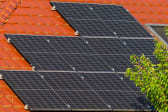
Solar energy was included in Group 1 , with an initial £1. The same amount was allocated to onshore and remote island wind in Group 2, offshore wind in Group 3, and floating wind and other deep-water technologies in Group 4.
Group 5 , on the other hand, will have a final budget of £0, so emerging technologies included in that category will not receive new CfD contracts in this round.
The change introduces greater flexibility compared to previous processes, by allowing the Executive to evaluate all proposals before establishing how much volume it wants to contract.
In the previous round, the budget allocated to offshore wind ended up more than doubling after the Government reviewed the submitted prices.
More than 40 GW of renewables could compete
The volume of potentially eligible projects makes AR8 one of the rounds with the greatest capacity at stake.
Solar Energy UK estimates that more than 20 GW of already authorized photovoltaic projects could be available to compete .
In wind power, RenewableUK counts another 17 GW offshore and 3.5 GW onshore eligible.
The size of the portfolio also raises questions about how much the Government will ultimately decide to contract once the prices are known.
ORE Catapult estimates that the UK should allocate at least 4.5 GW of offshore wind in AR8 to keep pace with its Clean Power 2030 targets.
According to their calculations, that volume could require between £850 million and £1350 million , depending on the final award prices.
For fixed-foundation offshore wind, the maximum reference price was set at £113/MWh , while for floating wind and other deep-water technologies it reaches £271/MWh , in 2024 values.
The eligible offshore portfolio totals 17,164 MW distributed across 21 projects , including West of Orkney, with 2,000 MW; Mona and Outer Dowsing, with 1,500 MW each; and Norfolk Boreas, with 1,380 MW.
In floating wind, ORE Catapult identifies four suitable projects for 332 MW , while a hypothetical budget of £180 million could allow for the awarding of between 200 MW and 275 MW, depending on the prices offered.
For its part, LCP Delta estimates that AR8 could contract up to 19 GW of renewable capacity, including solar, onshore wind and offshore, if the budget allocation is optimized according to the electrical system.
The consultancy also estimates that this volume could generate more than £11 billion in cumulative savings for consumers by 2050 , although these are technical scenarios and not official commitments.
Applications to participate in AR8 closed on August 7, 2026 .
With the new procedure, the key data will no longer be the budget announced before the bids are known, but how much renewable volume the United Kingdom finally decides to contract after checking what prices the market offers.
 By Florencia Guglielmetti


 By Matías Medinilla
 By Ailén Pedrotti