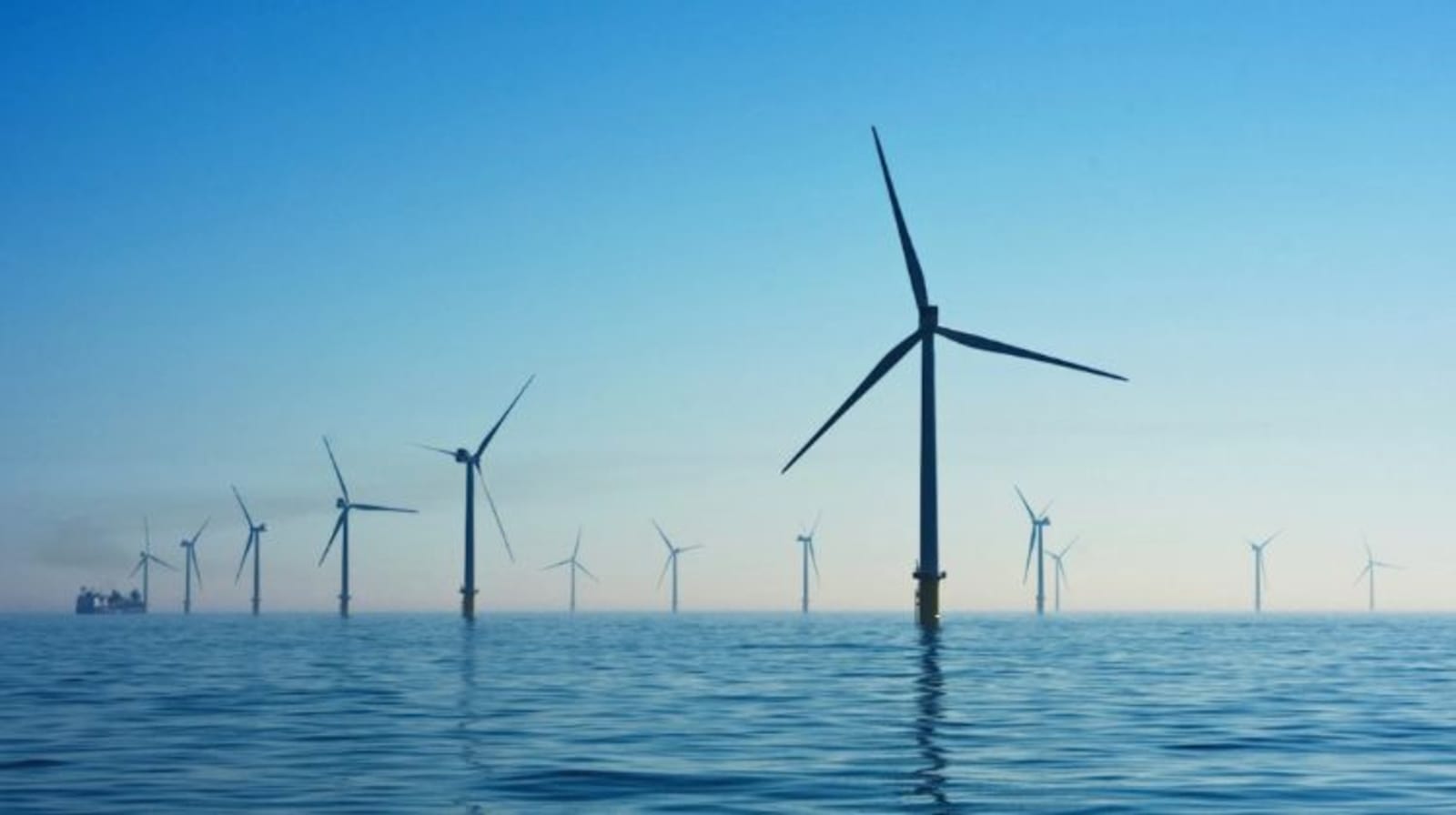
The UK and Japan formalized a strategic agreement to boost a 5.9 GW portfolio of floating offshore wind projects and facilitate up to £9 billion of Japanese investment , through an industrial cooperation framework aimed at accelerating technological development, strengthening supply chains and expanding renewable generation capacity.
The agreement, signed on November 10, 2026 , establishes the basis for deepening bilateral collaboration in offshore wind energy, including fixed-foundation, floating, and deep-water wind, with the aim of facilitating joint investments and reducing the costs of these technologies.
The investment and capacity figures correspond to the targets previously announced by the British Government in June 2026, while the new agreement establishes the operational framework to advance that cooperation.
Among the identified projects are Ossian and Green Volt, off the coast of Scotland, and Erebus, in the Celtic Sea . According to government estimates, the UK's 5.9 GW portfolio could generate enough electricity to power approximately eight million homes once built.

The document, called the UK-Japan Offshore Wind Industrial Compact , was signed by Michael Shanks , UK Minister of State for Energy, and Takagi Kei , Japan's Minister of State for Economy, Trade and Industry.
The initiative is structured around four pillars: co-investment in offshore projects, development and demonstration of floating technologies, strengthening of supply chains, and regulatory cooperation .
Through this scheme, both governments seek to combine British experience in energy policies, market mechanisms and the execution of wind farms with Japanese industrial and manufacturing capabilities.
The signing represents a new step forward in a relationship that already had a bilateral cooperation memorandum since March 2025 and was deepened during the Energy and Climate Dialogue held in February 2026.
Up to £9 billion to boost a 5.9 GW portfolio
One of the main objectives of the cooperation is to facilitate the entry of Japanese capital into the British floating offshore wind energy market.
In June 2026, the UK Government had unveiled an initiative aimed at mobilizing up to £9 billion of Japanese investment , with the purpose of supporting projects under development and strengthening the sector's industrial capabilities.
The commitment was linked to a potential portfolio of 5.9 GW of floating offshore installations , a technology that allows wind resources to be harnessed in marine areas where the depth makes it difficult to use traditional foundations fixed to the ocean floor.
The developments mentioned by the Government include Ossian, Green Volt and Erebus, which feature different scales of capacity, locations and stages of development.
Ossian , located off the east coast of Scotland, is one of the largest projects in this portfolio, with a planned capacity of up to 3.6 GW.
The development involves SSE Renewables, Copenhagen Infrastructure Partners and the Japanese company Marubeni, through an investment structure that reflects the participation of international capital in the British wind power expansion.
For its part, Green Volt , also located off the coast of Scotland, has approximately 560 MW of installed capacity and includes participation from the Japanese company TEPCO.
The installation is geared towards the use of floating wind technology and is part of the developments that seek to expand its commercial application in British waters.
The third highlighted project is Erebus , located in the Celtic Sea, with a planned power of approximately 100 MW.
This initiative is linked to TotalEnergies and Simply Blue Group, and constitutes another of the developments considered within the British strategy for deploying floating wind turbines.
British authorities estimate that the development of the identified portfolio could contribute to generating specialized employment in engineering, manufacturing, installation and maintenance of marine infrastructure.
However, the £9 billion represents an expected investment and not committed funding through the signing of the new agreement .
The implementation of the facilities will depend on final investment decisions, authorizations, commercial conditions and financing mechanisms specific to each project.
The agreement signed in November also does not establish a single construction schedule for the 5.9 GW, but seeks to create conditions of cooperation that facilitate its development.
Floating technology, supply chains and cost reduction
In addition to promoting investment, the agreement includes a technological cooperation agenda to accelerate the commercial deployment of floating offshore wind farms.
Continue reading
One of the central objectives is to develop shared technology roadmaps to reduce costs and facilitate the implementation of larger-scale projects .
In this context, the authorities will seek to coordinate testing, demonstration and standardization activities for floating foundations, components and other systems necessary to operate in deep waters.
The document contemplates the participation of specialized organizations such as Offshore Renewable Energy Catapult , from the United Kingdom, and Floating Offshore Wind Technology Research Association , from Japan.
Both entities will be able to deepen the exchange of experiences related to research, technological demonstration and validation of solutions for the sector.
The cooperation also includes activities related to underwater engineering, robotics, digitalization and technologies applied to supply chains.
In particular, the agreement identifies opportunities to adapt knowledge and components used in fixed-foundation wind projects to future floating installations.
This line of work aims to facilitate manufacturing and technological development processes that allow progress from demonstration projects to larger commercial parks.
Another relevant aspect is the search for a more competitive, diversified and resilient supply chain , through collaboration between manufacturers, developers and public bodies.
The governments will promote exchange between British and Japanese companies to identify opportunities for the production of wind turbine components, associated infrastructure and technical services.
Cooperation in wind turbine manufacturing technologies is also planned, with special attention to the needs arising from the development of floating installations.
The activities may also involve engineering companies, digital solution providers, and research institutions from both countries.
The United Kingdom will share its regulatory expertise with Japan
The fourth component of the partnership is geared towards the exchange of regulatory and market knowledge.
The United Kingdom will offer its expertise in financing offshore wind projects, designing contracting mechanisms, regulation, integration into the electricity grid and assessing environmental impacts .
It will also cover aspects related to technical standards, industrial certifications and training of specialized professionals.
The cooperation will seek to support the development of the Japanese market, particularly in its first offshore wind projects with fixed foundations, through the exchange of experiences and regulatory tools.
The British side will include the Department for Energy Security and Net Zero, the Department for Business and Commerce, and other specialized institutions.
Among the latter are Ofgem, the National Energy System Operator and Offshore Renewable Energy Catapult , which will be able to collaborate on issues related to regulation, system operation and technological integration.
In Japan, coordination will be handled by the Ministry of Economy, Trade and Industry , which will work with the relevant entities to facilitate technical exchange and trade cooperation.
The implementation of the agreement will be coordinated by Great British Energy and the UK Department for Energy Security and Net Zero, together with the Japanese ministry.
The document includes periodic follow-up meetings, including annual meetings at the management level within the existing bilateral cooperation mechanisms.
In addition, the authorities expressed their intention to evaluate the possible incorporation of other international partners interested in advancing the development of floating offshore wind power.
The commercial relationship between the two markets already has relevant precedents, such as the creation of JERA Nex bp and the participation of Japanese companies in British projects awarded through different rounds of contracting.
Consequently, the formalization of the new agreement seeks to consolidate a framework that allows linking investments, industrial capabilities and regulatory knowledge.

 By Emilia Lardizabal

 By Matías Medinilla

 By Energía Estratégica