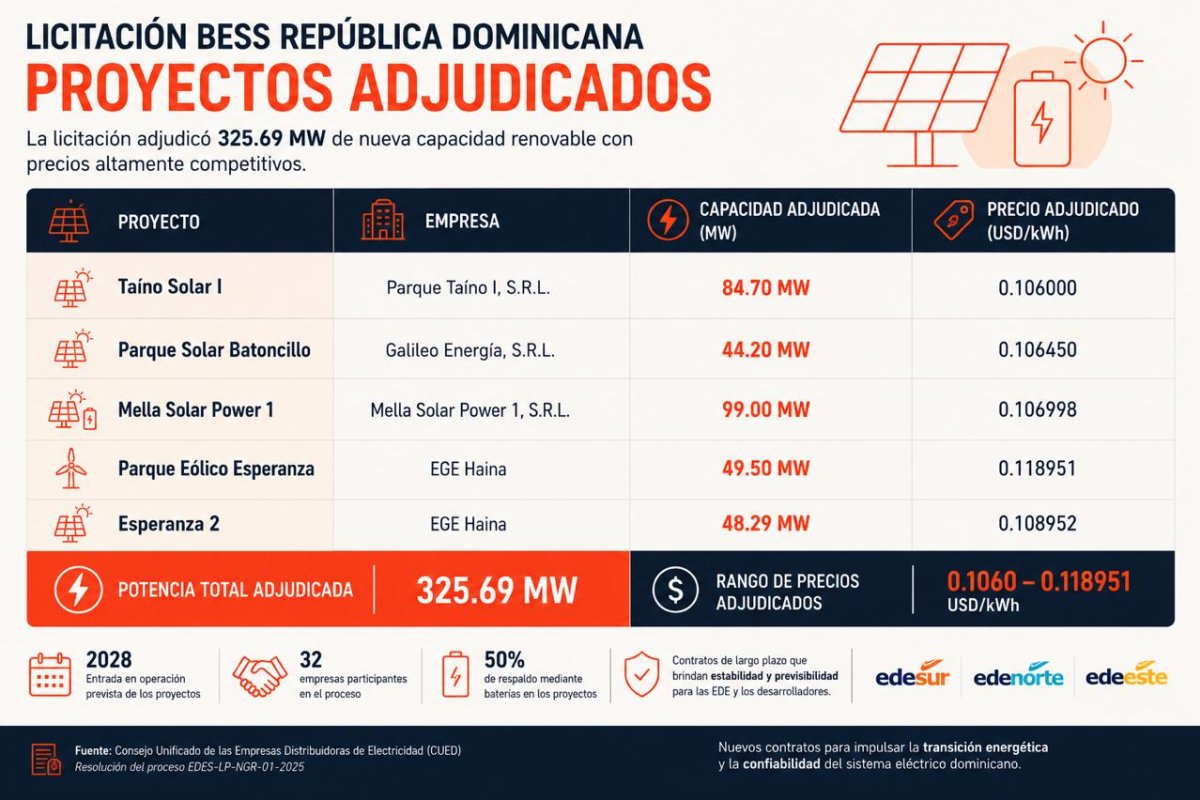
The Dominican Republic will return to the market in the coming weeks to contract another 300 MW of renewable generation, after awarding only 325.69 MW of the 600 MW originally tendered .
In parallel, the Unified Council of Electricity Distribution Companies (CUED) will open an independent process to incorporate 200 MW of BESS systems into existing solar plants, with the aim of strengthening the operation of the electricity system.
"In the next three or four weeks we are going to launch another 300 MW process," announced the president of CUED, Celso Marranzini , during the signing of the power purchase agreements derived from EDES-LP-NGR-01-2025.
"Furthermore, the tender specifications for 200 MW of batteries for existing solar plants will be released next week," he added.

This initiative "would not only help the system, but will also help with the integration of both solar and baseload energy, that is, thermal energy," one of the main challenges facing the Dominican electrical system as the share of renewable sources increases.
However, sources close to Energía Estratégica maintain that the battery initiative is not yet official, as it "clashes" with ETED's 1200 MWh project.
CUED also reported that the process registered the highest participation ever achieved in an electricity generation auction in the Dominican Republic , with 32 companies submitting bids.
The contracts were signed to supply Edesur, Edenorte and Edeeste , distributing the awarded capacity as 35% for Edesur, 30% for Edenorte and 35% for Edeeste .
The awards were distributed among five developers. Parque Taíno I obtained 84.70 MW for the Taíno Solar I project; Galileo Energía was awarded 44.20 MW with the Batoncillo Solar Park ; Mella Solar Power 1 received 99.00 MW for the MSP1 project; while EGE Haina obtained 49.50 MW for Esperanza Eólico and 48.29 MW for Esperanza Solar II , according to the official resolution of the process.
According to CUED, the projects will begin to be incorporated into the Dominican electrical system in 2028 , contributing to diversifying the energy matrix, reducing dependence on imported fuels and supporting the strategy of the Luis Abinader Government to accelerate the energy transition and the electrification of transport.
The reason behind the concession: more competitive prices
The decision to award the contract "cut" the initially planned capacity raised doubts among the developers who participated in the process.
Marranzini attributed that result to the criteria applied by the evaluation committee when applying a " curve on the best prices" , explaining why the process did not complete the capacity initially planned.
This criterion was also reflected in the final contract values, since at the time of the award there were offers between USD 0.085/kWh and USD 0.131/kWh , in addition to blocks at USD 0.093/kWh and USD 0.106/kWh , reflecting a wide dispersion of prices among the proposals submitted.
Finally, four of the five awarded projects were priced between USD 0.1060 and USD 0.1090/kWh, values that CUED highlighted as record prices for this type of contract in the Dominican Republic. These projects included Taíno Solar I (USD 0.106000/kWh), Batoncillo Solar Park (USD 0.106450/kWh), Mella Solar Power 1 (USD 0.106998/kWh), and Esperanza 2 (USD 0.108952/kWh). The only exception was Esperanza Wind Farm , awarded at USD 0.118951/kWh .
The EDES-LP-NGR-01-2025 had already set a precedent by requiring that awarded projects incorporate 50% battery backup , becoming one of the first processes in the region to combine new renewable generation and storage within the same contracting scheme.