


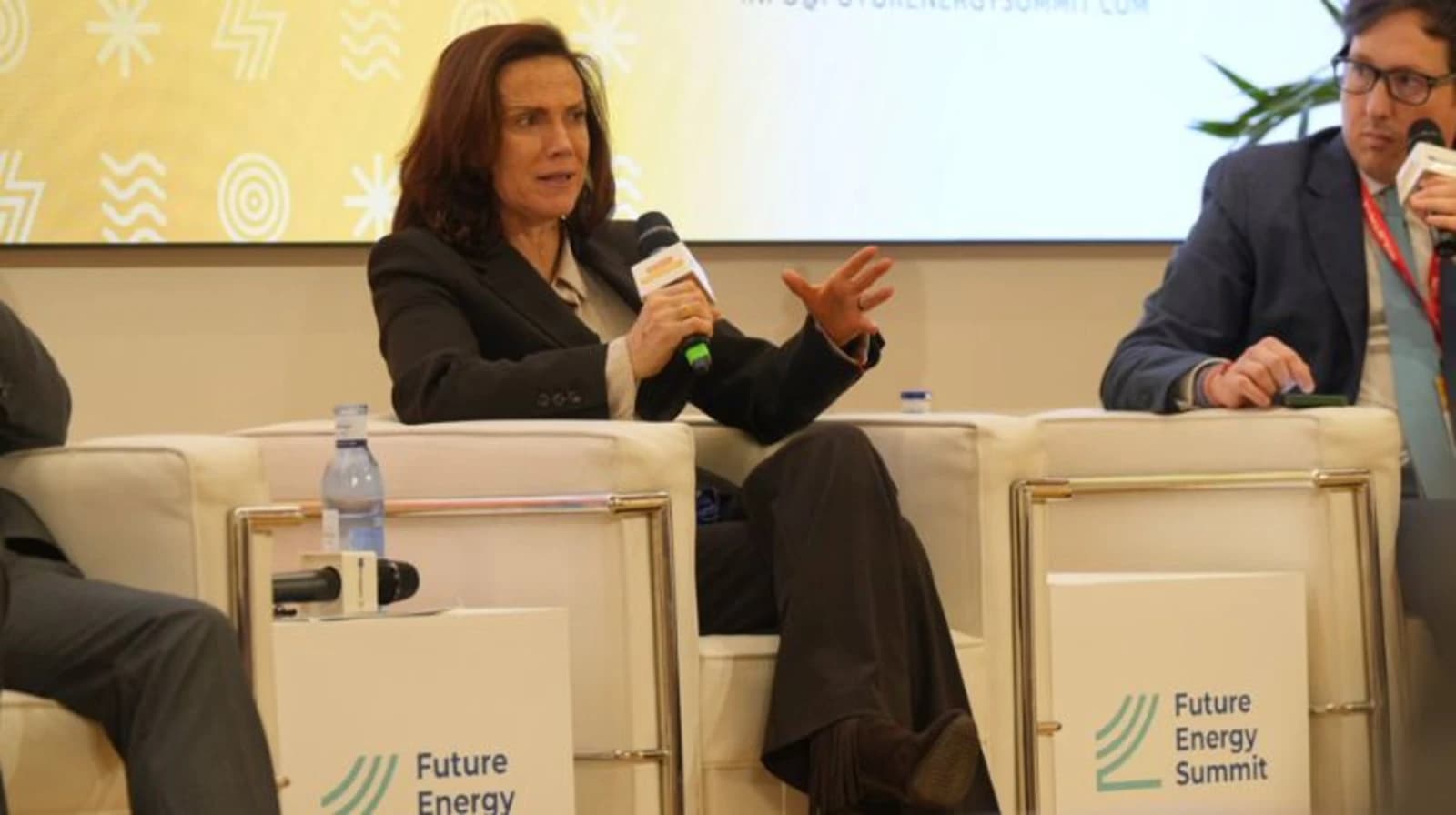
Rocío Sicre , CEO of EDP Spain , warned that the country could become one of the major centers for attracting renewable capital in Europe or lose that opportunity due to a lack of infrastructure and clear regulatory signals.
We need investment in networks and we need investment in demand.
Capital is mobile and can choose to come to Spain or go to any other country.
"We have all the conditions: competitive price, clean energy and one of the best connectivitys in Europe, but we must be able to take advantage of that," Sicre stated during FES Iberia 2026, before 500 executives from the sector, when he argued that the bottleneck is no longer generation but the network and the transformation of consumption.

"For every euro invested in generation, only 0.4 is invested in networks; it doesn't make sense," he stated.
Added to this is a structural fact that conditions the integration of renewable energy across the continent: 40% of the European grid is over 40 years old.
"I would ask the regulator to seek that balance."
"We need to open the doors to demand, avoid over-regulation, and seek a balance between long-term visibility for investment, the security of an economic framework, and a stable regulatory framework, which do not exist right now," the executive pointed out.
This lack of predictability, he explained, ends up affecting both new generation projects and the development of electrified consumption.
The saturation of nodes and the simultaneous bidding processes for generation and consumption capacity are creating a paralysis that, in practical terms, limits the expansion of the system.
"We are leaving almost all the nodes at the tender level, which is causing a paralysis in the development of demand, and what cannot be is that we have a system in which there is no more capacity," he argued.
For Sicre, the risk is not technological but structural, given that without modernization of the infrastructure and without clear regulatory signals, the integration of new capacity and the arrival of capital could slow down.
In that context, he insisted that the energy transition can no longer be analyzed exclusively from a climate perspective: "The transition goes a little beyond what is merely climate-related; we are now talking about security, about energy independence."
Hybridization and storage: the technological response to a strained systemFaced with a system that requires greater flexibility and integration capacity, EDP has been advancing in an operating model based on technological complementarity.
For Sicre, the discussion is no longer limited to producing more renewable capacity, but to better managing its contribution to the system.
"We are no longer looking to produce more megawatts, it's about when and how to produce them," he stated during the meeting.
That logic explains the hybridization strategy that the company began in 2016 with a pilot project that combined hydraulic and solar power.
In 2022, it launched a floating solar project integrated with hydropower in Alqueva, Portugal; and a year later it advanced with schemes that combine hydropower, solar and wind in Poland and Iberia, to the point that it currently exceeds 1 GW in photovoltaic projects in its portfolio in the region.
Furthermore, the next stage incorporates storage as a structural part of the model, so the company will launch its project with wind, solar and battery power.
From his perspective, batteries should not be analyzed as a conventional load, but as a system management asset, although he also emphasized the regulatory issue and how BESS systems compete with any consumption; therefore, he highlighted the importance of placing " the concept of flexibility."
For the CEO of EDP Spain, recognizing the flexible nature of storage is key to optimizing the existing network, improving renewable integration, and providing stability in an environment of greater variable penetration.
The group's technology strategy thus aligns with the structural diagnosis presented to the regulator: without modern infrastructure and without differentiated rules for flexible assets, the system will lose efficiency and competitiveness in attracting investment.