


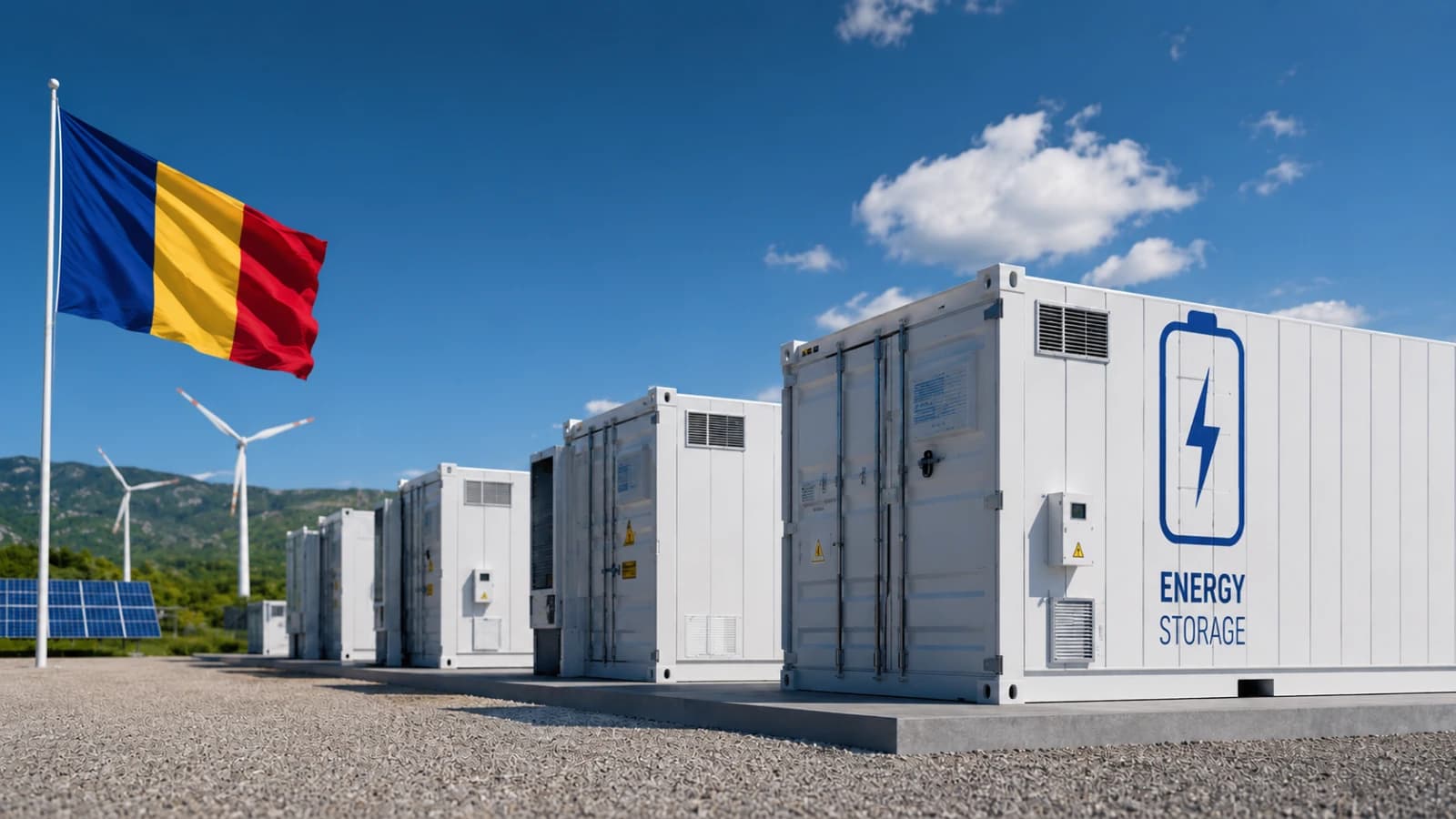
Romania has launched a new auction aimed at accelerating the deployment of large-scale energy storage , with a budget of 150 million euros from the Modernisation Fund and reserved for new stand-alone battery installations.
The mechanism seeks to award projects that, together, incorporate at least 2174 MWh of capacity , in an electrical system where the advancement of renewables increases the need for flexibility, balance and tools to manage network congestion.
The call was formalized through Order No. 915 of the Ministry of Energy, dated August 14, 2026 , which approved the Applicant's Guide and the conditions of access to the Key Program 1 of the Modernization Fund, aimed at renewable sources and storage.
The 150 million euros will not be distributed as a conventional subsidy , but through a competitive tender in which the level of aid requested for each MWh installed will have a determining weight in the award.

According to the technical and economic evaluation grid, the proposal requesting the lowest state support in euros/MWh will receive 100 points, while the highest will receive zero . Intermediate bids will be scored proportionally, making the efficient use of public funds a central variable in the competition.
Thus, the design aims to mobilize the largest possible volume of storage within the available budget . The support can cover up to 100% of eligible costs, although with two additional limits: €69,000/MWh installed and €15 million per company , regardless of the number of projects submitted.
When the overall cost of the investment exceeds the aid recognized, the beneficiary must cover the difference with own resources or external financing that does not constitute other state aid applied to the same eligible expenses.
The tender is aimed exclusively at new autonomous battery storage systems , connected directly to public transport or distribution networks and capable of operating independently of generation plants or consumption centers.
Each installation must have its own dedicated connection and metering point , draw the electricity needed for charging from the public grid, and then feed it back into the same infrastructure. For this reason, the program excludes assets physically integrated with solar, wind, or other generation plants.
Among the technical requirements is also a minimum duration. The ratio between storage capacity in MWh and power in MW must be at least 2:1 , equivalent to two hours of discharge at nominal power.
In turn, each installation will have to have a minimum capacity of 1 MW . When a project includes several aggregated units, this threshold will be applied individually to each system.
Once operational, the assets will be able to participate in electricity markets and, where applicable, in system services, either directly or through aggregators. Arbitrage, frequency regulation, balancing, and congestion management are emerging as some of the main ways to monetize BESS.
Continue reading
The Guide expressly excludes hybrid renewable generation and storage projects, the replacement of old installations, proposals submitted in partnership, and lead, nickel-cadmium, or nickel-metal hydride-based batteries .
Micro-enterprises, small and medium-sized enterprises, large corporations, and even newly established companies are eligible to participate. For the latter , a minimum paid-up share capital of 100,000 lei is required, and all applications must be submitted individually. The awarded assets must be put into service within a maximum of 48 months from the date the grant is awarded .
The funds may be used for new equipment and works related to the construction of the systems , while excluding, among other things, land, VAT, used equipment, operating costs, certain connections, financial expenses and preparatory work such as permits or feasibility studies.
Storage gains importance in the face of Romania's renewable energy growth
The announcement comes as Romania's renewable energy portfolio grows at a much faster rate than the number of projects that will ultimately reach the construction stage . According to the recent update by Energia Estratégica , the pipeline exceeds 113 GW , although approximately 89% is not expected to become operational within the next five years , leaving roughly 11% with the potential to materialize during that period.
The scale of the pressure on infrastructure is also reflected in grid connection permits. By the beginning of 2025, more than 1,200 renewable energy projects, equivalent to approximately 60 GW, already had grid connection approvals , although only 11% had all the necessary permits and few incorporated storage.
Given this scenario, the Romanian government anticipates that battery development will contribute to reaching 1200 MW and 2400 MWh by 2030 , while the target for 2035 is 2000 MW of capacity . The new competitive bidding round alone could cover a minimum of more than 2.1 GWh .
The government links this strategy to absorbing surplus renewable energy, reducing congestion, moderating imbalances between production and demand, and partially displacing fossil fuel generation during peak hours . In addition to these functions, it also offers the possibility of providing frequency and balancing services.
The initiative is also part of an energy policy that already uses competitive mechanisms to promote new generation. In its first contract for difference (CfD) auction , Romania awarded 1,528 MW , distributed between 1,096 MW of wind and 432 MW of solar , with average prices of €65/MWh for wind and €51/MWh for solar .
The second round increased the awarded volume to approximately 2.75 GW , with 1,488 MW of solar and 1,260 MW of wind power . Photovoltaic projects closed at an average price of €40.46/MWh , while wind power projects averaged €73.8/MWh .
This progress in competitive processes is also beginning to serve as a benchmark for other commercial instruments. The Romanian Power Purchase Agreement (PPA) market tripled its contracted volume during 2024 , with indicative prices between €65 and €85/MWh , in parallel with a scenario where liquidity and regulatory changes continue to be among the main variables monitored by industry players.
With this new call for proposals, the competitive logic now extends specifically to energy storage . The ranking will depend not only on the size of each project, but also on its capacity to meet the technical and eligibility requirements with a lower need for state backup per MWh.
If the minimum volume is awarded, Romania will add at least 2174 MWh of stand-alone BESS capacity , while reinforcing the flexibility of the system and the infrastructure needed to integrate a renewable portfolio that continues to expand.