


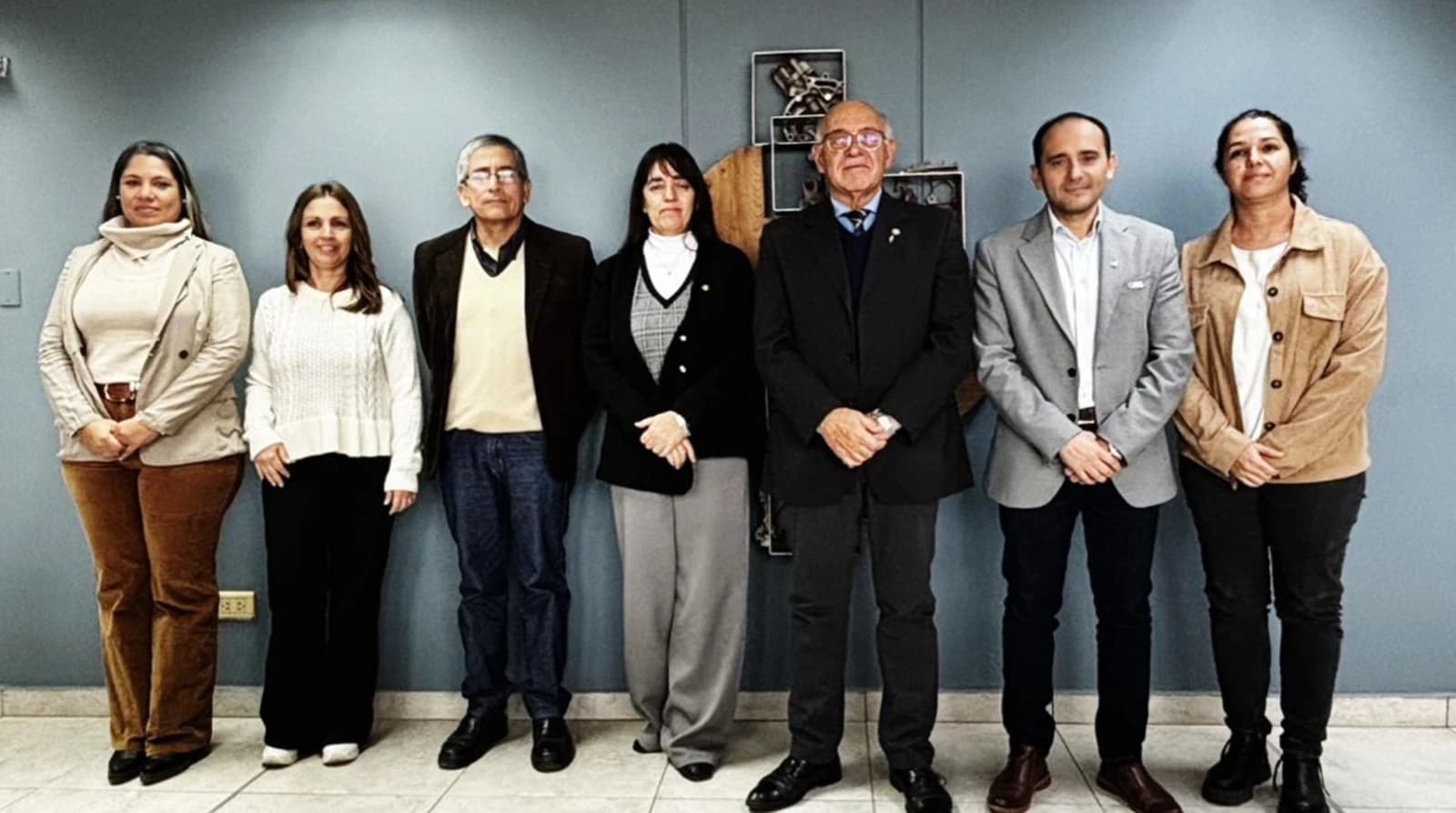
Energía Provincial Sociedad del Estado (EPSE) and the National University of San Juan (UNSJ) signed a cooperation agreement to develop the first Geothermal Map of the Province of San Juan, a study that will allow the identification and characterization of geothermal resources in different points of the provincial territory.
The agreement was signed by the president of EPSE , Lucas Estrada ; the rector of UNSJ, Tadeo Berenguer ; and the dean of the Faculty of Exact, Physical and Natural Sciences, Jorge Castro . The project will last two years and will be carried out by the university's Geothermal Center.
During the presentation, Estrada highlighted that the study will allow for the completion of the survey of the province's main renewable resources.
“A few years ago we developed the solar and wind maps of San Juan. This geothermal map completes the province's renewable energy map and has a very important feature: it will be developed in conjunction with the National University of San Juan, using local knowledge and capabilities,” he noted.

The head of EPSE also explained that the project responds to a State policy promoted by the Government of San Juan to strengthen the development of renewable energies.
“We have a mandate from Governor Marcelo Orrego to work diligently on the renewable energy development of the province. In San Juan, this is a state policy, and this project represents another step in that direction,” he stated.
The initiative will generate strategic information for future projects related to electricity generation, heating, building air conditioning, and industrial applications linked to geothermal energy use.
For his part, Rector Tadeo Berenguer highlighted the collaboration between the university and the provincial government for the development of applied knowledge.
“That the Government of San Juan continues to trust in the public university and its researchers is fundamental to continue providing concrete tools for the development of the province,” he said.
The project's technical manager, Sofía Pérez Luján , explained that the study will incorporate specialized equipment to measure subsurface temperatures and create low, medium, and high enthalpy maps, allowing the identification of different potential uses of geothermal energy.
With this project, San Juan will move towards creating the first comprehensive map of renewable resources in an Argentine province, incorporating solar, wind, and geothermal information into a single energy planning strategy. The information obtained will be available for future investments and projects that contribute to the province's productive and energy development.