


Energy storage in Peru would gain momentum with the recent modification of Law No. 28832 , which introduces changes in the provision of Complementary Services within the Peruvian electricity market.
These new conditions, which will come into effect on January 1, 2026, open up opportunities for the expansion of BESS (Battery Energy Storage Systems) projects, mainly associated with power generation plants.
One of the most relevant changes is the inclusion of Complementary Service Providers as system agents, expanding the scope of the regulations beyond generators, transmitters and distributors.
Furthermore, the new regulation assigns responsibility for payment for these services to those who generate instability in the electrical system, a point that, according to Margarett Matos , Senior Associate Lawyer at Rodrigo, Elias & Medrano Abogados , is interesting for the sustainability of the market even though we must wait to see how this provision will be regulated.

In a conversation with Energía Estratégica, the lawyer from the firm Rodrigo, Elias & Medrano Abogados , noted that Peru has at least 10 energy storage projects in operation, implemented before the law update by owners of generation plants to provide Primary Frequency Regulation (PFR) services, which were already mandatory for all plants with a capacity greater than 10 MW. "The percentage that generators > 10 MW (except wind, solar, and tidal) must cease operating to contribute to PFR is 2.5%," Matos points out.
As a result, several companies have already opted to install battery banks.
Among the most emblematic projects are those promoted by Kallpa, Engie, Enel, Minera Poderosa and GR Cortarrama , exceeding 70 MW of equivalent capacity in BESS.
- Kallpa Generación SA has the project "Battery Energy Storage System (BESS) of the CT Kallpa for Primary Frequency Regulation.
BESS power 31.32 MW and 20.28 MWh.
- Engie Energía Perú SA has the project BESS battery bank storage system for the Primary Frequency Regulation of the Chilca 1 Power Plant.
BESS power 26.5 MW and 13.25 MWh
- Enel Generación Perú SAA has the project BESS battery bank storage system for the Primary Frequency Regulation of the Ventanilla CT.
BESS power 14.63 and 5.04 MWh
- GR Cortarrama SAC would have continuous power from independent battery banks, according to the EO, at the Matarani 1 and 2 Solar Power Plant of 80 MW each.
Companies have requested the inclusion of batteries within the Transmission Plan, considering them a viable alternative to provide greater stability to the network and to delay or complement investments in infrastructure.
In the generation sector, energy storage is also seen as a key tool for energy arbitrage and optimization of grid injection.
The increasing penetration of solar and wind projects in the country has begun to generate congestion problems at some nodes of the electrical system, leading companies to seek storage-based solutions. "Just as is happening all over the world, in Peru there are also nodes that will become congested, nodes where multiple renewable projects, wind and solar, are being developed, and we know that sooner or later congestion and curtailment will occur," warns Matos. "So in these curtailment scenarios, companies will likely be able to choose to store the energy that would otherwise be 'injected' so that it can be injected into the system when needed."
The amendment to Law No. 28832 allows Complementary Services to be provided by different types of actors, not only by generation plants; also giving rise to the use of energy storage solutions not only for primary frequency regulation but also for energy accumulation, voltage regulation, black start and other auxiliary services.
However, challenges remain for promoting stand-alone storage projects, that is, independent battery projects that are not associated with a generation plant: "Currently in Peru, there are several challenges and risks to developing stand-alone BESS projects.
"We need a clearer definition of how they will operate, what permits they will obtain, how they will connect, their operation, and the associated charges."
Pending further clarity and its implementation starting January 1, 2026, the trend points to a very attractive environment for the development of energy storage projects in Peru.
With the evolution of the regulatory framework and the advancement of technology, battery banks would be ready to play a key role in the stability of the electrical system and the integration of renewable energies in Peru. 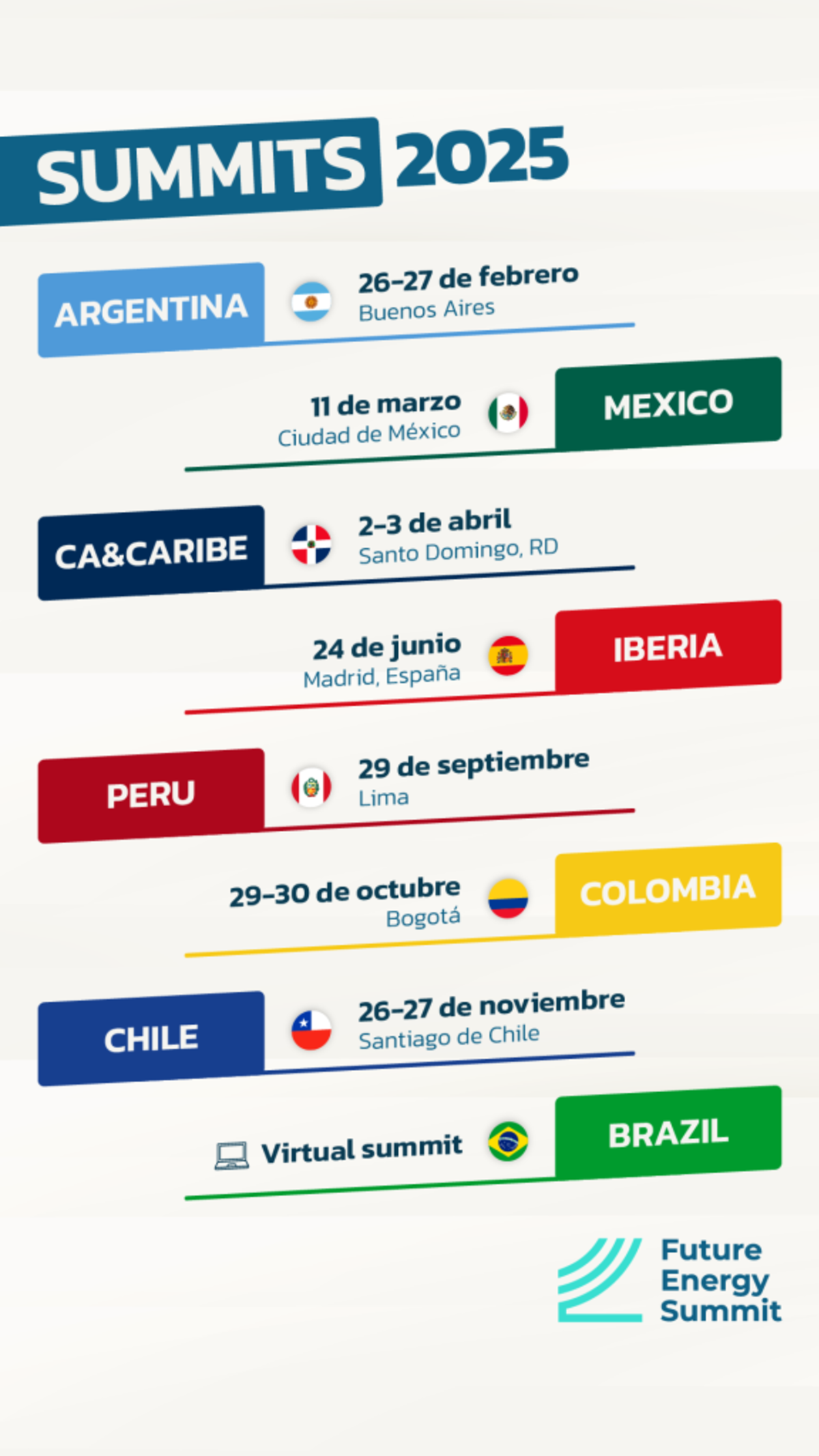
Mega event in Peru As part of the progress towards energy diversification proposed by the modification of Law No. 28832, Future Energy Summit (FES) will hold a mega renewable energy event in the country on September 29, which promises to bring together hundreds of executives from the sector, as it has been doing in other latitudes.
It is worth noting that in February, on the 26th and 27th at the Hotel Emperador in Buenos Aires, more than 500 industry leaders will participate in the meeting, at a time when the energy sector is awaiting the update of new MATER mechanisms, the definition of new electric transport works and a public tender for approximately 500 MW of battery system power.
The tour will then continue in Mexico on March 11 with FES Mexico, and on April 2 and 3 at the Intercontinental Hotel in Santo Domingo, Dominican Republic, FES Caribe will take place.
In both cases, the main companies in the sector will assess the reality of the market and the region.
It is worth noting that the meetings include exclusive networking spaces.
For ticket or sponsorship inquiries, please contact commercial@strategicenergycorp.com