

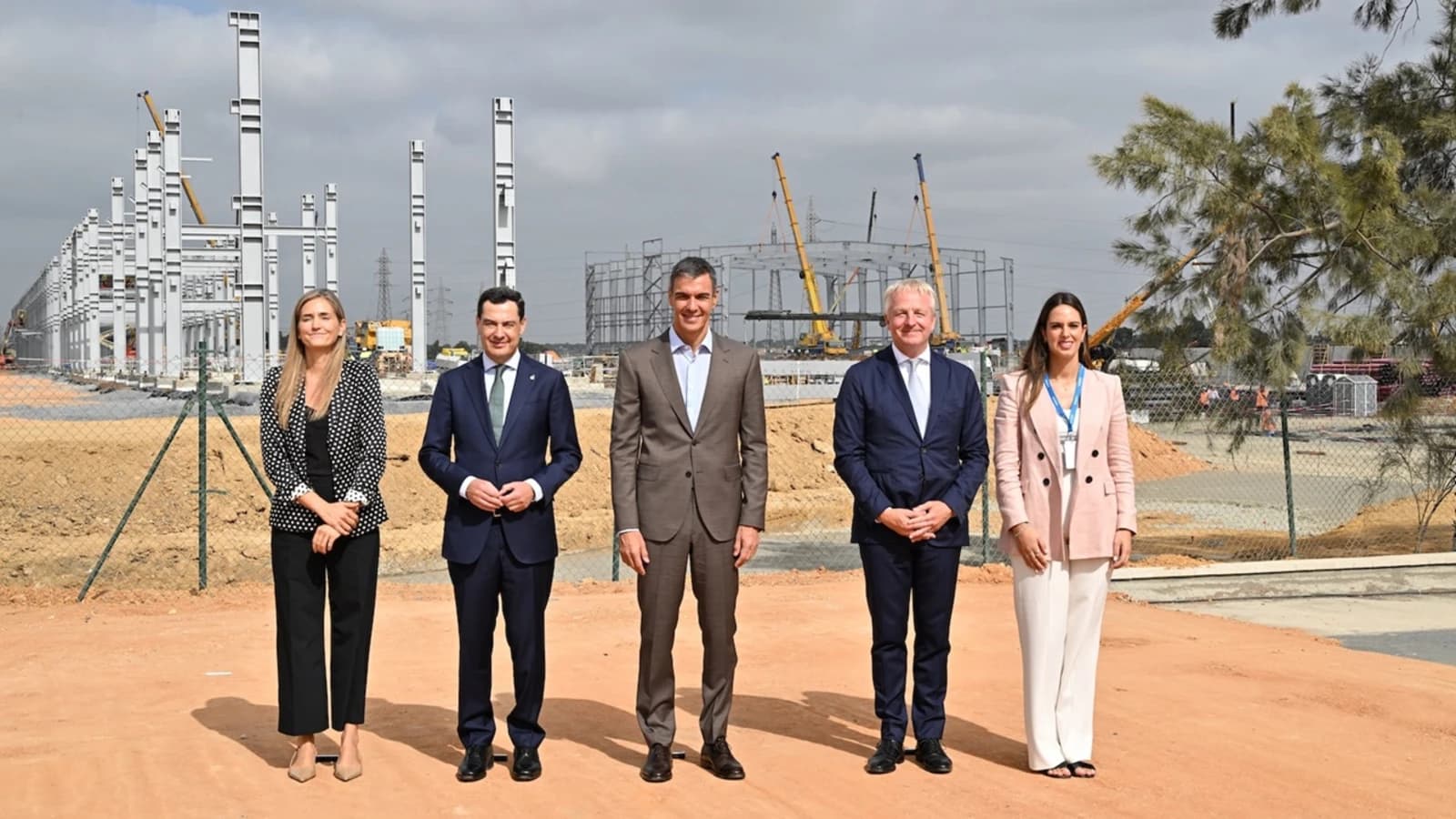
Spain has begun construction of the first phase of the Andalusian Green Hydrogen Valley, a project that aims to reach 2 GW of electrolysis and which Moeve presents as the largest development of its kind in Europe.
The initial phase, called Onuba , will be located in Palos de la Frontera, Huelva, and will have 300 MW of electrolysis capacity , expandable by another 105 MW. The total investment exceeds €1 billion , including associated infrastructure and a self-consumption photovoltaic plant.
Once operational, the facility will be able to produce around 45,000 tons of renewable hydrogen per year and avoid about 250,000 tons of CO₂ annually .
“Today we leave behind the era of green hydrogen pilot projects to move towards the construction of large-scale projects,” said Maarten Wetselaar , CEO of Moeve, during the groundbreaking ceremony.
The development will be led by Moeve, with a 51% stake. Hy24 and COFIDES will jointly hold another 29%, while the remaining 20% will be held by Enagás Renovable and Alter Enersun.
The first phase also has €304 million in public funding granted by the Government of Spain within the program to support Renewable Hydrogen Valleys.
Pedro Sánchez highlighted that the Spanish Executive has already allocated more than €3 billion to more than 120 renewable hydrogen projects and noted that Onuba received more than €300 million in public support.
The project was also recognized by the European Union as a Project of Common Interest (PCI) .
The production will be used to replace fossil fuels in sectors that are difficult to electrify, including road transport, aviation, shipping and energy-intensive industries.
The anticipated industrial impact is also significant. During the development, construction, and commissioning phases, the project is expected to generate over 8,000 direct, indirect, and induced jobs , as well as activity for more than 400 local SMEs and self-employed individuals.
From 300 MW to a 2 GW hub
Onuba is only the first piece of the Andalusian Green Hydrogen Valley.
The complete project includes 2 GW of electrolysis distributed between the energy complexes of Palos de la Frontera, in Huelva, and San Roque, in Cádiz.
Moeve combines this deployment with another major industrial commitment in Huelva: a new 2G biofuels plant that will produce sustainable aviation fuel (SAF) and renewable HVO diesel .
Overall, the company plans to invest €2.4 billion in Andalusia in industrial projects linked to the energy transition.
The strategy seeks to transform Palos de la Frontera into a hub for the production of green molecules and to take advantage of benefits such as land availability, port infrastructure and a renewable resource that is competitive with northern Europe.
Hydrogen will be a central piece of that equation, but not the only one. Moeve also aims at advanced biofuels and other molecules capable of reducing emissions in sectors where direct electrification has technical or economic limitations.
The leap in scale is significant: from an initial 300 MW plant to a global development of 2 GW , with public funding, private capital and industrial contracts as the basis for moving from pilot projects to projects with commercial ambition.