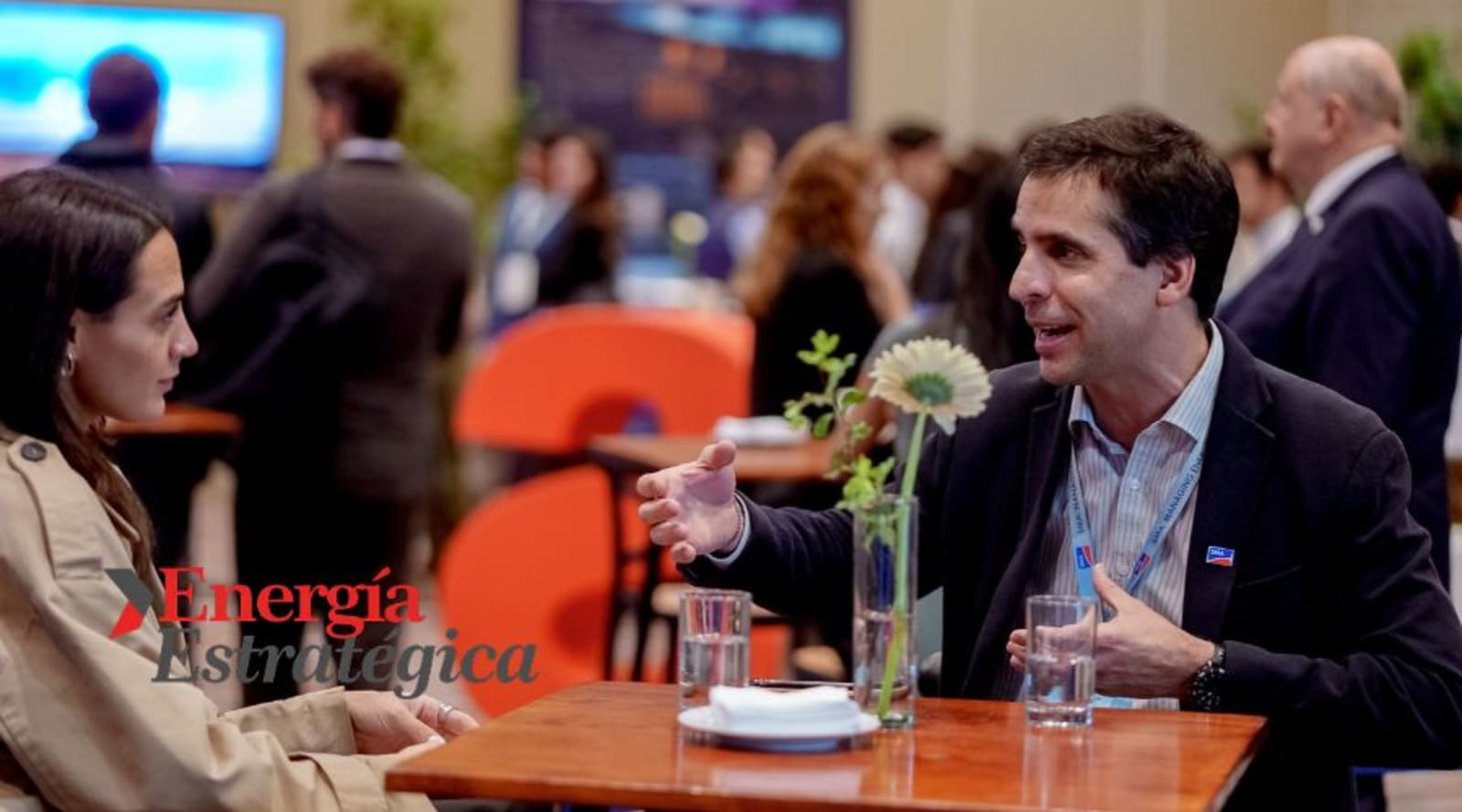
With 3,125 MW and 13,555 MWh of installed storage as of September 2026 , according to ACERA, Chile is going through a new stage of technological development, in which the profitability of hybrid projects and new electricity demands are beginning to modify investment strategies.
In this scenario, Daniel Rosende Völker, Managing Director Latin America of SMA , told Energía Estratégica , during FES Chile, about the company's next moves and the timeline for a technology that seeks to gain ground among the country's large generators.
“ We are already in very advanced talks with several clients negotiating the solution ,” the executive revealed, while setting a date for the next commercial milestone: the first facilities could be operational by the end of 2027 .
Following its international presentation at Intersolar Europe, the firm is preparing for the commercial launch in Chile at the end of November of an architecture that connects photovoltaic generation and batteries on the direct current side , reducing conversion stages and additional equipment.

Depending on the project configuration, significant savings in equipment are estimated, in addition to a significant improvement in round-trip efficiency.
The proposal is aimed primarily at independent power producers (IPPs) and large generators , in a market where renewable spills accumulated 3,546 GWh between January and September 2026 and the need to recover revenue is driving new storage strategies.
But SMA's next opportunity may not be limited to renewable energy plants: the company is also looking to bring its US expertise in electrical solutions for data centers to Chile , given the interest of artificial intelligence giants in developing large-scale facilities in the country.
The timing of the grid connection is particularly relevant given the difficulties photovoltaic generation faces in capturing revenue during certain time slots. Between January and September 2026, renewable energy sold in Chile totaled 3,546 GWh , a situation that is driving the search for alternatives to store surplus energy and sell it during periods of higher value.
The question now is how much of that potential can be translated into concrete investments, especially in a market where financing conditions and the remuneration of storage services are beginning to weigh as heavily as technological performance.
Artificial intelligence giants explore investments in Chile
What if the next big energy storage business in Chile isn't solely in renewable energy plants? SMA identifies a new opportunity in data centers , driven by the interest of major technology companies that have already begun exploring potential sites in the country.
“ Many of the well-known companies in the world of artificial intelligence, which we all know, have been visiting Chile for quite some time now, looking at where their projects, which will be on a very large scale, could eventually be located, ” Rosende revealed in an interview with this media outlet.
The potential of this segment is beginning to be reflected in the figures: according to Colliers, Chile has 36 operational data centers and 255 MW of installed capacity , in addition to 34 planned developments, including new installations and expansions. Of these, eight initiatives identified for completion by 2031 would add 367.8 MW and US$1.616 billion in investment .
But what role does the firm intend to play in this market? The company seeks to leverage the experience gained in the United States, where it has already completed its first power electronics and storage projects for data centers.
“ We have already closed the first projects in the type of solution we are providing based on power electronics with storage to replace other traditional forms of energy supply and stability that data centers have ,” he explained.
The technology strategy includes SMA's GridAssist, GridLink AC, and GridLink DC solutions, three architectures launched in 2026 to manage demand fluctuations, improve power quality, and meet the electrical needs of artificial intelligence. The latter includes 800-volt DC applications, with deployment planned for 2027.
However, the difference could lie in a function that transcends the electricity supply: converting high-consumption installations into resources capable of contributing to the stability of the network , through BESS systems and Grid Forming technologies.
“ Even today, what’s happening is that the data center can be what’s called an energy asset. It can provide a stability solution at the connection node ,” he said.
Under this model, batteries and power electronics could provide voltage and frequency support, as well as manage consumption variations in installations that, due to their scale, pose new challenges for electrical systems.
In Chile, the development of these applications will depend on connectivity conditions, permits, and the technical requirements of each project. Rosende believes the current framework offers opportunities for progress , and SMA is interested in exploring ways to promote these types of solutions in the Chilean market.
From arbitrage to stability: where will the next profitability of storage lie?
The growth of battery storage and energy efficiency (BSE) systems in Chile raises a question that is beginning to spread to the rest of Latin America: will simply buying and selling energy at different times be enough to guarantee the profitability of the batteries? For the company, the next stage will be marked by the incorporation of stability services, such as frequency control, inertia control, and black start , which could diversify the revenue streams of the projects.
“ These other concepts are not just a matter of technical requirements, but also the possibility of generating additional income for the different companies involved in generation ,” he noted.
Chile has already begun adapting its requirements to this evolution. In May 2026, the National Electric Coordinator published a guide for verifying installations with Grid Forming inverters, although technical recognition of these features still does not guarantee sufficient compensation for developers .
“ We are doing well on the technical side, but we are failing on the economic side ,” warned the executive, who believes that the next regulatory challenge will be to create conditions to monetize the services that batteries can provide to the electrical system.
Uncertainty also extends to financing, especially in a market where curtailments and exposure to low prices during daylight hours are changing banks' preferences, which are showing greater interest in BESS and hybrid projects compared to new independent photovoltaic plants.
“ The era of having a very open source of financing for solar projects is over, at least for this period, ” Rosende said.
Could this scenario be repeated in other countries in the region? The executive is already involved in opportunities related to capacity reservation tenders in Brazil and is supporting partners who are developing their first storage projects in Mexico, Argentina, and several other countries in the region .
From the perspective of the interviewee, with more than 15 years of experience in the company, Chile offers a reference for its incorporation of international regulatory experiences, particularly from the United Kingdom, although it still has pending challenges to translate technical requirements into economic opportunities.
“ The new regulations in Chile are a good sign, because we are looking where we need to look – at the most advanced markets in the world, such as the United Kingdom – and we are not trying to reinvent the wheel ,” he commented.
With almost 15 years at SMA and participation in the opening of its operations in Chile, Brazil and Mexico, the executive observes how storage is beginning to gain prominence in sectors that exceed renewable generation.
The question for 2027 will no longer be just how many megawatts of batteries will be installed, but which markets will be able to remunerate their new functions and turn that technological potential into bankable investments.
 By Ailén Pedrotti
 By Energía Estratégica

 By Matías Medinilla