Solis plans to accelerate the commercialization of energy storage systems in Latin America during 2027, following a year marked by the expansion of the commercial and industrial (C&I) segment, the incorporation of new technologies and the strengthening of its regional structure.
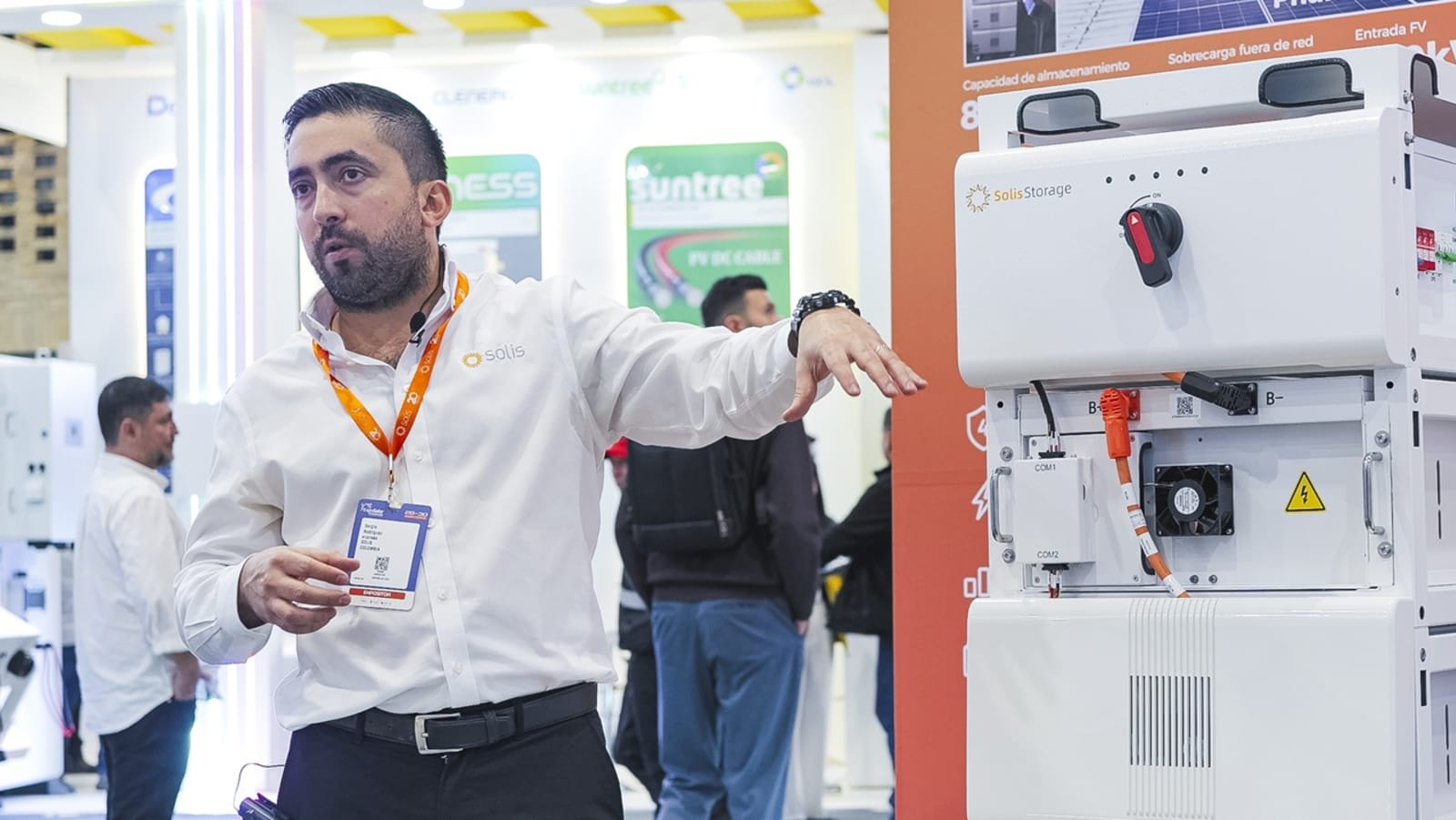
Sergio Rodríguez , Technical Director LATAM of Solis , estimated the company's commercial participation at "40% of the overall LATAM market share" in C&I and aims to continue increasing.
“What goal have we set for ourselves? I think we aim to sell at least 500 EverCores (depending on the solution, the power output could vary between 50 MW and 130.5 MW). We need to maintain a healthy market share and ensure that 100% of the projects are operational,” he stated. dialogue with Strategic Energy , during ExpoSolar Colombia 2026 .
The regional business shows a progressive recovery in activity, with a greater presence of commercial and industrial applications, accompanied by an internal reorganization and new training opportunities aimed at integrators, distributors and customers.

"The first quarter started a bit slowly but then picked up speed, for example in Mexico, Chile, and Argentina, mainly participating in C&I. In addition, a lot of effort has been made to strengthen the team, since there is a new product portfolio that requires training and development, as well as raising awareness among customers. It's a very dynamic market," Rodríguez stated.
It is worth remembering that the company launched its BESS segment in 2025 and began installing the first systems during 2026, while moving forward with new technological proposals.
Even during ExpoSolar Colombia 2026, it exhibited its SolisStorage portfolio, with special emphasis on EverCore 261 kWh and FlexCore-ID 80 kWh , geared towards commercial and industrial applications.
EverCore integrates batteries and a hybrid inverter into a single enclosure, with energy conversion and management functions. It features rapid transition between grid-connected and stand-alone operation, air cooling, and scalability.
The FlexCore-ID 80 kWh uses lithium iron phosphate (LFP) batteries with a modular, stackable architecture designed to adjust storage capacity to the specific characteristics of each installation. The updated product line also includes FlexCore-OD , an alternative that allows battery packs to be distributed as individual components.
"EverCore is an all-in-one cabinet. FlexCore, on the other hand, consists of individual, split battery packs. It's practically a custom-made suit," explains Rodríguez.
The configurations mentioned by the executive comprise 100, 120 and 261 kW for EverCore , compared to a range of 60 to 261 kW for FlexCore .
In the residential segment, Solis presented the 16 kWh IntelliHouse and the 15 kWh FlexHome-L , in addition to five S6 series inverter models for different photovoltaic applications.
"Obviously the interconnected part is quite interesting, but the hybrid part is what's moving the most," says the executive.
The international context also favors the deployment of these technologies, since according to the Global Solar Market Outlook 2026–2030 report by SolarPower Europe, global photovoltaic capacity added 664 GW during 2025 , raising the cumulative total to over 3 TW.
Meanwhile, the International Energy Agency (IEA) reported 108 GW of new battery storage capacity , representing a 40% increase over 2024.
Power outages and cost optimization drive investments in batteries
"I believe the most expensive energy is the energy you don't have. So, when you have a commercial or industrial project where you lose one or two hours of production, that has a very high cost for the client and is very difficult to quantify," Rodríguez warned.
Operational continuity is one of the main use cases for energy storage in production facilities. Other key applications include peak shaving , to reduce peak demand, and energy management, through consumption and grid injection strategies.
Site conditions, power requirements, consumption profiles, and operational constraints determine the choice of configurations.
"The key has been the follow-up during the pre-engineering phase. Understanding the client's needs very well, setting realistic expectations, and having a clear pre-design in advance makes the project successful. Then, you practically just turn it on as soon as you arrive," emphasized the Technical Director LATAM of Solis.
Looking ahead to the next fiscal year, the regional strategy includes strengthening support for integrators and clients to sustain the company's commercial growth.
"It's about trying to accurately reflect these client expectations, giving them the tools and knowledge they need to make the best decision. And if we're ultimately selected, advising them to ensure the project's success," he concluded.

 By Emilia Lardizabal

 By Energía Estratégica
 By Ailén Pedrotti