Colombia faces a paradox in the development of energy storage systems : intraday price differentials for four-hour batteries increased by 350% between 2021 and 2026 , according to Aurora Energy Research, but arbitrage opportunities have not yet translated into a massive deployment of this technology.
The consulting firm projects that the country will reach approximately 6 GW of installed solar capacity by 2030 , an expansion that will deepen the price differences between peak photovoltaic generation hours and periods of higher demand for flexibility. However, it warns that the financial viability of batteries will depend on complementary remuneration mechanisms, such as reliability payments and ancillary services.
This was stated by Melissa Carreño, Head of Peru and Colombia at Aurora Energy Research , during her presentation at Future Energy Summit (FES) Colombia 2026, where she analyzed the evolution of market signals and international regulatory experiences that allowed for the acceleration of investments in storage.
The executive identified a structural change in the formation of Colombian electricity prices, directly linked to the greater participation of photovoltaic generation.

In 2022, when solar penetration was below 5% , the intraday price curve maintained a relatively stable behavior, with moderate increases during periods of higher consumption.
Relive FES Colombia 2026 here:
Four years later, with solar power expected to reach 13% market share by 2026 , the market is beginning to show a different profile. Although photovoltaic generation is not yet causing price reductions as pronounced during the day as in more mature electrical systems, ramp-up times are showing significant increases.
"During peak hours, that is, when the sun goes down, there is a significant increase in prices. This already tells us about a need for firm capacity with flexibility," Carreño pointed out.
According to the diagnosis presented, the flexibility limitations of thermal and hydroelectric generation contribute to raising prices during peak hours.
The outlook for 2030 anticipates a deepening of this trend. With approximately 6,000 MW of solar installed , the generation curve will shift even further, increasing the potential value of assets that store electricity during the day and deliver it when photovoltaic production falls.
The battery business is changing: from following demand to capturing solar supply
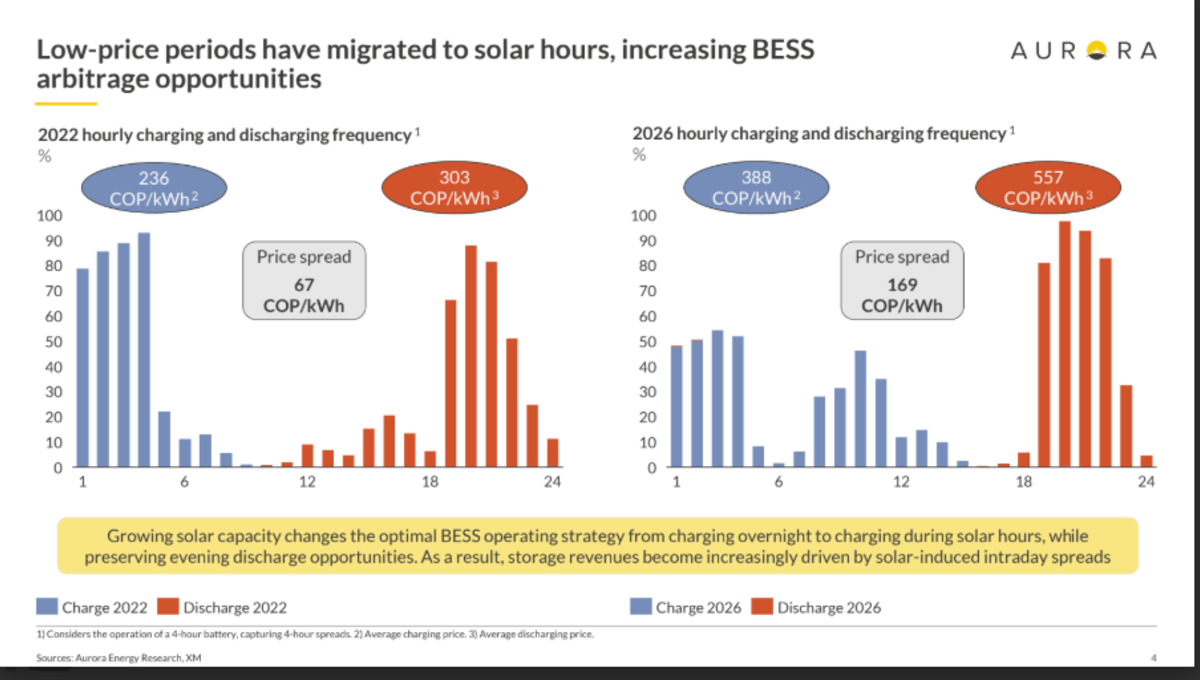
According to Aurora's simulations, in 2022 a battery would have essentially followed the behavior of electricity demand: charging during the early morning, when consumption was lower, and discharging at times of highest system demand.
In 2026, however, charging cycles begin to shift towards times of peak solar availability. This trend demonstrates that solar expansion is altering the commercial incentives for batteries , even before reaching penetration levels comparable to those in other international markets.
The change is directly reflected in the price differential between electricity purchase and sale. While in 2022 the difference between charging and discharging reached approximately 67 Colombian pesos per kWh, in 2026 it rises to 170 Colombian pesos per kWh , according to the results presented by the consulting firm.
This represents an increase of approximately 154% between the two values , which should be distinguished from the cumulative growth of 350% reported by Aurora for four-hour battery spreads during the 2021-2026 period. Both indicators show an expansion of arbitrage opportunities, although they correspond to different timeframes.
Carreño also highlighted that storage takes on particular importance during climatic phenomena that affect the availability of hydroelectric resources.
"In El Niño years, the spread level is very high," the specialist stated when discussing the historical behavior of the market.
Water scarcity widens price differences and, therefore, can increase potential arbitrage revenues. However, the contribution of storage is not limited to the economic benefit of its operators.
During these periods, batteries can also contribute to the resilience and operational stability of the system by supplying electricity at times of greater demand and reducing dependence on generation available at certain times.
This positions storage as a resource with a dual function: capturing commercial opportunities in the wholesale market and providing flexibility during energy stress situations.
Continue reading
However, Aurora's main warning is that the existence of high spreads does not, in itself, guarantee investment decisions in battery projects .
California, the United Kingdom and Spain: why arbitration falls short
To explain the barriers that Colombia faces, Aurora Energy Research compares its situation with three international markets that have different experiences in terms of remuneration for storage.
The first case is California , where the heat waves recorded in 2020 caused operational difficulties and frequency drops during ramp hours.
Faced with this scenario, the system operator, California Independent System Operator (CAISO), increased the demands for firm capacity with rapid response, a need that contributed to the accelerated development of battery systems.
According to Aurora's presentation, California subsequently experienced one of the world's largest storage deployments, second only to China.
A particularly relevant fact for Colombia is that Californian spreads in 2020 were lower than those recorded in the Colombian market during 2025 .
The comparison reveals that the price differential is not necessarily the determining factor in attracting capital to this technology . Reliability requirements and market design can also act as drivers.
The second example is the United Kingdom , where initially revenues from ancillary services boosted the development of storage. However, increasing competition eventually saturated that segment, highlighting the importance of diversifying project revenue streams.
Carreño points out that the British market incorporated capacity mechanisms with long-term contractual horizons, of at least 15 years as stated in the presentation, as part of the scheme that allows structuring additional income.
"Today, the company pays battery banks through arbitrage, capacity market fees, and ancillary services," the executive explained. This combination offers a benchmark for the Colombian market: projects don't depend solely on buying electricity at lower prices and selling it during more expensive periods, but can instead rely on different revenue streams for their contribution to the grid.
The third case is Spain , presented by Aurora as an example of the distance that can exist between price signals and the actual installation of batteries.
According to data presented by the consultancy, the Spanish market registers a solar penetration of 36% and spreads close to 400 Colombian pesos per kWh , the highest level among the markets compared.
Nevertheless, the lack of sufficient remuneration for capacity and ancillary services, along with the difficulties in securing long-term revenue, historically limited the deployment of storage, according to the analysis presented.
The specialist points out that this situation began to change with the approval of the capacity market, a regulatory instrument that the sector has been demanding for some time.
International comparison allows us to identify three different conditions: California boosted storage based on operational needs for rapid response; the United Kingdom developed mechanisms to diversify income; and Spain demonstrates that a market with wide price differentials does not necessarily generate massive installations.
Colombia presents a growing arbitrage opportunity, but still faces the challenge of turning that potential into bankable projects.
In this sense, the main question for developers and investors is not only how much spreads can grow over the next few years, but also what proportion of storage revenue will be predictable enough to support long-term financial commitments.
Aurora's diagnosis suggests that the wholesale market price signal should be complemented by instruments that recognize other attributes of storage , particularly capacity availability and the provision of complementary services.
"Market opportunities alone are not enough. To take off, batteries need other long-term financing mechanisms, such as reliability payments or payments for ancillary services," Carreño concluded.


 By Matías Medinilla

 By Ailén Pedrotti

 By Emilia Lardizabal