


The growth of battery storage in Latin America is forcing countries in the region to accelerate a technical discussion that can no longer be postponed: what services these assets should provide to the electrical system.
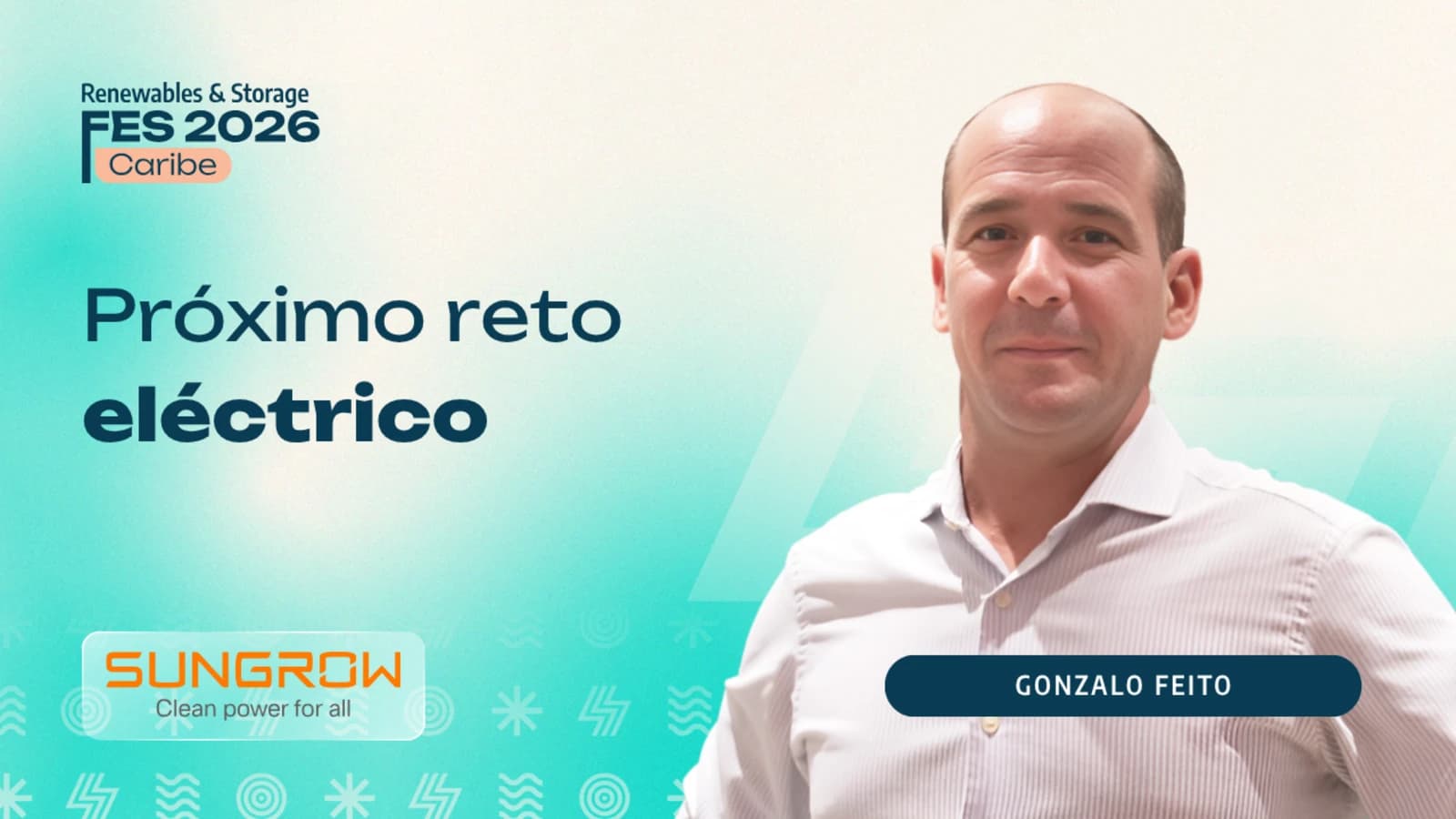
This was stated by Gonzalo Feito, director for Latin America at Sungrow, in an interview conducted within the framework of the Future Energy Summit , where he warned that new BESS projects should consider from the beginning minimum requirements for black start and grid forming , two capabilities that will be increasingly relevant to sustain the stability and security of the networks.
“That the network clause considers from the outset certain requirements, however minimal, for black start and grid forming,” Feito stated during the conversation with Energía Estratégica.
The warning aims to prevent projects currently being designed or tendered from having to be adapted later due to retroactive regulatory requirements.

“Otherwise, sooner or later they will request them retroactively,” the executive said.
Batteries become critical grid infrastructure
Sungrow's message comes at a time when several Latin American markets are beginning to incorporate storage in response to renewable expansion, spills, grid congestion, and the need for greater operational flexibility.
According to Feito, energy storage should no longer be analyzed solely as a solution to displace energy or improve revenue from renewable projects. Its role will also be linked to system stability.
“This technology is going to be extremely important and have a huge impact. Network stability and security are paramount,” he stated.
Along those lines, the executive considered that technical requirements should be incorporated from the early stages of regulatory and contractual design, especially in countries that are launching tenders or structuring new mechanisms for batteries.
Black start and grid forming: why they matter
Black start allows an installation to contribute to restoring the electrical system after a total or partial blackout, without initially depending on an external energized network.
Grid forming , meanwhile, allows power electronics-based systems to contribute to voltage and frequency formation, a key function in networks with greater penetration of variable renewables.
Both capabilities are beginning to gain relevance as electrical systems incorporate more solar, wind and battery power, and reduce the relative share of conventional synchronous generation.
Therefore, Feito believes that Latin American countries should anticipate and define minimum requirements before the massive deployment of storage proceeds without these criteria.
From tender to contract: what customers look for
The executive also described how commercial talks begin for a storage system in the region.
According to Feito, the first questions from clients are usually related to power, the size of the project and the tender they are going to submit.
“It always starts with what power, what size of project they expect. It is usually linked to a tender,” he explained.
Before arriving at a final offer, Sungrow works on the technical sizing of the system. This includes variables such as degradation, guaranteed power, capacity, performance guarantees, and operating conditions.
“Degradation from day one is one of the most important factors,” Feito noted.
Contracts that can take up to six months
The commercial closure of a BESS project can take several months, especially when it is the first contract between manufacturer and client.
Feito explained that these processes combine technical analysis, contract review, financial evaluation, and definition of guarantees.
“With clients we need to get to know, the first contract can take six months,” he said.
The executive stressed that a storage system should not be interpreted as a simple equipment purchase, but as a complex project in which the technological, logistical and operational components weigh heavily on the entire CAPEX.
Continue reading
Logistics: the challenge of the last mile
Once the contract is signed, Sungrow assigns a project team and a project manager to oversee the process from manufacturing to delivery and connection.
One of the most sensitive points is logistics.
Feito explained that the batteries are transported in 20-foot containers, but they are heavy and require specific handling. This makes the last mile—the stretch from the port to the project site—one of the main operational challenges.
“These are machines that go in 20-foot containers, but they are very heavy. Where I have seen the most restrictions is in the last mile, from the port to the site,” he said.
To avoid delays, the site must be prepared before the arrival of the equipment: foundations ready, slabs completed, advanced cabling, and substation ready to receive the connection.
Six to eight months to connect the batteries
Another critical point is the time between the arrival of the equipment and its connection.
According to Feito, the batteries should not be stored indefinitely before being put into operation.
“We have a limited time before connecting. The machines absolutely must be connected within six to eight months,” he warned.
The risk is associated with system degradation if equipment remains offline for too long. While Sungrow can analyze individual cases, the goal is to minimize that period.
The executive assured that, so far, Latin American clients have taken this point seriously.
“The client has taken it very seriously. We have always been on time or ahead of schedule, we have even accelerated our delivery,” he noted.
Safety: “The risk exists”
Feito also referred to the debate on the safety of storage systems, especially regarding the risk of fires.
The executive acknowledged that, like all electrochemical technology, batteries have risks that must be managed from the design, operation, and protection systems stage.
“Safety is one of the things Sungrow prioritizes. We are very conservative in that regard,” he stated.
He added: “The risk is there. It’s a reality.”
However, Feito maintained that the company pays special attention to prevention and that, so far, they have not registered this type of event in their regional systems.
Chile as the first regional experience
Sungrow already has operational experience in Latin America, especially in Chile, where the company has installed storage systems in projects already developed or in operation.
“Our first experience is in Chile. There we haven’t seen major challenges, mainly because these are projects that are already developed and operational, where a new technology has been implemented,” Feito explained.
The Chilean case shows a trend that could be replicated in other markets in the region: incorporating storage into existing renewable projects to improve their operation, reduce spills, optimize revenues and provide services to the system.
Regional regulation and coordination
Feito observes that Latin American countries are beginning to advance in greater technical knowledge about storage and network codes.
He also noted that some coordination between dispatch centers is beginning to emerge, a key point to ensure that requirements are not defined in isolation in each market.
“There is some coordination taking place between dispatch centers,” he said.
For Sungrow, this coordination will be fundamental at a stage where BESS projects will cease to be marginal assets and will begin to fulfill critical functions for the electrical operation.