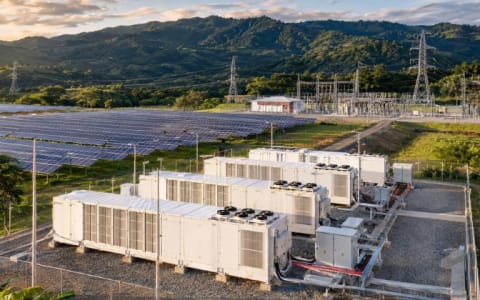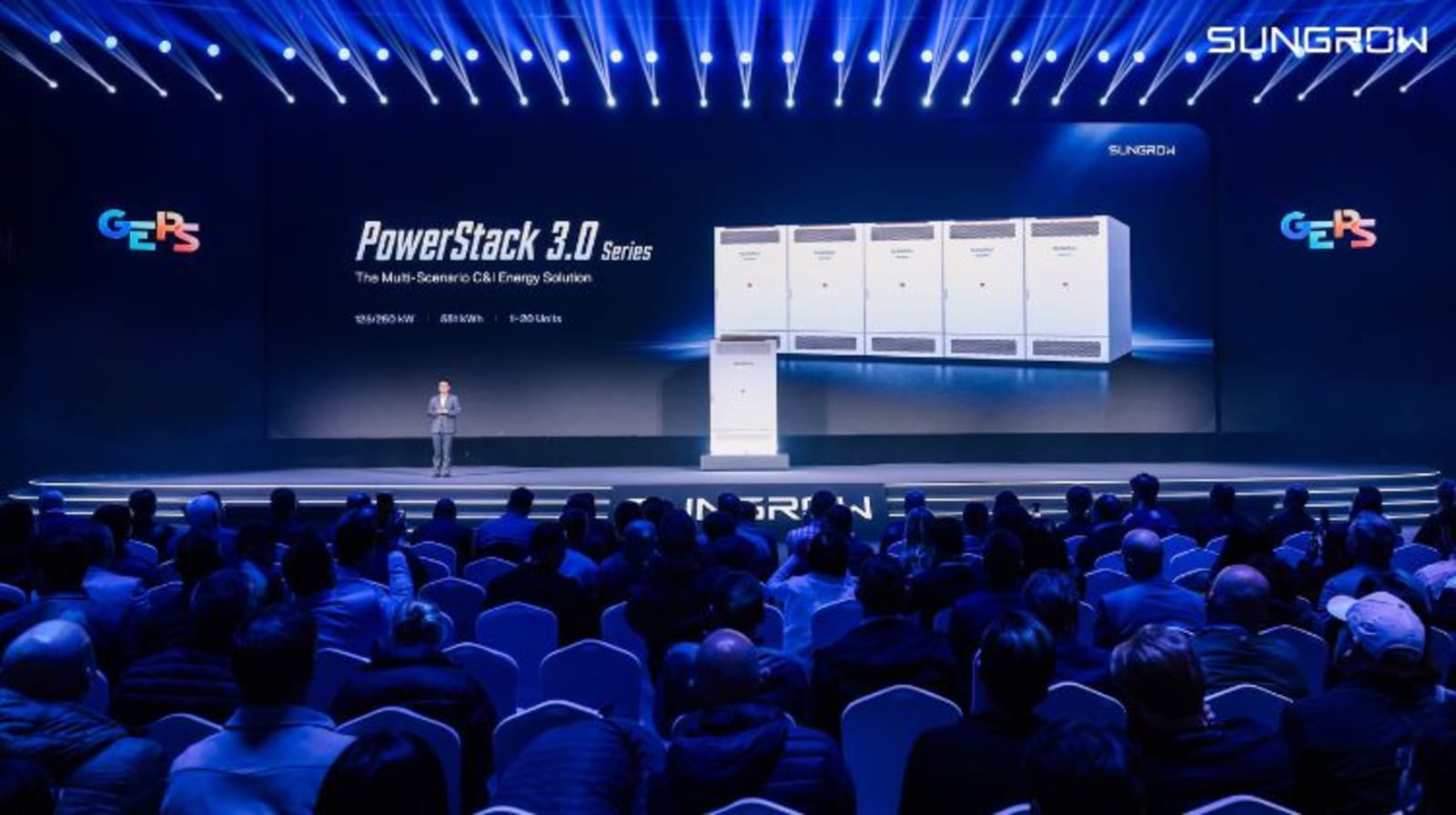
Sungrow , a global supplier of photovoltaic inverters and energy storage systems, presented PowerStack 3.0 , its new generation of solutions for the commercial and industrial (C&I) segment, which incorporates artificial intelligence, a full cycle efficiency of over 92% and a modular architecture designed to integrate different energy applications.
In parallel, the company expanded its portfolio with the PowerKeeper family, which comprises storage systems ranging from 50 to 1,000 kWh, with power outputs from 50 to 125 kW, in addition to the launch of PowerKeeper Lite, aimed at simplifying installation and maintenance.
Both new products were announced during the Global Energy Pioneer Summit (GEPS) 2026 , held on November 11 in Hefei, China, where Sungrow presented its strategy to address the diverse energy storage needs of the commercial and industrial sectors. Energía Estratégica was present at the event.
In the case of PowerStack 3.0, the proposal is based on the Scene-in-One concept, which seeks to overcome the conventional physical integration of components through an architecture configurable according to the requirements of each project.

In this way, the new system incorporates four specialized modules: power conversion, photovoltaic generation, electric vehicle charging and microgrids, which allow the configuration to be adapted to different operating scenarios.
For standalone storage applications, the combination of power conversion modules allows for discharge durations of two or four hours , reducing the need for multiple equipment variants.
In installations that combine solar generation and batteries, the solution incorporates direct current coupling , taking advantage of the storage conversion system to process photovoltaic generation without requiring an additional inverter.
Likewise, for projects that integrate solar energy, storage and electric vehicle charging, the architecture allows the different components to be connected via direct current, simplifying integration work and reducing implementation times.
For its part, the microgrid module incorporates functions to ensure the continuity of the electrical supply to critical loads during network interruptions.
According to Sungrow, PowerStack 3.0 allows for a 0 millisecond transfer between connected and isolated modes , without the need to incorporate a separate static transfer cabinet.
This functionality is geared towards industrial and commercial facilities that need to maintain their operations in the face of disturbances or interruptions in the supply.
Artificial intelligence, efficiency and greater profitability with PowerStack 3.0
One of the main innovations of the new system is the incorporation of Bubbly , the artificial intelligence assistant developed by Sungrow to optimize the different stages of the life cycle of a storage project.
During the planning phase, the tool combines satellite imagery with three-dimensional modeling to generate design proposals that include technical configurations, equipment layout, and financial calculations.
According to the manufacturer, Bubbly can generate these proposals in 30 seconds , facilitating the initial evaluation of projects and reducing surveying tasks.
During the startup phase, the platform automates configuration and data validation processes, allowing these operations to be completed in approximately three minutes .
In terms of operation, the assistant integrates photovoltaic generation and demand forecasts to coordinate self-consumption strategies, power peak management, energy arbitrage, and frequency regulation.
According to data presented by Sungrow, this optimization of the dispatch can increase economic returns by more than 12% compared to a conventional strategy based exclusively on self-consumption.
Artificial intelligence also plays a role in maintenance, through continuous monitoring that identifies more than 30 potential risks and generates recommendations for their resolution.
In a 10 MWh installation, the system can produce a fault diagnosis report in approximately one minute, according to specifications released by the company.
In terms of its technical characteristics, PowerStack 3.0 achieves an energy density of up to 256 kWh/m² and supports different physical arrangements to adapt to the available space.
Continue reading
The system allows up to 20 units to be connected in parallel and, for a 5 MWh installation, reduces the occupied surface area by 43% compared to the previous generation.
In terms of efficiency, it incorporates a power converter developed by Sungrow with silicon carbide technology, which achieves a maximum conversion efficiency of 99.2%.
Combined with stacked 684 Ah battery cells, the system achieves a full cycle efficiency of over 92% , considering the charging and discharging process.
It also features IP55 protection against dust and water ingress, a C5 anti-corrosion rating, and an operating range of -30°C to 50°C.
The solution also supports network harmonic distortion levels of up to 30% and incorporates three-level fuse protection and a four-layer fire safety system.
In this way, Sungrow seeks to respond to the efficiency, safety and operational availability requirements of commercial and industrial applications.
"Today we have entered the 3.0 era, the scenario-based era. Sungrow offers you more than just a new product. We offer you a comprehensive solution for the entire ecosystem: designed for every scenario, powered by artificial intelligence, and connected throughout the entire value chain," stated Dr. Cao Wei, General Manager of Sungrow's C&I ESS product line.
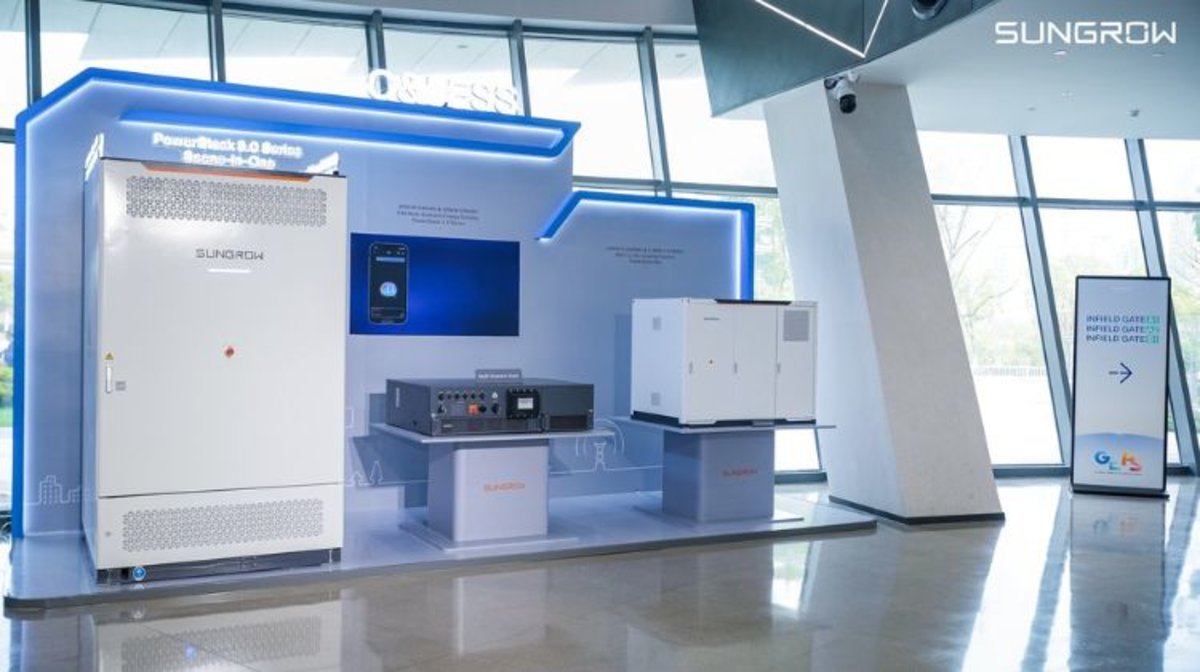
PowerKeeper: modular solutions up to 1 MWh for the commercial and industrial segment
As a complement to the launch of PowerStack 3.0, Sungrow introduced its PowerKeeper family, designed to offer flexible configurations and meet the storage needs of commercial and industrial facilities of varying scales.
The system, combined with the SHCX series hybrid inverters, covers a range of 50 to 125 kW of power and 50 to 1,000 kWh of capacity , allowing the sizing to be adapted to the energy requirements of each establishment.
One of its features is the three-level security architecture, which combines preventive anomaly detection, immediate interruption, and physical containment against potential incidents.
According to Sungrow, the solution passed more than 700 safety tests , conducted from the cell level to the entire system, including water immersion tests, impact resistance and fire spread prevention.
In terms of profitability, the company points out that the energy optimization algorithms incorporated in PowerKeeper can generate between 10% and 30% additional monthly revenue , depending on operating conditions.
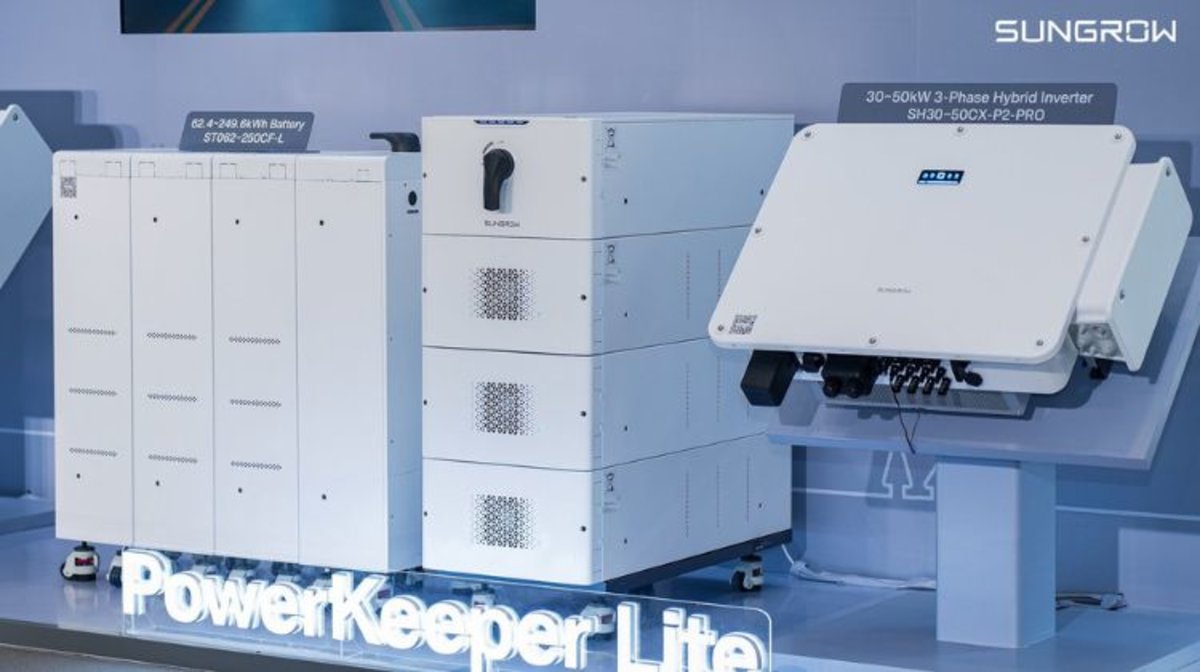
Furthermore, the company announced PowerKeeper Lite , a solution designed to make the work of installers easier through a modular design and mounting options adaptable to different interior spaces.
The system is compatible with the SH50/80/100/110/125CX hybrid inverters and the new SH30/40/50CX-P2 series, expanding the configuration possibilities according to the characteristics of each installation.
PowerKeeper Lite incorporates plug-in connections, side wiring, and remote monitoring tools via iSolarCloud , enabling fault location and operational diagnostics.
In addition, the PowerKeeper family supports direct parallel connection of up to ten units and offers transition functions between connected and isolated grid operation.
For microgrid applications, it incorporates grid forming capabilities using virtual synchronous generator technology, which contribute to voltage and frequency stability.
The system also supports a ratio between installed photovoltaic power and nominal inverter power of 2.0 , along with a load capacity of up to 1.6 times the reference power, with the aim of taking advantage of surplus solar generation.
With these developments, Sungrow expands its energy storage portfolio for the commercial and industrial segment, combining the multi-scenario integration capabilities and artificial intelligence of PowerStack 3.0 with the modularity, scalability and installation flexibility of the PowerKeeper family.

 By Emilia Lardizabal