


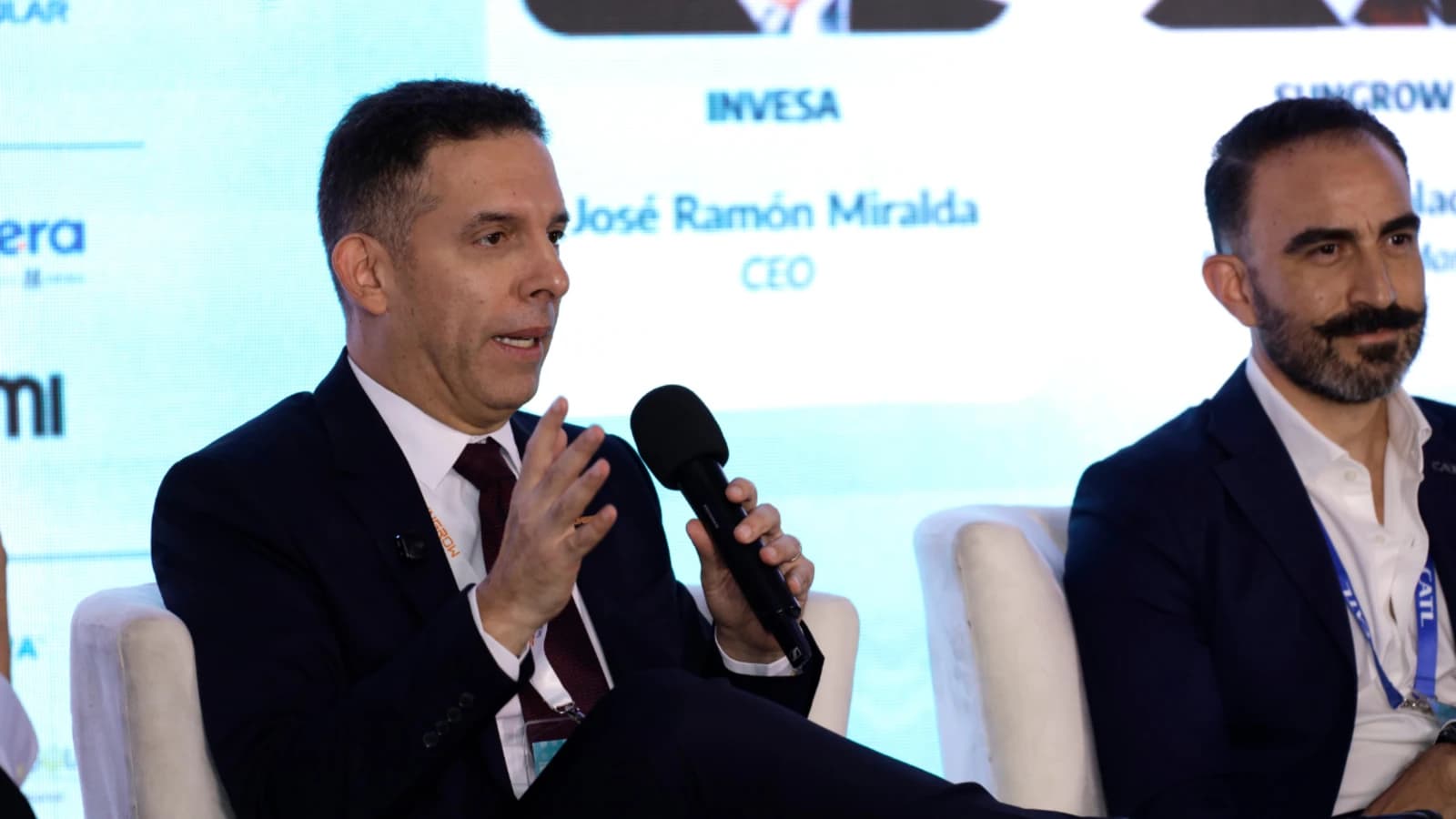
For Sungrow, the main takeaway from the PEG-5 tender was the diversity of companies and projects awarded . Beyond the 1258 MW allocated, the single-unit prices close to USD 101/MWh achieved , and the boost that hybrid projects will receive with BESS, the process showed that there is room for developers of different scales, a sign that the company considers key for the evolution of the Guatemalan market.
"The first thing we have to consider is the range of companies that were awarded contracts. Many people with a lot of ambition, different types of projects: large projects, medium-sized projects, even small projects. There was a piece of the pie for everyone, and that's a very important aspect to consider," said Ricardo Palacios , Key Account Manager for Sungrow Latin America , during FES Guatemala.
Relive FES Guatemala: https://www.youtube.com/watch?v=-fQIrVqwZYk

The outcome of the tender also confirms, according to the executive, that the market is beginning to consolidate a new stage of development, where solar generation and batteries are advancing together.
"It's clear there's a huge appetite in Guatemala and the region to develop these projects, which obviously go hand in hand with photovoltaics and energy storage," he said.
Palacios considered one of the main achievements of the process to be demonstrating that the market has already overcome the uncertainty inherent in initial experiences with storage. "At first, the fear is taking the first step, but once the first step is taken, subsequent steps are taken with greater confidence, and we have been finding that specifically in Guatemala from now on," he stated.
From the manufacturers' perspective, this evolution justifies a very positive assessment of the process. "Personally, I would give it a 10, because it's what we want to see happen," he asserted, emphasizing that the interest shown by developers confirms that the market is moving in the direction the industry expected.
Sungrow's analysis comes at a particularly favorable time for Guatemala. Following the awarding of PEG-5, the sector is already projecting a new phase of expansion with future calls for proposals such as PEG-6 and PET-4 , while BESS is beginning to establish itself as a central component of new developments. However, the industry is also closely monitoring regulatory challenges, such as municipal fees that affect some projects and other regulatory changes that could impact execution timelines.
For Sungrow, the growth in storage also changes the criteria developers use to select their suppliers. Equipment quality is no longer the only relevant factor; the ability to support each project throughout its entire lifecycle becomes increasingly important.
"The first thing a battery manufacturer needs is backup," Palacios said.
The executive explained that BESS systems require ongoing support because they are tied to long-term contracts and specific operational requirements. In that regard, he warned that a manufacturer that disappears after the sale will struggle to remain competitive.
"The company needs to have the support and the ability to say, 'You know what? I have personnel on site; I'm going to have parts in place.' Everything related to the development and maintenance of that project has to continue from there on," he stated.
Continue reading
In addition to that support, there is another attribute that, according to Sungrow, will be crucial for future developments: the ability to adapt quickly to new needs during the execution of the works.
Palacios explained that during some commissioning processes, additional requirements arose from clients that forced them to modify configurations on the fly to optimize the performance of the systems.
"New, immediate customer needs have arisen, asking us to have the change immediately at that moment of system commissioning and saying, 'We are going to make the necessary changes to cover that need you have,'" he recalled.
He also highlighted that international experience and a regional presence are key differentiators for supporting long-term projects. Sungrow develops initiatives in various Latin American markets, a reach that, he indicated, underscores the company's commitment to the region.
Batteries also emerge as a tool to address one of the main challenges facing the Central American electrical system: transmission limitations. Energy arbitrage allows for the distribution of electricity delivery throughout the day, avoiding the concentration of all generation in a single period and providing greater flexibility to the system's operation.
"Let's extend delivery times a bit. Let's not get stuck in a single period. Let's plan and schedule more clearly what we really need," he explained.
In his opinion, the success of the projects will also depend on manufacturers having a deep understanding of the regulations in each market and not limiting their participation solely to the commercial aspect.
"We need to understand the regulations for each project in each country, and not just from a commercial perspective," he stated.
As an example, he mentioned the work that Sungrow does in the Dominican Republic, where its technical teams analyze each regulatory change to adapt the solutions to the requirements established by the authorities.
The executive warned that this knowledge allows them to anticipate possible problems during project development and respond more quickly to the specific needs of each client.
According to Palacios, storage is going through a stage of strong technological evolution that will continue to expand the possibilities for the market.
The executive explained that the continuous improvement of the cells, the increase in container capacity, and new configurations for different applications will drive greater adoption of these systems in the region.
Furthermore, he maintained that feedback from customers themselves became a key input for accelerating innovation and perfecting the available solutions.