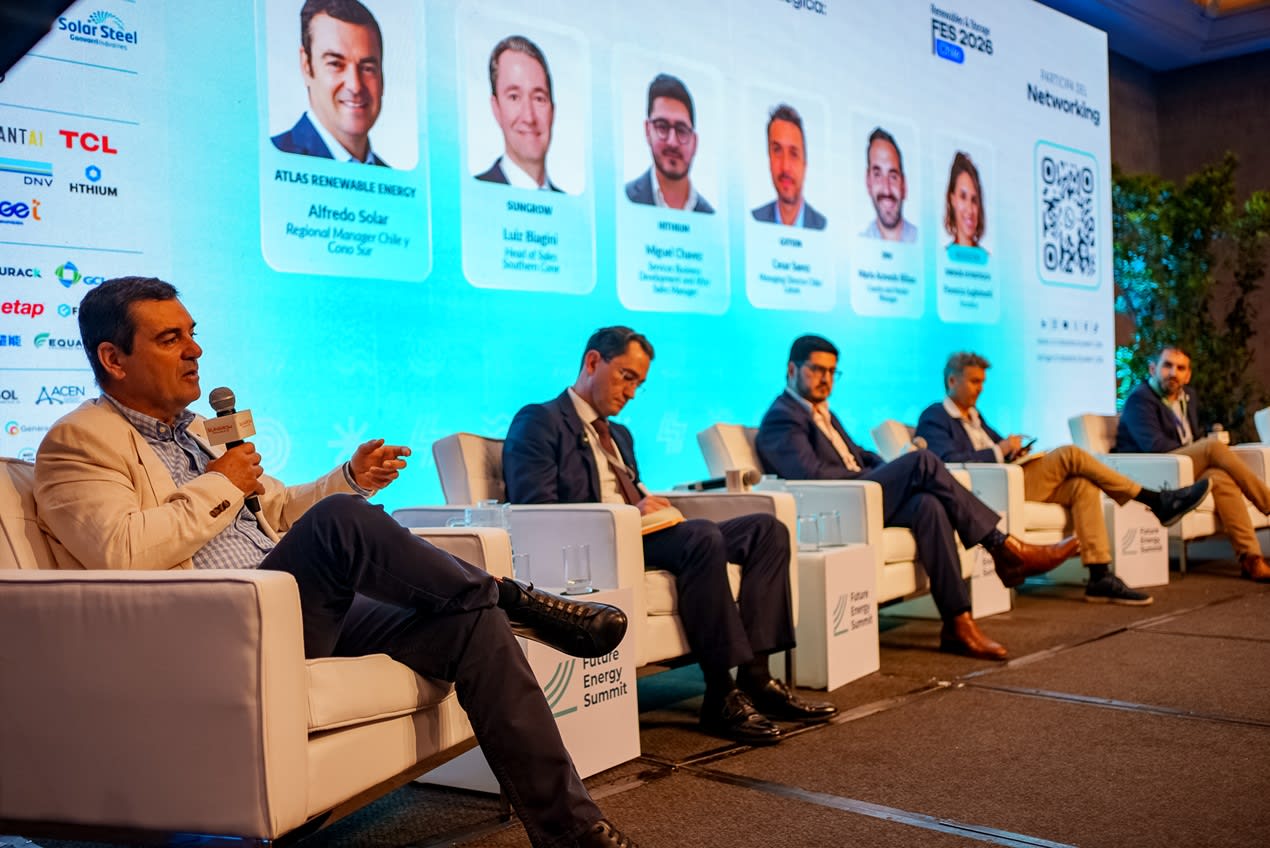
The meeting, held at the Alvear Icon Hotel and attended by more than 160 people, focused primarily on expanding energy transport capacity and ensuring national regulatory predictability.
Martín Genesio , president of LIDE Energía and CEO of AES Argentina, highlighted that the energy surplus exceeds USD 9.4 billion so far this year and attributed it to sound investment and infrastructure decisions. He also maintained that to attract international financing, Argentina needs clear and consistent rules that allow for the assessment of long-term risks.
In this context, the Minister of Deregulation and State Transformation, Federico Sturzenegger, urged energy companies to "change their mindset" and stop considering the State as the central figure in their decisions. "The deregulations we need to implement won't be discovered from behind a desk. You, from within the sector, will have to propose them to us," he stated.
In turn, the minister called on companies to promote proposals and coordinate investments: “Our greatest achievement will be the day when it is no longer necessary to invite a public official to your meetings, because the debate is focused exclusively on your businesses and how to coordinate investments freely.”
For his part, Rodolfo de Felipe , president of LIDE Argentina, maintained that next year will be decisive to consolidate a “change of era” in the four pillars of the development of the national economy (agriculture, mining, knowledge and energy) and anticipated that the “blue economy” and the potential of the Argentine sea will be the fifth engine of growth in the medium term.
Electric transport as a condition for competing
Fernando Bonnet , CEO of Central Puerto; Pablo Tarca , general manager of Transener; and Daniel Marx , president of Edenor, agreed that normalizing the electricity market requires clear price signals and a predictable regulatory framework. In the panel moderated by Nadia Sager , CEO and founder of GEINSA, they warned that the lack of transmission capacity limits competition and the efficient dispatch of energy.
The executives argued that deregulation must be accompanied by an urgent expansion of the transport network. They also pointed out that frequent short-term regulatory changes increase financing costs and stressed the need to gradually move towards a market with greater participation of private contracts.
Continue reading
Vaca Muerta and the challenge of expanding exports
Ricardo Markous , CEO of Tecpetrol, highlighted the competitiveness of the resource during a conversation with Rodolfo de Felipe , president of LIDE Argentina. “Geologically, Vaca Muerta is on par with the United States. Productivity compensates for differences in scale and makes us highly competitive,” he stated. The executive pointed out that taking advantage of the energy transition opportunity requires infrastructure and collaboration among companies.
The expansion of transportation was also the focus of the gas and liquefied natural gas (LNG) panel, featuring Oscar Sardi, CEO of TGS; Horacio Pizarro, CEO of TGN; and Sergio Martín Mengoni, CEO of TotalEnergies. In the debate moderated by Candela Macchi of Moody's Investors Service, the executives agreed that long-term predictability is essential for sustaining international investment and consolidating the country's position as an energy supplier.
Reforms and agreements to sustain investments
Senators Flavia Royón and Pablo Cervi, president and secretary of the Senate's Mining, Energy, and Fuels Committee, respectively, agreed on the need for infrastructure planning and progress with tax reforms. The panel was moderated by journalist Sofía Diamante.
Royón highlighted the Large Investment Incentive Regime (RIGI) and Vaca Muerta's contribution to foreign exchange earnings. He also called for political agreements to support tax and revenue-sharing reforms. Cervi proposed allocating resources from the activity to basic infrastructure and reducing the tax burden to encourage the development of local suppliers.
Hernán Mandará, a tax partner at KPMG, emphasized that tax competitiveness and fiscal stability impact access to international financing and the establishment of projects. De Felipe, for his part, identified energy as one of the main drivers of Argentine development, along with agriculture, mining, and the knowledge economy.
Recognition of the sector
Finally, the day included the presentation of the LIDE Energy Awards 2026; a recognition of the outstanding companies and personalities in the energy sector in the last year.
- LIDE Award for Investment and Energy Development : Pampa Energía, for its sustained growth and infrastructure plan. The award was received by its CEO, Gustavo Mariani.
- LIDE Award for Technological Innovation and Shale Modernization : Halliburton, for introducing the region's first all-electric fracturing system. The award was accepted by its general manager, Héctor Gutiérrez.
- LIDE Award for Energy Career : Engineer Oscar Sardi, in recognition of his more than 40 years of work, leadership and contribution to the development of gas infrastructure in Argentina.
The closing remarks were delivered by Rodolfo de Felipe and Martín Genesio. In his concluding remarks, Genesio shared an optimistic reflection on the future of the industry: “To develop a successful sector, we not only need clear rules, continuity, and investment, but we also need to do all of that with optimism. Let's stop thinking about what will happen in the next election; we need to be aware of what we are experiencing today,” he concluded.
For LIDE Argentina, this VIII National Energy Forum represents a fundamental milestone in the consolidation of the "Country Agenda", a proposal aimed at promoting strategic and high-level debates on the key vectors of national growth.
 By Emilia Lardizabal
 By Florencia Guglielmetti