


TCI GECOMP , a company founded in Spain and dedicated to the design and construction of renewable energy plants in several countries in Europe and Latin America, will make a significant investment in the clean energy sector in Chile. Mario Gómez , CEO of the company, as well as Director of H2 Chile , the Chilean Hydrogen Association, and member of the Spanish Hydrogen Association, provided information on the role of hydrogen in Chile, future projects, and TCI GECOMP's strong commitment. What is the role of hydrogen in Chile? There is tremendous interest in the hydrogen economy, supported by several factors that converge in a climate of optimism and hope for making the country a world leader in green hydrogen production. The main factor is the work of people who have been committed to this technology for years.
The Chilean Hydrogen Association, H2 Chile, along with the Innovation Club and the strong support of the Government, is leading the way in making hydrogen the country's new copper. This makes Chile a case study and an example for many countries that want to take advantage of the new hydrogen-based energy model. There are projects in the country with diverse applications, from hydrogen production for fertilizers, transportation, explosives, and ammonia, to its use as a fuel in various thermal and chemical processes, and even the use of green hydrogen for electrical energy storage. What projects does TCI have in the pipeline or under development? We want to establish ourselves as one of the world's largest green hydrogen development and production companies, aiming to be present throughout the entire value chain.
As an engineering and consulting firm, we have projects underway in Europe, Africa, and Latin America, and are expanding into the Japanese market. In Spain, we are promoting ten green hydrogen generation projects for transportation using renewable energy, and one for ammonia production. In Argentina, we are studying the potential of Patagonia and its wind power for hydrogen production.
As a consultancy, we are currently designing the green hydrogen strategy for the Uruguayan-Argentine company Buquebus. In Chile, there is a research project, funded by the European Union, for the use of electrolyzers with direct water desalination. It is a renewable energy and hydrogen generation initiative for heavy-duty transport.
As a consultancy, we have three hydrogen generation projects associated with photovoltaic plants smaller than 3 MW for different uses. What is your most ambitious project at the moment? In Antofagasta, in northern Chile, we are developing an ambitious green hydrogen generation project called HOASIS.
This project addresses the future green hydrogen consumption needs of the region, introducing a new concept of circular economy and creating lateral synergies. HOASIS is planning the world's largest photovoltaic plant in the area with the highest solar radiation on the planet, with an installed capacity of 3 GW, associated with a 2.1 GW electrolyzer facility capable of producing 102,000 tons of hydrogen per year to serve various clients in the region. HOASIS could supply 100% of the hydrogen consumption for the Antofagasta mining industry in its decarbonization process, estimated at more than 50,000 tons of H2 per year just for the consumption of large CAEX trucks. It also has the capacity to produce 250,000 tons/year of ammonia through the installation of an industrial plant and 440,000 tons/year of urea, which could supply 82% of Chile's consumption of this product, currently 100% imported. 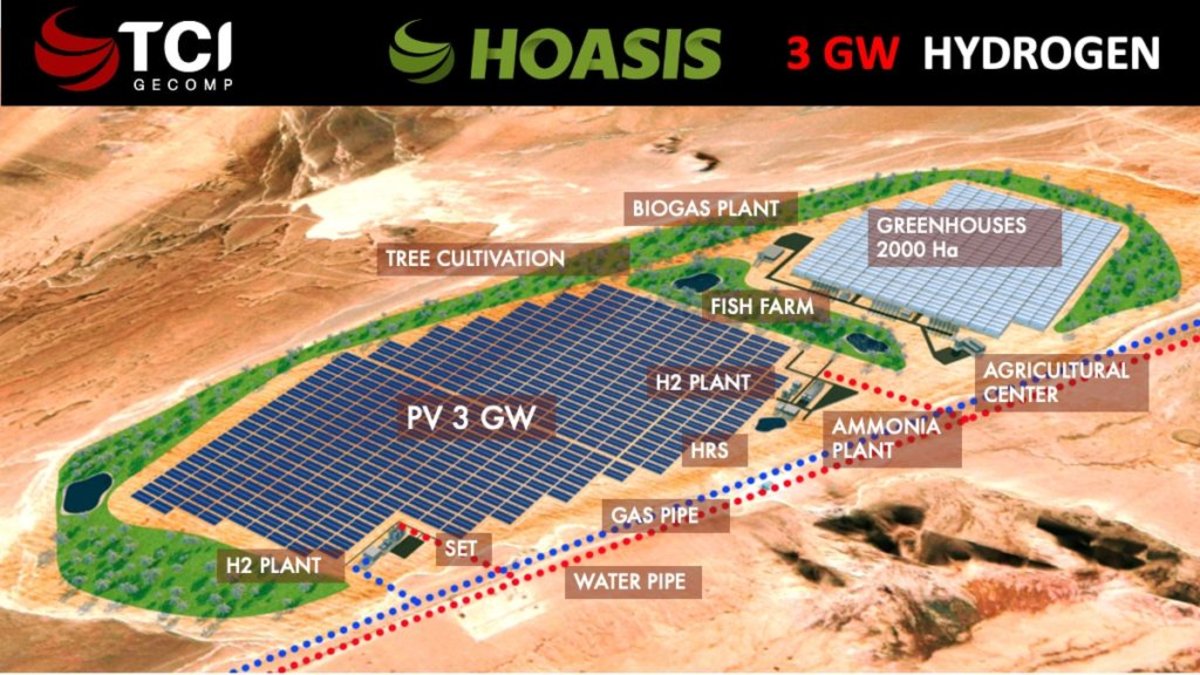
The HOASIS project – TCI is preparing one of its largest investments in renewable energy. Other clients would include hydrogen refueling stations for heavy goods and passenger transport, cement and chemical industries in the area, and the capacity to inject a percentage of H2 into the existing gas networks in the region. But HOASIS is much more than that.
To accelerate the convergence with competitive prices, the project proposes creating a parallel industry that receives services from the main activity, services that would be discarded in other projects. These services include oxygen, heat, and waste electricity.
With these ingredients, TCI designed a complex Industrial Symbiosis system, which includes the construction of fish farms integrated into the Aquaponics system, associated with the creation of a 2,000-hectare greenhouse cultivation area. Following the product traceability, a processing and preservation industry for greenhouse products will be established, along with an agricultural waste recycling plant to generate electricity and heat, as well as compost for use in another pistachio cultivation area. This project was born to demonstrate that predictions of falling hydrogen prices were wrong and that, as happened with renewable energies, the exponential pace of technological advancement and industrial scaling will make a hydrogen-based economy possible several decades sooner than anticipated just a few months ago. Can we envision a hydrogen industry for international trade by 2030? That goal could be achieved much sooner, as evidenced by the evolution of green hydrogen target price indices, which in just twelve months have reduced their 2050 target by fifteen years. The maritime and even air transport industries already have projects using hydrogen to replace fossil fuels. Chile projects a five billion dollar hydrogen business by 2025.
And by 2030, the goal is to have a hydrogen export revenue of two and a half billion dollars. For example, with HOASIS's ammonia production capacity at projected prices upon commissioning, it would represent an export value of approximately one hundred million dollars annually derived from hydrogen. To this, due to the project's added value, we must consider agricultural production of approximately sixty million dollars annually, plus salmon production yet to be determined.