


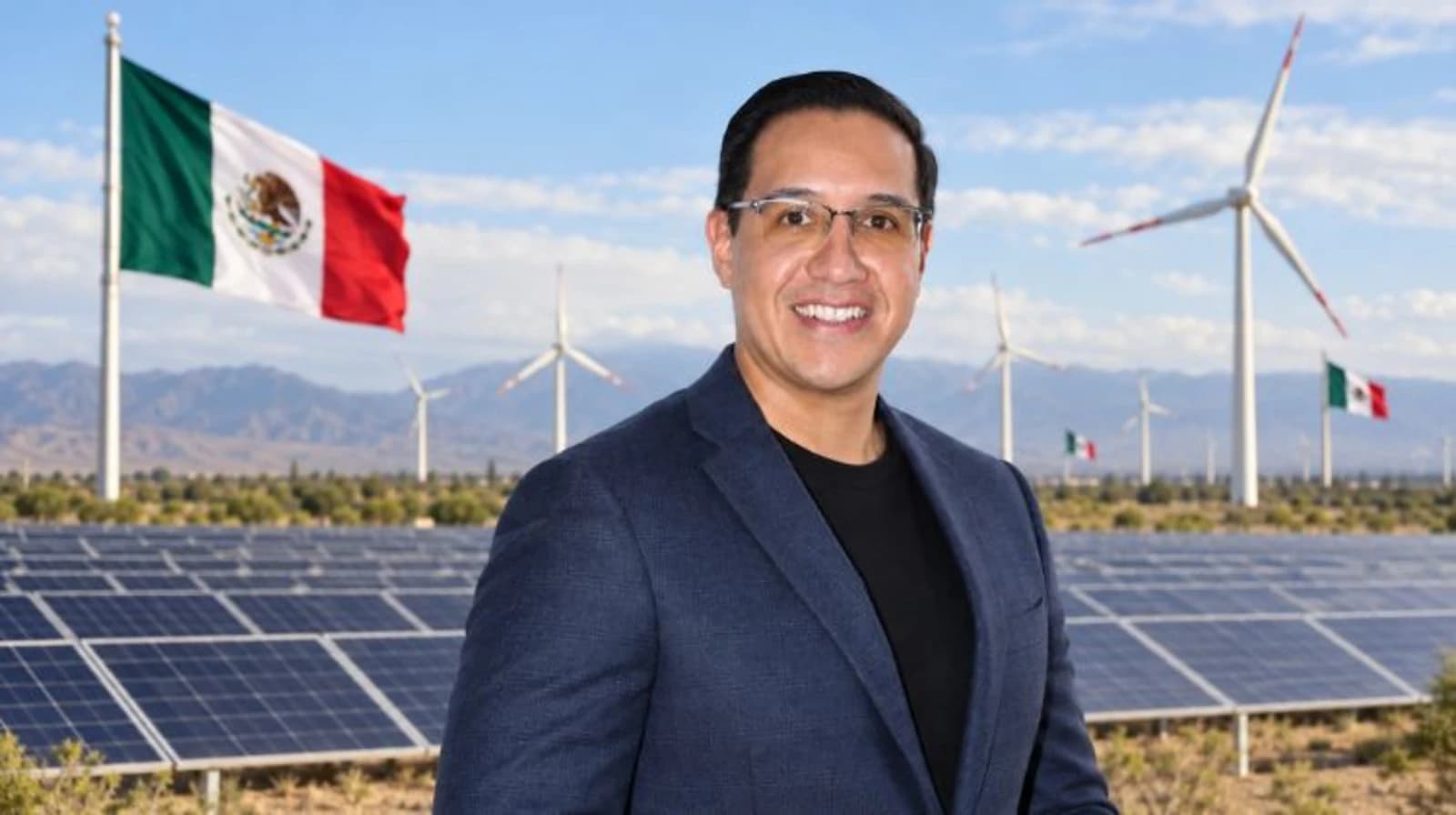
Terralia is moving forward with an 850 MW portfolio of wind and photovoltaic projects in Mexico's second mixed call for bids, while the private sector remains attentive to the definition of the awards and the possibility that the Government will open new investment opportunities in renewable energies.
Ricardo Hurtado González, CEO of Terralia , revealed that the company has a 100 MW wind farm in Puebla and around 750 MW of solar projects within its portfolio that is currently advancing in the pre-selection process in Mexico.
“Our 100 MW wind project is one of those that has good reinforcement and interconnection works,” he said during his participation in the “It had to be said and it was said” streaming event by Energía Estratégica.
In this way, photovoltaic technology accounts for approximately 88% of the 850 MW that Terralia is evaluating , while the remaining 12% corresponds to wind power generation.

Terralia's current participation comes after the company was awarded El Chorro, a 705 MW wind project accompanied by 317 MW of batteries with a three-hour duration, equivalent to approximately 952 MWh of storage , in the first mixed call in partnership with the Federal Electricity Commission (CFE).
As Hurtado González previously revealed to Energía Estratégica, that award required four rounds of negotiation with the CFE and sector organizations, during which the economic and technical conditions of the initiative were adjusted.
The project envisions an investment of approximately $1 billion, an energy price of around $50 per MWh, and a target internal rate of return of 14.5% , in addition to a 25-year power purchase agreement.
In that first experience, storage went from initially representing 30% of the generation power to approximately 45%, as a result of negotiations developed with the state-owned company.
The executive maintains that the first call for proposals helped to clear up some of the doubts that certain developers had about how the scheme worked, especially among companies that initially adopted a more conservative position.
If all these projects participating in the call were to obtain a final award, the company would reach 1555 MW of awarded renewable generation between both schemes , not counting the power of the associated storage systems.
However, the executive warns that the pre-selection represents only one stage of the process and that participants must pass further filters before finalizing the corresponding agreements.
On the other hand, Hurtado González stated, “There is talk of a third call for proposals, though not yet officially announced.” This expectation arises in a context where the Ministry of Energy and the Federal Electricity Commission (CFE) are progressing with the technical and financial evaluation of the submitted initiatives, under a mixed-participation scheme that Terralia considers favorable for structuring long-term investments.
From a business perspective, the executive argues that this mechanism represents an opportunity to mobilize private capital and facilitate the development of new power plants.
“From our point of view, from a business perspective, it has been one of the best financial ways to make these projects possible,” he said.
Why does solar energy account for 80% of projects in Mexico?
Regarding the predominance of photovoltaic technology in the calls for proposals, Hurtado González explains that development deadlines and bankability requirements condition the participation of wind power projects, despite their advantages in terms of energy production.
In particular, it highlights that wind farms normally require at least one year of resource measurements to meet the conditions demanded by financial institutions, a circumstance that makes it difficult to present completely new initiatives within the established timeframes.
“It’s very difficult to launch a brand new project with the kind of time constraints we have to participate,” explained the CEO of Terralia.
This difference contributes to approximately 80% of the projects corresponding to photovoltaic technology and the remaining 20% to wind power generation, according to the executive's estimates.
However, Hurtado González believes that wind farms offer advantages due to their higher capacity factors, which allow for higher levels of energy production.
Increased storage requirements and interconnection costs
One of the main changes that Hurtado González identifies in the second call is the incorporation of new technical and economic filters to select the projects , especially related to impact studies and infrastructure needs.
As he explained, developers must face payments for indicative and impact studies that allow them to determine the reinforcement and interconnection requirements of each power plant.
From their perspective, these requirements help to refine the set of proposals and allow the identification of those initiatives with the best conditions to move towards their implementation.
In that context, he highlighted the speed with which the National Energy Control Center (CENACE) began to deliver technical results corresponding to certain projects.
He explained that “ studies that initially had a 30-day timeframe began to be delivered in approximately one week,” a circumstance he interprets as a sign of the procedure being accelerated.
Regarding storage, the call establishes a minimum battery requirement equivalent to 30% of the generation power , although the technical results may determine additional needs.
Hurtado González revealed that some Terralia developments registered increases compared to the initially planned dimensions.
“For us it increased a little more, it went up 15% in some of the projects we were considering,” he commented.
In concrete terms, it points out that certain 100 MW power plants that initially planned for 30 MW of storage now require between 35 and 40 MW of batteries .
Continue reading
However, the CEO pointed out that these increases do not necessarily represent the main risk to the profitability of the projects, because the financial model allows for modifications to be made to the storage sizing.
Conversely, the reinforcement and interconnection works constitute the most sensitive economic factors for developers , since their costs can condition the viability of the power plants.
“In the financial model, the main things that can affect you are practically the reinforcement works and the interconnection works,” he warned.
This concern is directly related to Terralia's previous experience in the first call for proposals, where the company had submitted a project in Campeche that was ultimately not selected due to capacity limitations in the region.
Therefore, Hurtado González believes that the results of the technical studies will be decisive in determining which initiatives will advance to the next stages of negotiation.
Terralia anticipates up to 6 GW in awarded contracts and is looking for new opportunities
Beyond its own developments, Hurtado González believes that the second mixed call could conclude with authorizations of approximately 6 GW , although he clarifies that this is a business estimate and not an officially confirmed figure.
The executive bases this projection on the possibility that certain selected projects may not be completed due to technical, financial or execution-related difficulties.
For this reason, it interprets that the authorities could consider a volume of initiatives greater than the capacity they ultimately expect to incorporate into the electrical system.
It's worth noting that the requirement for this scheme is 3,995 MW, divided between solar photovoltaic and wind power. The call for proposals received over 40 GW, and the government has pre-selected more than 8 GW.
“I believe that the Mexican government is considering having a few more projects, knowing and considering that a certain percentage will not succeed due to the nature of the project itself,” he analyzes.
The objective, from their perspective, is to ensure the effective incorporation of new generation, considering that the projects have a maximum operational horizon of December 2029 .
Regarding the remaining stages, the CEO explains that developers initially receive a favorable technical opinion and then must face the costs of the corresponding studies.
Subsequently, the authorities assess the infrastructure requirements and move towards defining the projects that present the best conditions for negotiation.
The next step involves discussions with CFE regarding the financial model and the terms of the power purchase agreement , including the so-called financial calculator and Annex N.
“In three weeks, a month, the results of how they fared in this Mixtos II call for applications will be made public,” he anticipated.
However, the company's prospects are not limited to the resolution of the current process , as the executive identifies possibilities for new calls for bids to be enabled given the interest generated by the Mexican market.
In this regard, Hurtado González identifies that companies from Spain and the United States resort to alliances with local developers to structure their participation, a strategy he considers convenient to understand the rules and conditions of the market.
Terralia presents itself as a company with Mexican capital and personnel, a condition that, according to the executive, favors knowledge of the country's regulatory, business and administrative particularities.
25-year contracts and prospects for continuity until 2035
Another factor that Terralia identifies as crucial for attracting investment is the contractual security offered by the mixed scheme.
Hurtado González argues that 25-year power purchase agreements constitute one of the main elements of financial backing , especially in the face of possible changes in energy policies.
According to their interpretation, the agreements incorporate clauses designed to protect the recovery of capital against various contingencies, including possible political changes during the useful life of the projects.
“I believe that as investors and businesspeople we can easily recover any investment made during this six-year term,” he said.
Furthermore, the executive believes that the expansion of renewables could continue beyond the current administration's term.
In that regard, he mentions that during various sector meetings, the possibility of energy planning with a horizon up to 2035 was raised.
Hurtado González also identifies structural factors that could sustain demand for new generation capacity in the coming years. Among these, he highlights the industrial growth associated with nearshoring, which since 2020 has driven new electricity supply needs in cities such as Monterrey, Querétaro, Mexico City, and Guadalajara .
The company also participates in the industrial park business, which allows the executive to observe the energy needs associated with the expansion of new productive activities.
According to their analysis, the development of electrical infrastructure still needs to keep pace with the growth in industrial demand. This is compounded by the increased supply requirements linked to data centers, artificial intelligence, and new technological investments —sectors that could further increase generation needs over the next five to ten years.
“It is an exponential growth of all this demand that is required today in Mexico,” he noted.
In that context, the continuation of the calls for bids and the incorporation of storage would allow us to keep pace with the growth in demand and expand national generation capacity , according to the executive's analysis.