


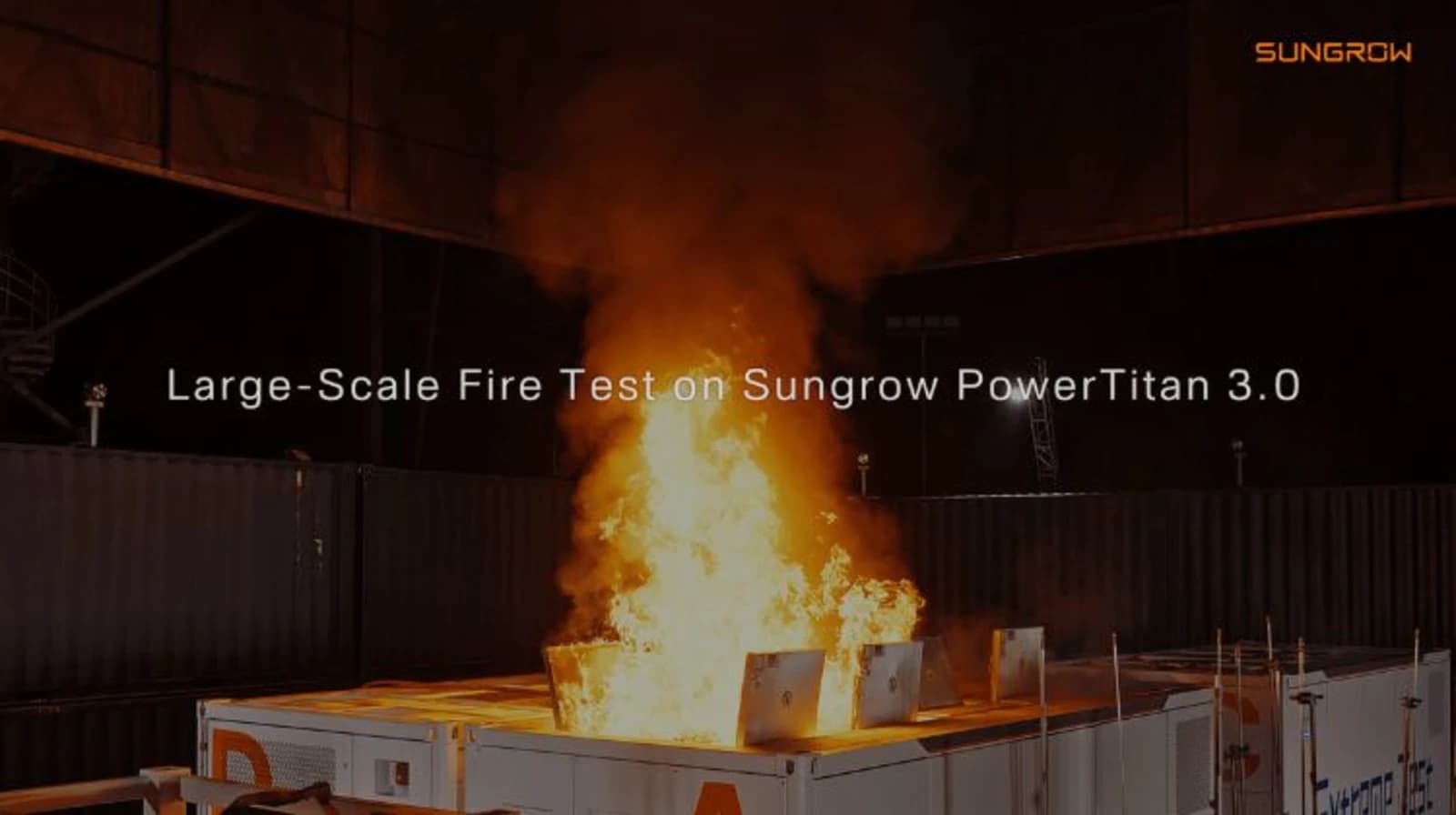
Sungrow, a leading global provider of photovoltaic inverters and energy storage systems, has announced that its latest battery energy storage system (BESS), the PowerTitan 3.0, has successfully passed a full-scale fire test conducted in accordance with the latest applicable requirements of UL 9540A:2026 and CSA/ANSI C800-2025 standards, making it the industry's first AC block stacked cell BESS to successfully pass such a test . From the PowerTitan 1.0 to the 3.0, all three generations passed the full-scale fire test on the first attempt.
Conducted by UL Solutions, with the Fire Risk Alliance (FRA) present as a witness and under the supervision of Jensen Hughes (JH), the test evaluated the system's ability to contain a severe thermal runaway event and prevent it from spreading to adjacent containers of the battery energy storage system (BESS) and the medium-voltage substation.
Tested under real and demanding installation conditions
The test setup replicated the block-level layout of a real-world utility-scale battery energy storage system (BESS) installation, which included a 28.56 MWh liquid-cooled PowerTitan 3.0 BESS system and a 7.4 MW medium-voltage substation (MVS). The PowerTitan 3.0 features high-energy-density stacked cells and an integrated AC block architecture, combining the battery system and DC/AC converter unit in a single 20-foot container.

To further test the system's safety design, the BESS was at 100% load. The originating container and the adjacent container were installed back-to-back, in close proximity. The MVS was also included in the test setup. All active fire suppression systems and the thermal management system were deactivated, and the pressure relief panels on top of the initiation container were fully opened to maximize ventilation and oxygen availability. The test focused on the system's inherent ability to contain thermal runaway.
All gases and fumes generated during the event were collected and channeled through a dedicated purification system. The collected gases were fully treated, with no untreated fumes released directly into the environment.
The thermal leak did not propagate
The test successfully demonstrated that the thermal runaway did not propagate from the battery energy storage system (BESS) container where the incident started to any adjacent container or to the MVS.
Continue reading
The test lasted 7.5 hours under continuous supervision. The maximum internal temperature in the container where the fire started, identified as container A, reached 1259.8 °C, while the maximum temperature of the cells in adjacent containers remained well below the thermal runaway threshold established in UL 9540A:2026.
Despite the intensity and duration of the fire, container A remained structurally intact. The adjacent containers B, C, D, and E also remained structurally intact, showing no deformation. Even after the fire test, the container remained structurally intact and was able to be lifted as a complete unit.
Under full load, reduced spacing, and maximum ventilation conditions, the PowerTitan 3.0 contained the thermal incident within the container where it originated and prevented it from spreading to other containers. These results demonstrate the system's stable, reliable, and controllable performance under extreme conditions and represent a key step in validating the safety of higher-energy BESS platforms.
Three generations. All successfully tested. Simulation and reality meet.
From the PowerTitan 1.0 and 2.0 to the PowerTitan 3.0, all three generations have passed their full-scale fire tests on the first attempt, enabling Sungrow to create a comprehensive database of behavior in the event of thermal runaway and fire. Prior to physical testing, the PowerTitan 3.0 underwent simulation-based evaluations across hundreds of application scenarios and operating conditions using Sungrow’s simulation platform, the largest of its kind in the world . The simulated fire intensity and evolution trends closely matched those observed during physical testing, validating the model’s ability to predict fire behavior under extreme conditions.
“This test was designed to verify our safety design under real-world extreme conditions,” said Roger Li, General Manager of the Utility product line for Sungrow’s energy storage business unit. “Safety must be built into the product design from the outset. Simulation helps predict how the system will respond, while large-scale fire tests put those predictions to the test. Energy storage safety goes far beyond the mere safety of the cells. It results from the interaction of multiple factors, including cell performance, system integration, thermal management, structural protection, engineering design, and much more.”
Benjamin Liu, director of engineering at UL Solutions, commented: "Sungrow took a 'safety by design' approach, using pre-test assessments to predict fire behavior and then validating those predictions through a full-scale fire test. The test results demonstrated that the design was able to contain the fire and prevent its spread, which significantly reduced the potential magnitude of losses."
By combining "safety by design" technology, predictive simulation, and large-scale physical testing, Sungrow is developing a robust, data-driven approach to the safety of battery energy storage systems (BESS). For project developers, investors, insurers, and emergency services, this provides a stronger technical foundation for assessing fire risks, planning emergency responses, and protecting critical assets throughout the entire project lifecycle.
