


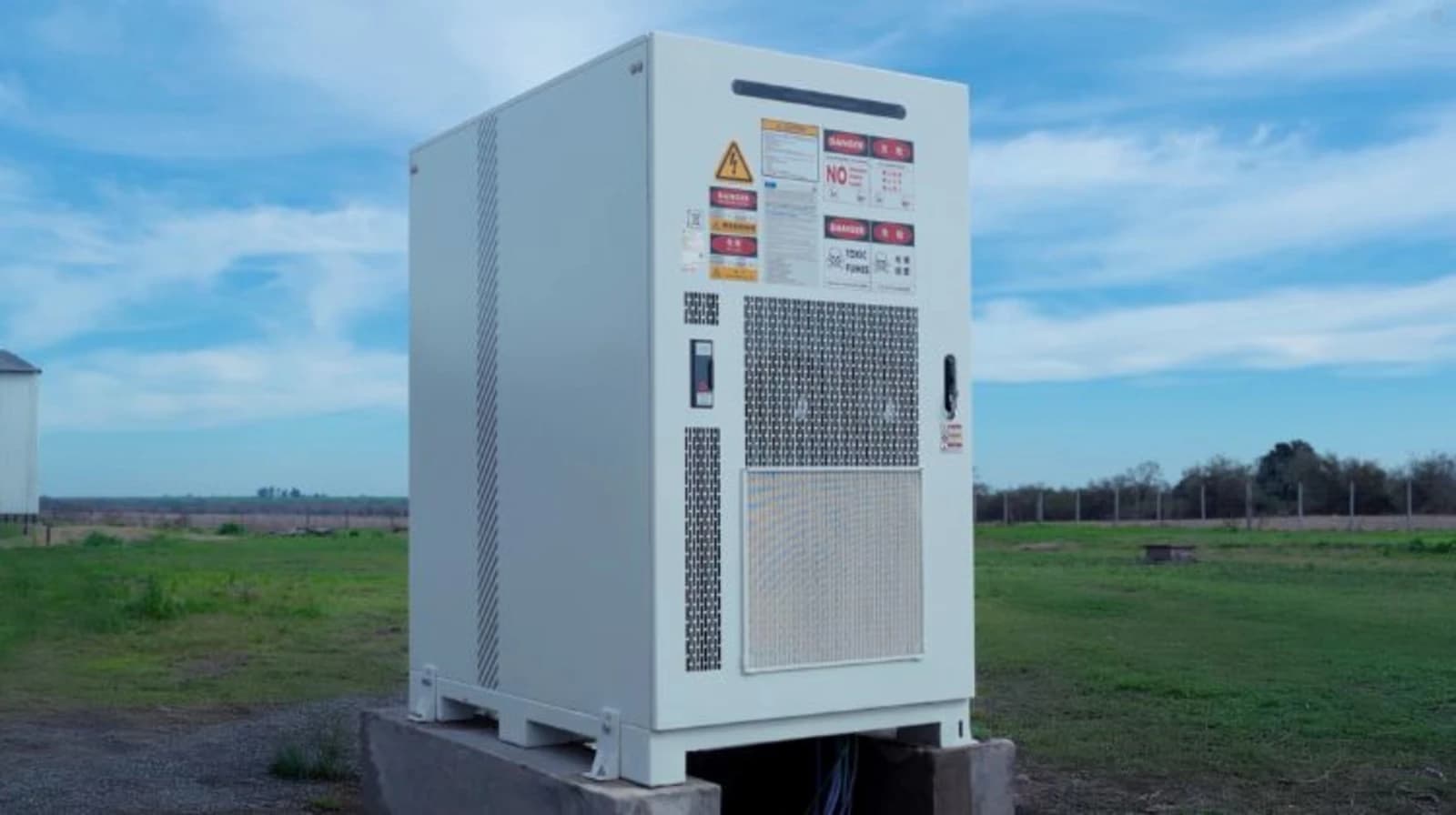
In Viale, Entre Ríos, a poultry farm found in energy storage a concrete alternative to overcome one of the main limitations it faced for growth: the capacity of the rural electrical grid. Avícola Huayra incorporated a Huawei battery, the largest for the C&I segment, the 241kWh LUNA, into a 200kW photovoltaic solar system, in a project developed by Biosolares Argentina, an installation company based in Crespo, with Huawei technology and technical support from Efergía, Huawei Digital Power's distributor in Argentina.
The project arose from a specific production need. In 2023, Avícola Huayra had designed an expansion plan that included eight buildings for its first production facility. However, limitations in the area's electrical infrastructure ultimately hampered the project's progress. The facility had a generator as an alternative, but its use was not economically viable as a permanent solution.
“We encountered energy limitations in the area and the project was stalled for a while. We had a generator, but it wasn't economically viable,” explained Iván Eichhorn of Avícola Huayra, describing the origin of the need that led to the incorporation of the storage system.
The Huayra experience reflects a problem that is beginning to recur in various production facilities in rural areas of Entre Ríos. The growth in electricity demand and the limitations of certain power grids can hinder production.

“The demand for batteries in the area has become very noticeable recently. We've received many inquiries, as the electrification system is somewhat deficient, especially in rural areas,” explained Daniel Gillig of Biosolares. He noted that in various locations, the power lines lack sufficient capacity to deliver the power required by producers, making the combination of solar generation and storage an alternative for obtaining a more stable energy supply.
In this context, energy storage ceases to be merely a tool for accumulating energy and becomes an enabler of production. In the case of Avícola Huayra, the battery allows them to supplement the available grid energy and photovoltaic generation to cover specific power requirements, reducing their dependence on a grid that has limitations in keeping up with the farm's growth.
“The storage complements what the panels lack and the availability of the grid. With these three elements, the facility can operate and produce,” explained Gerardo Méndez, managing partner of Biosolares, the company responsible for implementing the project.
The solution incorporates a Huawei LUNA 241kWh battery, a high-capacity storage system that allows energy to be managed according to the facility's needs. In this project, its primary function is to cover peak power requirements and minimize the need for energy from the grid. However, the technology has other applications, such as providing backup power during outages, managing peak consumption, and taking advantage of different tariff periods.
Continue reading
“In this case, the LUNA 241kWh will be used to minimize the energy requirement from the grid, but it has many applications,” explained Gabriel José, technical specialist at Efergía.
He added: “It can serve to provide a small or large backup, depending on the number of batteries installed, so that if the grid fails, the system allows you to continue having power.”
The expert also highlighted that energy storage can be used to manage consumption based on electricity tariffs and to implement peak shaving. In this way, when an installation has a certain contracted power, the battery can provide additional power during periods of high demand and help keep consumption within established parameters.
Furthermore, the system incorporates remote monitoring tools that allow for continuous tracking of its operation. Through Huawei's management ecosystem, specialists can monitor system performance and analyze its operation without needing to be physically present at the facility.
For Avícola Huayra, technical support was a determining factor in moving forward with a solution that involved incorporating a relatively new technology for the area. “We are very satisfied; they were always there for me,” Eichhorn stated, referring to the collaborative work with Biosolares and Efergía. “Since this can be monitored remotely, they studied how to develop something that would work,” he added.
The businessman also highlighted the possibility of incorporating new technologies to support the growth of his business. The installation of the LUNA 241kWh system made Huayra one of the first establishments in the region to incorporate this type of storage and sparked the interest of other producers who approached them to learn how the solution works.
The project also represents a significant step for Biosolares, which has been working on developing energy solutions for production facilities in the region. “It is a tremendous privilege to carry out this project, which was developed in conjunction with Efergía, with whom we have been working for some time and whose support and guidance we have felt throughout the entire process,” Méndez noted.
For Efergía, the project reflects the role that energy storage can play in the energy transition of productive sectors: not only as a complement to solar generation, but also as a tool to address power constraints and support the growth of companies that require greater energy availability. As a Huawei distributor, Efergía contributes to the project by providing access to the technology and specialized technical support through its network of installers.
“We are proud that this is the first LUNA 241kWh battery installed in Entre Ríos, but above all it demonstrates that today energy storage can become a concrete tool to solve energy limitations and support the growth of productive establishments,” Méndez concluded.