


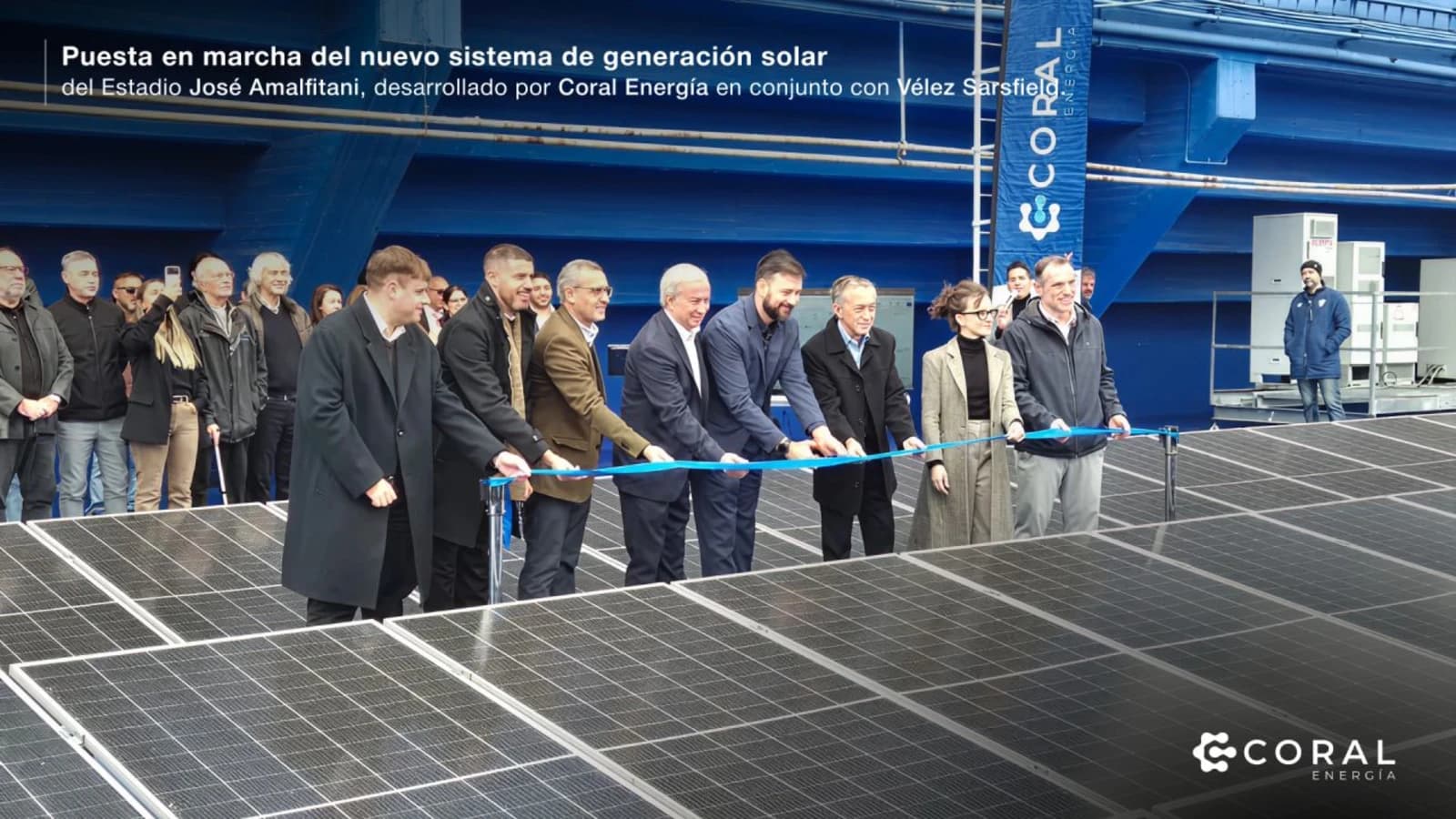
Club Atlético Vélez Sarsfield has put its photovoltaic system into operation at the José Amalfitani stadium and is already working on a possible second phase to extend the initiative to its facilities at the Olympic Village, the "Fortín's" sports complex in Parque Leloir.
The project, developed in conjunction with Coral Energía —a company of the Corven Group— , introduces the club to distributed generation with an on-grid system of 120 kWdc (100 kW AC), geared towards self-consumption and opens a new phase within its energy efficiency strategy.
The installation took about three months from the purchase of materials and included the assembly of 210 solar panels on a surface of 1250 square meters , on the roof of the sector located on Juan B. Justo Avenue, the main access to the social headquarters, which allows a saving of 15-20% and up to 25% in the annual consumption of the club.
“The idea arose in early 2025 and finally materialized towards the end of 2025. It is an unprecedented event for Argentine football, as we are the only First Division clubs to have renewable energy (connected to the grid),” stated Nelson Pugliese , 3rd vice president of Vélez Sarsfield

“The energy we generate with the solar project is equivalent to 600 hours of use of the Amalfitani stadium fully illuminated at 100%. If we average 4 hours per match, that means Vélez generates the energy equivalent to 150 matches annually,” he added.
The technical difference in this case is significant. While there are already precedents for photovoltaic installations in sports infrastructure in Argentina, Vélez's model relies on a turnkey distributed generation project.
“From the time we started purchasing materials, the project took about three months. The implementation was interrupted on a few occasions by club events, but there were no problems with the operations,” explained Maximiliano Gonella , Operations Manager of Grupo Corven.
In Argentina's top football league, Estudiantes de La Plata also installed solar panels at the Jorge Luis Hirschi stadium, albeit in an off-grid system. Meanwhile, in South America, clubs like Cruzeiro, Atlético Mineiro, and Universidad Católica have also implemented similar solutions.
The second phase is already on the table.
The alliance between Vélez and Coral Energía will not end at the Amalfitani, since both parties are already analyzing how to replicate the model in the Olympic Village.
“As part of the strategic alliance, we also have an agreement signed for 2027. The idea is to create a project similar to the one we did at the stadium. While we have space to install PV panels, we are developing the idea to create something with a dual purpose. On the one hand, environmental protection and energy savings, and on the other, the use of solar panels as part of the roof for the parking garages,” Pugliese explained.
“It’s a wonderful challenge to continue the relationship and partnership between the group and Coral Energía with the club. We are very pleased with the project on the stadium roof, and we hope that this, which began as a conversation on the terrace, can materialize in the Olympic Village,” added Martin De Gaetani, Director of Institutional Relations and Press for Grupo Corven.
“It is an energy transformation that the country is undergoing and it is the path to the future, and it is where we have to invest, both in these powerful places like the big cities, like the City of Buenos Aires, but also in the interior of the country,” he continued.
Coral Energía is currently experiencing a period of strong operational growth and strategic expansion within the Argentine electricity market. The company projects to close 2026 with 260 MW built within its contracted portfolio, while also advancing with new renewable energy developments and energy storage systems.
In parallel, it has accumulated around 400 MW between contracted renewable capacity and projects under construction , while advancing with a roadmap aimed at reaching 1 GW in signed renewable contracts by 2030 .
The strategy includes expanding its participation in different segments of the national electricity market, including new storage tenders, projects connected to distribution networks, PPA contracts in the Term Market and energy supply for high demand sectors such as mining and data centers.