


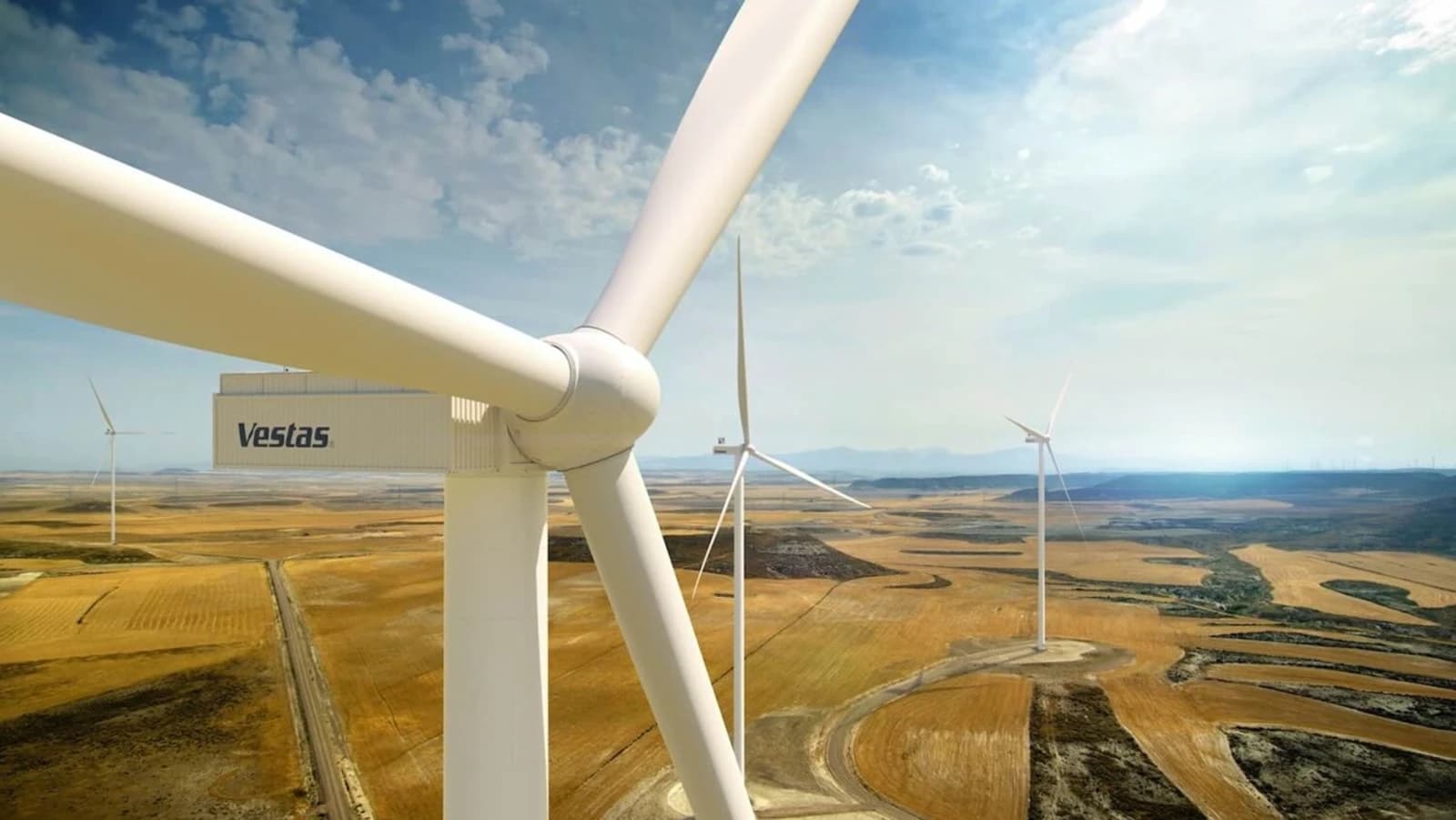
Vestas globally launched the new V182-7.2 MW turbine and is already evaluating its application in Latin America as an alternative to improve the viability of wind projects in low and medium wind zones.
Presented during WindEnergy Hamburg , the wind turbine combines 7.2 MW of nominal power with a 182-meter rotor , a configuration aimed at capturing more available energy and strengthening the business case of projects where resource quality, costs or financing conditions put pressure on profitability.
“Latin America has some of the best wind resources in the world. Turning that potential into new investments requires continuous innovation, competitiveness, and solutions that can respond to the reality of each market,” said Eduardo Ricotta , CEO of Vestas for Latin America.
According to the executive, the new platform can play a specific role in that equation.

“With a high capacity factor and greater utilization of the available wind resource, the new turbine has the potential to strengthen the business case of projects and help unlock new investments in wind farms in the region,” he added.
The main difference lies in the size of the rotor, as the V182-7.2 MW incorporates a diameter of 182 meters and a swept area of approximately 26,016 m² .
Compared to the V172-7.2 MW, the area increases by about 12%; compared to the V162, the difference reaches 26%, while compared to the V150 it reaches 47%.
This greater sweep allows for increased energy capture without increasing the nominal power compared to the V172-7.2 MW.
The result is a specific power of 277 W/m² , a parameter especially relevant for low and medium wind sites, where maximizing production hours can modify the project's economics.
According to Vestas, the configuration allows for an increase of up to 2% in the capacity factor compared to the V172-7.2 MW , while also seeking to reduce the levelized cost of energy (LCoE), increase annual energy production (AEP), and improve financial indicators such as net present value and rate of return.
The technical specifications state a standard rated power of 7200 kW , an inlet speed of 3 m/s, and a cut-out speed of 25 m/s. The equipment is designed for IEC wind class S and to operate within a standard temperature range of -20 °C to +45 °C .
It also incorporates a three-stage planetary gearbox , a 50/60 Hz electrical system, and a full-scale converter.
The maximum specified sound power is 109 dB(A) .
The new machine is based on the EnVentus architecture, which already exceeds 15 GW installed and 2000 turbines in operation globally.
Vestas sought to maintain much of that technological base and concentrate the changes on components where it could obtain concrete performance improvements, mainly the rotor and the transmission system.
The strategy aims to reduce the technological risk of introducing a completely new machine and, at the same time, gain performance in more complex projects.
“Our commitment is to connect innovation with customer needs and industry challenges, working collaboratively to build competitive, predictable projects capable of generating long-term value,” Ricotta said.
For Latin America, however, the application will not be automatic.
The company will evaluate the use of the V182-7.2 MW project by project , considering wind resource, infrastructure, transport conditions, network characteristics and economics of each development.
That point will be especially relevant in a region where mature markets coexist with new areas that are still seeking to achieve sufficient scale to justify investments in transmission, logistics and generation.
First worldwide order just one day after launch
The V182-7.2 MW presentation has already had its first commercial validation.
Vestas secured its first firm order just one day after launch , through an agreement with SR Energy for the Staverhult wind project in Sweden.
The contract covers four V182-7.2 MW turbines , totaling approximately 29 MW , and includes supply, delivery and commissioning.
It also includes a 35-year Active Output Management 5000 (AOM 5000) service contract, aimed at optimizing equipment performance throughout the project's lifespan.
The delivery of the turbines is scheduled to begin during the second quarter of 2028 , while commissioning is expected in the third quarter of the same year.
Vestas also plans to be able to scale up series production of the V182-7.2 MW from the end of 2027 .
The Swedish order provides an initial commercial signal for a turbine that will now seek to gain a foothold in other markets.
In Latin America, the opportunity will be determined by one specific point: whether the larger rotor and the increased capacity factor manage to transform marginal or less resource-intensive projects into developments capable of achieving better returns and moving towards an investment decision.