

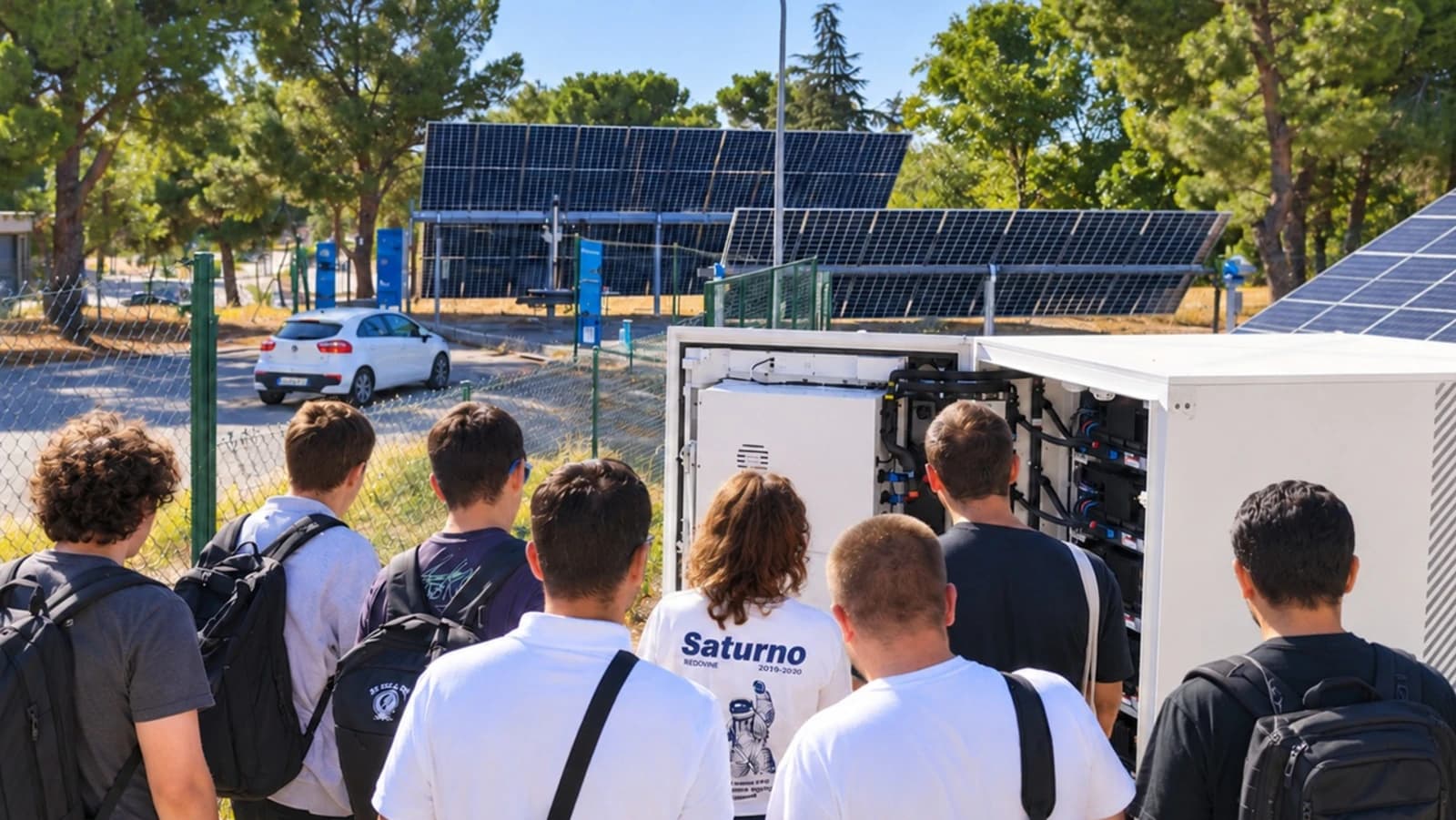
Wattkraft Iberia and the Polytechnic University of Madrid (UPM) have launched a collaboration to familiarize students with the operation and applications of renewable energy storage by setting up a space equipped with a state-of-the-art Huawei LUNA2000-215 BESS system. This initiative will strengthen the connection between academic training and industry practice, facilitating student engagement with cutting-edge technologies used in real-world projects.
The agreement was announced during the welcome event for new students of the Master's Degree in Photovoltaic Solar Energy , held at the Institute of Solar Energy (IES), part of the Higher Technical School of Telecommunications Engineering (ETSIT) at the Polytechnic University of Madrid (UPM). The event brought together 35 participants and was attended by Manuel Sierra Castañer, director of the ETSIT ; María de la Nava Maroto García, deputy director of International Relations and Employability at the ETSIT ; and Ignacio Antón, director of the IES .
Following the official welcome and the program presentation by its coordinators, Wattkraft, Huawei's Value Added Partner for the distribution of its FusionSolar products in Spain, shared its experience in developing photovoltaic and energy storage projects with the attendees. The day continued at the IES prototype field , where students were able to see the LUNA2000-215 system firsthand and learn more about its technical characteristics and potential applications.
The battery, which has a capacity of 215 kWh and a nominal power of 108 kW, will remain installed in this space to support future academic and technical activities.
“We want students to be able to see firsthand how a storage solution works and understand its application in real-world projects. This collaboration allows us to share our technical expertise with the university and create a space where academic knowledge and industry realities can advance hand in hand,” explained Jesús Heras, Co-Country Manager and Technical Director of Wattkraft Iberia.
A collaboration with a commitment to continuity
Over the next year, Wattkraft and UPM will explore new ways to leverage the facility as a resource for learning and experimentation. Planned initiatives include developing master's theses, conducting technical tests, and jointly producing publications and specialized articles.
The permanent presence of the battery in the prototype field will also allow for the organization of training and other activities on energy storage in coordination with the university.
“Integrating more photovoltaic energy into the energy mix requires deploying storage systems that allow us to manage solar generation and provide stability to the grid. Having this cutting-edge technology in our facilities is an opportunity to train professionals who will lead the energy transition,” says Ignacio Antón Hernández .
Although the agreement will initially last for one year, both entities envision this initiative as the beginning of a long-term relationship. The continued operation of the facility will facilitate the gradual incorporation of new projects and allow activities to be adapted to academic needs and the technological evolution of the sector.